
Vermiculite Insulation
Vermiculite Insulation, Fire Bricks & Gas Fire Embers
VITCAS vermiculite products provide lightweight, low-conductivity thermal insulation in several different formats for fireplaces, stoves, gas fires and other compatible high-temperature applications. Expanded vermiculite is particularly useful where low mass, heat resistance and the ability to fill or line irregular spaces are required.
Loose Fill Vermiculite is a lightweight exfoliated granular insulation rated up to 1100°C, suitable for enclosed voids, behind firebacks, around compatible pipework and other protected thermal-insulation duties. Its loose-fill form allows it to conform to spaces that would be difficult to insulate with rigid boards.
Gas Fire Ember Pack uses vermiculite granules as a decorative medium for compatible gas-fire burner arrangements and is rated up to 1100°C, while Vermiculite Fire Bricks are lightweight pre-cut refractory insulation pieces rated up to 1000°C for suitable fireplaces and wood-burning stoves.
Select the product according to its required function, installation position, temperature exposure and appliance design. Loose-fill insulation, decorative gas-fire embers and rigid vermiculite fire bricks perform different roles and should not be treated as interchangeable simply because they share the same base mineral.
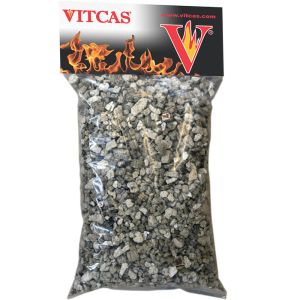 Gas Fire Ember PackSpecial Price £6.00 £5.00 Regular Price £12.00 £10.00
Vitcas Vermiculite Gas Fire Ember Pack is a pack of small crushed vermiculite granules. The vermiculite can withstand temperatures reaching 1100°C. Due to its properties such as low thermal conductivity, heat resistance and moisture storage, it is ideal for being the base in gas fire burners.
Read more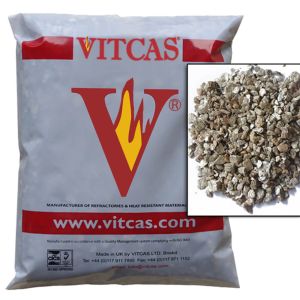 Vermiculite Loose Fill InsulationSpecial Price £35.99 £29.99 Regular Price £47.99 £39.99
Loose Fill Vermiculite in a 100-litre bag is a thermal insulation material that can withstand high temperatures up to 1100°C. It is lightweight and fire-resistant, making it suitable for pipe insulation and various other applications.
Read more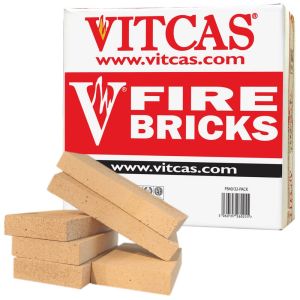 Vermiculite Fire BricksSpecial Price £14.40 £12.00 Regular Price £30.00 £25.00
Vermiculite Fire Bricks are a set of 6 fire-resistant bricks made from natural minerals. Measuring 200 x 90 x 25mm (7.8" x 3.5" x 1") each, these bricks have low thermal conductivity for greater energy efficiency and can be sawn, drilled, and sanded to fit any fireplace or wood-burning stove. Perfect for creating a heat-resistant barrier that contains heat and prevents damage to the surrounding area.
Read more
Vermiculite Insulation Products for Fireplaces, Stoves & High-Temperature Applications
VITCAS vermiculite insulation materials use the lightweight, low-thermal-conductivity properties of expanded vermiculite in three distinct formats: loose-fill granules for enclosed insulation spaces, crushed vermiculite for compatible gas-fire ember beds, and pre-cut insulating fire bricks for suitable fireplaces and wood-burning stoves. Although all three products are based on vermiculite, they perform different functions and should be selected according to the required application, temperature exposure and appliance design.
| Product | Format | Maximum Listed Temperature | Primary Applications |
|---|---|---|---|
| Vermiculite Loose Fill Insulation | Expanded loose-fill granules, 100 L | 1100°C | Behind firebacks, enclosed insulation voids, pipe insulation and compatible thermal or acoustic cavities |
| Vermiculite Gas Fire Ember Pack | Crushed vermiculite granules, 200 g | 1100°C | Decorative ember beds and burner-tray applications in compatible gas fires |
| Vermiculite Fire Bricks | Pre-cut lightweight insulating bricks | 1000°C | Suitable fireplace and wood-burning stove linings and replacement insulating panels |
Vermiculite Loose Fill Insulation
VITCAS Vermiculite Loose Fill Insulation consists of lightweight expanded vermiculite granules supplied in a 100-litre bag and rated up to 1100°C. The granular format allows the material to fill enclosed spaces and irregular voids that can be difficult to insulate effectively with rigid boards or pre-formed products.
One of its principal fireplace applications is insulation behind firebacks, where loose vermiculite can fill the prepared void while adding relatively little weight to the construction. VITCAS also identifies the material for compatible insulation around pipes, where its low thermal conductivity can help reduce unwanted heat loss.
Beyond high-temperature applications, loose vermiculite can also provide thermal and acoustic insulation in compatible wall cavities and enclosed building voids. Its lightweight granular structure can help reduce sound transmission while providing additional insulation without forming a rigid structural layer.
Typical Loose-Fill Applications
- Behind fireplace firebacks: filling compatible enclosed spaces around refractory fireplace components.
- Pipe insulation: reducing heat transfer around suitable hot pipework and enclosed pipe systems.
- Chimney and thermal cavities: lightweight insulation within compatible protected voids.
- Pizza and wood-fired oven construction: insulating compatible enclosed spaces around oven structures where loose-fill vermiculite is appropriate.
- Wall cavities: providing combined thermal and acoustic insulation in suitable enclosed constructions.
Loose vermiculite is primarily an insulation material rather than a structural filling compound. Where a bonded infill or shaped insulating layer is required, a purpose-designed material such as VITCAS Vermiculite Insulating Cement provides a different installation format.
Vermiculite Gas Fire Embers
VITCAS Gas Fire Ember Pack contains crushed vermiculite granules designed specifically for compatible gas-fire burner arrangements. The material is rated up to 1100°C and combines high-temperature resistance with low thermal conductivity and the characteristic lightweight structure of expanded vermiculite.
The granules are used to form or refresh a decorative ember bed, helping reproduce the appearance of glowing solid-fuel embers beneath or around imitation coals according to the gas appliance design. They can also provide a thermally insulating layer over the burner tray where this arrangement is specified by the appliance manufacturer.
Vermiculite naturally has a porous structure capable of retaining some moisture, and the VITCAS product specification also notes minimal shrinkage under high-temperature exposure. These material characteristics support stability of the granules in their intended gas-fire application, while product selection should follow the burner and decorative-bed arrangement specified for the appliance.
Gas Fire Installation Is Appliance-Specific
The amount, distribution and position of vermiculite around a gas burner can influence combustion and flame behaviour. Use the Ember Pack where vermiculite is specified or permitted by the gas appliance manufacturer and follow the appliance instructions for placement and quantity.
Gas-fire servicing and replacement of burner-bed materials should comply with the regulations, approved procedures and competence requirements applicable in the country of installation.
Vermiculite Fire Bricks
VITCAS Vermiculite Fire Bricks are lightweight insulating refractory pieces rated up to 1000°C. Each brick measures approximately 200 × 90 × 25 mm, and the material's low thermal conductivity helps reduce heat transfer through suitable stove and fireplace linings.
Unlike dense fireclay bricks, vermiculite fire bricks have relatively low density and are easy to modify during installation. They can be sawn, drilled and sanded to reproduce replacement panels or fit individual fireplace and wood-burning stove geometries.
Their lightweight construction makes them particularly useful where the appliance is designed around insulating vermiculite rather than dense, heat-storing refractory brick. Dense firebrick provides greater thermal mass and generally greater resistance to impact, while vermiculite prioritises insulation and ease of shaping.
Typical Vermiculite Fire Brick Applications
- Wood-burning stoves: replacement insulating lining pieces where vermiculite is compatible with the appliance design.
- Fireplaces: lightweight heat-resistant lining components in suitable constructions.
- Replacement stove panels: cutting or shaping bricks to reproduce compatible worn or damaged vermiculite components.
- Bespoke insulating pieces: forming small heat-resistant panels or shapes where the 1000°C rating and mechanical properties meet the application.
Vermiculite Fire Bricks vs Dense Fire Bricks
| Property | Vermiculite Fire Bricks | Dense Fire Bricks |
|---|---|---|
| Thermal function | Primarily insulating | Greater heat storage and refractory durability |
| Thermal conductivity | Low | Generally higher |
| Weight | Lightweight | Heavier |
| Machining | Can be sawn, drilled and sanded relatively easily | Usually requires masonry or diamond cutting equipment |
| Mechanical resistance | Lower; requires careful handling and suitable support | Generally better suited to impact and mechanically demanding refractory duties |
| Typical use | Insulating stove and fireplace linings | Dense refractory linings, hearths and heat-storage applications |
When replacing an appliance lining, match the original material type, thickness and dimensions wherever possible. Changing between dense refractory and lightweight vermiculite insulation changes the thermal behaviour of the lining and should therefore follow the appliance design.
Selecting the Correct Vermiculite Product
The vermiculite products in this category share the thermal advantages of the same base mineral but solve different installation requirements:
- choose Loose Fill Vermiculite where lightweight granular insulation must fill an enclosed void or irregular space;
- choose Gas Fire Ember Pack for compatible gas-fire burner and decorative ember-bed arrangements;
- choose Vermiculite Fire Bricks where a lightweight rigid insulating lining or replacement piece is appropriate for the fireplace or stove.
Temperature capability should be considered together with the required physical form, mechanical exposure, moisture conditions and appliance specification. Selecting the correct vermiculite product means matching both its thermal capability and construction format to the application.
Frequently Asked Questions About Vermiculite Insulation
Should loose-fill vermiculite be compacted during installation?
Loose-fill vermiculite should generally be installed to provide consistent cavity coverage without unnecessary heavy compaction. Excessive compression reduces the open granular structure and can reduce the effective insulating thickness of the installed material.
How does moisture affect vermiculite insulation?
Vermiculite can retain moisture within its porous structure. Keep the insulation protected from unnecessary water ingress and take moisture conditions into account before heating the completed installation.
How does installed thickness affect vermiculite insulation performance?
Thermal performance depends on the installed thickness, density, cavity geometry and surrounding construction. A deeper, consistently filled insulation layer generally provides greater resistance to heat transfer than a thinner layer, provided the material remains evenly distributed and is not excessively compacted.
Does the vermiculite temperature rating apply to the whole installation?
No. The stated temperature capability applies to the vermiculite product itself. The maximum operating temperature of the complete assembly also depends on adjacent refractory materials, mortars, adhesives, metals, fixings and the overall construction design.
What should be considered when filling enclosed cavities with loose vermiculite?
Consider the cavity depth, containment, access for filling, uniform coverage, moisture exposure and temperature of adjacent materials. The cavity should retain the granules securely while maintaining the required insulation thickness throughout the intended area.
Can loose vermiculite be used around hot pipework and chimney cavities?
Yes. Loose vermiculite is suitable for compatible hot-pipe insulation and protected chimney or thermal cavities where granular insulation suits the construction. Selection should consider the surface temperature, required insulation thickness, containment and surrounding materials.
What is the difference between loose-fill vermiculite, vermiculite fire bricks and gas fire embers?
Loose-fill vermiculite provides granular insulation for suitable cavities and enclosed spaces. Vermiculite fire bricks provide a lightweight rigid insulating lining that can be shaped for compatible appliances. Gas fire embers use crushed vermiculite specifically for compatible decorative burner-bed arrangements.
When is loose-fill vermiculite preferable to rigid insulation?
Loose-fill vermiculite is particularly useful for irregular cavities, spaces behind firebacks and enclosed areas around compatible pipework or thermal equipment where granular material can conform to complex geometry. Rigid board or brick is generally more suitable where a fixed surface, defined lining thickness or self-supporting insulation layer is required.