
Insulation Fire Bricks
Lightweight Insulating Fire Bricks for Kilns, Furnaces and Forges
VITCAS manufactures insulating fire bricks (IFBs) from specially formulated refractory materials engineered to combine high-temperature capability with low density, low thermal mass and reduced heat transfer. Their controlled porous structure makes them particularly effective in kilns, furnaces, forges, heat-treatment equipment and other installations where thermal insulation and efficient heating are important.
VITCAS insulating fire brick grades cover a range of temperature classes for both primary hot-face and back-up insulation duties. The correct grade should be selected according to the calculated temperature at the brick position, furnace atmosphere, mechanical loading, abrasion, thermal cycling and position within the refractory system rather than maximum temperature alone.
Compared with dense fireclay brick, IFBs absorb and store less heat, helping correctly designed equipment heat and cool more responsively. Their lightweight porous structure also provides lower mechanical strength and abrasion resistance, so working faces exposed to heavy loads, aggressive wear, fluxes, slag or molten materials may require a dense or specialist refractory layer.
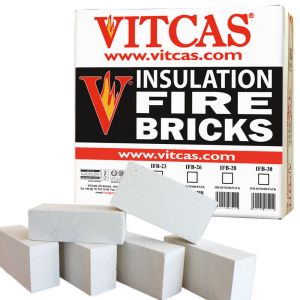 Insulating Fire Bricks-VITCAS Grade 23 - 2300°F/ 1260°CSpecial Price £2.76 £2.30 Regular Price £7.19 £5.99
Vitcas Insulation Firebricks- Grade 23. Resistant to a high temperature of 1260°C / 2300°F. Dimensions: 230x114x76mm. Ideal for situations where heat storage properties are not desired, and for insulating in different refractories- ceramic kilns, furnaces, flues and other high temperature industrial equipment.
Read more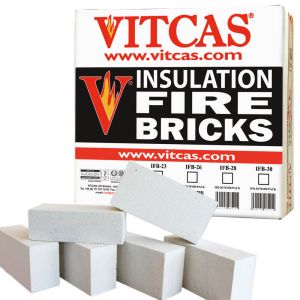 Insulating Fire Bricks-VITCAS Grade 26 -2600°F/ 1430°CSpecial Price £3.35 £2.79 Regular Price £8.39 £6.99
Vitcas Insulation Fire Bricks- Grade 26. Resistant to 1430°C (2600°F). Dimensions: 230x114x76mm. The insulating firebricks can be used in a variety of high temperature industrial applications, such as in insulating refractories- gas producers, kilns, furnaces and stress relieving furnaces.
Read more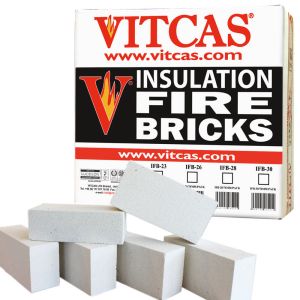 Insulating Fire Bricks-VITCAS Grade 28 -2800°F/ 1530°CSpecial Price £4.56 £3.80 Regular Price £9.59 £7.99
Vitcas Insulation Firebricks- Grade 28. Dimensions: 230x114x76mm. Resistant to 1530°C / 2800°F. The lightweight insulating fire bricks can be used in different industrial applications such as in lining ceramic kilns and furnaces, in areas that are not in contact with molten materials, etc.
Read more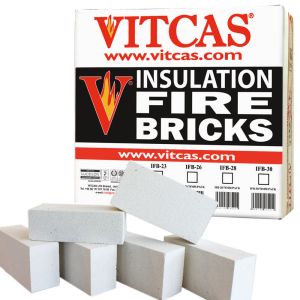 Insulating Fire Bricks-VITCAS Grade 30 -3000°F/ 1650°CSpecial Price £5.88 £4.90 Regular Price £11.94 £9.95
Vitcas Insulation Firebricks- Grade 30. Dimensions: 230x114x76mm. Rates at 1650°C / 3000°F. The lightweight insulation fire bricks can be used for industrial applications such as in hot blast stoves, as primary hot face linings, for back up insulation for kilns and furnaces and for flue insulation.
Read more
Selecting Insulating Fire Bricks by Temperature, Density and Application
VITCAS insulating fire bricks are engineered for high-temperature thermal insulation where reducing heat flow and refractory mass is as important as resisting furnace temperature. The combination of refractory chemistry and a controlled porous structure produces bricks that are substantially lighter than conventional dense fireclay while retaining useful refractory capability across a wide range of kiln, furnace, forge and process applications.
Grade selection should consider the complete lining duty. Maximum service temperature, alumina content, density, hot-face or back-up position, mechanical loading, furnace atmosphere and exposure to abrasion or process materials all influence the suitability of an insulating fire brick.
VITCAS Insulating Fire Brick Grade Comparison
| Grade | Maximum service temperature | Alumina content | Published density | Typical selection basis | Recommended setting material |
|---|---|---|---|---|---|
| Grade 23 | 1260°C / 2300°F | 38% Al2O3 | 600kg/m³ | Lower-temperature kilns, forges and heat-treatment equipment; clean-duty hot faces and back-up insulation | Silcas M White Refractory Mortar |
| Grade 26 | 1430°C / 2600°F | 57% Al2O3 | 800kg/m³ | Higher-temperature kilns, forges, heat-treatment furnaces and industrial back-up insulation | Vitset 45 Refractory Mortar |
| Grade 28 | 1530°C / 2800°F | 62% Al2O3 | 900kg/m³ | High-temperature ceramic kilns and suitable non-contact zones in glass and enamel furnaces where low iron content is relevant | Vitset 45 Refractory Mortar |
| Grade 30 | 1650°C / 3000°F | 72% Al2O3 | 1000kg/m³ | Demanding high-temperature kiln, furnace and forge linings, hot-face applications, back-up layers and compatible flue insulation | Vitset 45; higher-grade Vitset mortar where required by the jointing specification |
| Grade 32 | 1760°C / 3200°F | 78% Al2O3 | — | Specialist very-high-temperature insulating refractory applications requiring a higher IFB temperature class | Select a compatible refractory mortar for the complete lining specification |
Grades 23, 26, 28 and 30 use the same nominal brick format of 230 × 114 × 76mm, allowing temperature class and thermal properties to be changed without altering the basic masonry module. Across Grades 23 to 30, published density increases from 600 to 1000kg/m³ alongside progressively higher alumina content and refractory temperature classification.
The maximum service temperature is a material classification rather than a universal design temperature for every installation. Burner hot spots, process upset conditions, atmosphere, thermal cycling and the temperature of adjacent lining components should all be incorporated into the refractory design.
How VITCAS Insulating Fire Bricks Work
The insulating performance of an IFB comes from its controlled porous structure. Air trapped within the refractory body reduces bulk density and limits heat transfer compared with dense refractory brick. The lower mass also means that less energy is absorbed by the refractory lining itself during heating.
This provides two important engineering advantages:
- Reduced heat transfer through furnace, kiln and forge walls, helping control casing temperature and thermal losses.
- Lower thermal mass, allowing cyclic equipment to respond more rapidly during heating and cooling than an equivalent dense refractory structure.
The same porous structure that provides these thermal advantages also reduces resistance to heavy impact, point loading and severe abrasion. IFB should therefore be positioned according to both thermal and mechanical duty.
Insulating Fire Brick vs Dense Refractory Brick
| Property | Insulating Fire Brick | Dense Refractory Fire Brick |
|---|---|---|
| Structure | Lightweight and porous | Dense and comparatively heavy |
| Primary thermal function | Reduce heat transfer and stored heat | Provide refractory mass and heat-storage capacity |
| Heating response | Lower thermal mass supports faster response in cyclic equipment | Absorbs more energy and releases stored heat more gradually |
| Mechanical strength | Lower and grade dependent | Generally higher |
| Abrasion resistance | Lower; assess gas velocity and working-face wear | Usually more appropriate for mechanically demanding working surfaces |
| Typical position | Clean-duty hot face or back-up insulation | Hearth, load-bearing zone, working face or high-wear section |
Neither technology is universally better. A periodically fired ceramic kiln can benefit from the low thermal mass of an insulating lining, while an oven floor, furnace hearth or abrasion-exposed section may require the mechanical strength and heat-storage behaviour of a dense refractory fire brick.
Industrial refractory systems frequently combine both materials: a dense hot-face layer provides process and mechanical resistance while IFB behind it reduces heat flow towards the casing.
Insulating Fire Bricks as Primary Hot-Face Linings
Selected VITCAS IFB grades can be used as primary hot-face linings in compatible kilns, furnaces, forges and heat-treatment equipment. Their low thermal mass is particularly valuable where rapid thermal response and reduced energy absorption by the refractory structure are desired.
Hot-face selection should consider more than temperature. The exposed brick must also tolerate the furnace atmosphere, flame pattern, gas velocity, charge-handling method and any contact with ash, vapour or process deposits.
Clean-duty walls and roofs are generally more favourable IFB applications than heavily loaded hearths or impact zones. Where severe wear is expected, a dense brick, refractory castable or replaceable protective layer can be incorporated while retaining IFB elsewhere in the lining for thermal insulation.
Back-Up Insulation Behind Dense Refractories
Insulating fire bricks are widely used behind dense refractory brick, castable or another compatible working lining. In this position the IFB reduces heat flow towards the furnace casing or surrounding structure while the hot-face refractory manages mechanical wear and direct process exposure.
Typical applications include:
- Kilns and industrial furnaces.
- Heat-treatment and stress-relieving furnaces.
- Forges and brazing hearths.
- Regenerators and gas producers.
- Thermal process vessels.
- High-temperature flues and gas paths.
- Selected petrochemical and thermal-processing equipment.
The interface temperature between the hot-face refractory and the insulating layer should be calculated through the complete lining thickness. The IFB grade must remain within its own permissible thermal conditions rather than assuming that every back-up layer automatically operates at a low temperature.
Insulating Fire Bricks for Ceramic and Pottery Kilns
Low thermal mass makes IFB particularly useful in pottery, ceramic and other periodically fired kilns. Less energy is required to heat the refractory lining itself, allowing more of the furnace input to contribute to heating the chamber and load.
Grade 23 can serve suitable lower-temperature kiln duties, while Grades 26, 28 and 30 provide progressively higher refractory capability. Selection should be based on the highest credible brick-face temperature, including element temperature, burner hot spots and firing-cycle variation rather than controller setpoint alone.
Grade 28 is particularly relevant to ceramic applications where low iron content is desirable. Where contamination control, glaze chemistry or controlled-atmosphere firing is critical, the required refractory chemistry should be considered as part of the process specification.
Furnaces and Heat-Treatment Equipment
Insulating fire bricks can be used in suitable annealing, tempering, stress-relieving and general heat-treatment furnaces. Their low thermal mass can reduce the energy absorbed by the refractory structure and support responsive temperature cycling.
Different furnace zones frequently require different refractory materials. Door reveals, burner areas, lintels, hearths and load-bearing sections can experience substantially greater mechanical or thermal duty than walls and roofs. A zoned lining allows IFB to provide thermal efficiency while stronger dense refractory or castable materials are used where mechanical resistance is required.
Forges and Brazing Hearths
A lightweight insulating lining can help a forge chamber reach operating temperature efficiently while reducing heat transfer towards the external enclosure.
Areas exposed to repeated tool contact, stock impact, concentrated burner impingement or aggressive flux residues require additional consideration. Borax-containing fluxes and molten deposits can penetrate or react with porous refractory surfaces, so forge hearths and high-wear zones may benefit from a suitable dense refractory working layer while IFB provides insulation in walls and back-up sections.
Glass, Enamel and Molten-Material Applications
Grade 28 insulating fire brick is used in suitable non-contact areas of glass and enamel furnaces. The distinction between thermal insulation and direct melt containment is important: porous IFBs are primarily engineered for high-temperature insulation rather than retaining molten glass, metal, salt or slag.
Where molten materials are present, the lining should distinguish between the melt line, splash zone, potential overflow area and protected insulation zone. A compatible dense or specialist refractory can then form the exposed working face while IFB is positioned where it remains isolated from direct liquid penetration.
Flues and High-Temperature Gas Paths
Selected insulating fire brick grades can provide thermal insulation in compatible industrial flues and high-temperature gas paths.
Specification should consider gas temperature, velocity, pressure, condensate chemistry, soot or particulate loading and cleaning method. High-velocity gas containing entrained solids can erode a porous exposed surface, making a protected back-up position more appropriate in some systems.
Industrial refractory IFB should also be distinguished from certified domestic chimney systems, where appliance instructions, flue classification and applicable building requirements govern the installation.
Refractory Mortar for Insulating Fire Bricks
The setting material should be matched to the IFB grade, joint design and operating conditions. Ordinary Portland-cement masonry mortar is not suitable for constructing a high-temperature insulating refractory lining.
| Insulating fire brick | Typical VITCAS setting material | Selection consideration |
|---|---|---|
| Grade 23 | Silcas M White Refractory Mortar | Off-white refractory mortar particularly suited to Grade 23 insulating brick |
| Grade 26 | Vitset 45 Refractory Mortar | Ready-mixed refractory mortar for compatible higher-grade IFB construction |
| Grade 28 | Vitset 45 Refractory Mortar | Use controlled thin joints suitable for insulating refractory masonry |
| Grade 30 | Vitset 45; Vitset 80 or Vitset 90 where required by the mortar specification | A higher mortar rating does not increase the service-temperature classification of the brick |
Joint thickness influences masonry accuracy, lining stability and local heat transfer. IFBs should therefore be installed using the controlled joint geometry specified for the selected refractory mortar rather than a conventional thick bricklaying bed.
Cutting and Shaping Insulating Fire Bricks
The porous structure makes IFBs considerably easier to cut and shape than dense fireclay brick. This is advantageous around kiln doors, burner openings, curved details and other complex refractory geometry.
Measure each piece accurately and support the brick close to the cut because narrow sections and edges can be damaged more easily than dense refractory units. Suitable refractory or masonry cutting equipment should be used without applying excessive force.
Cutting refractory materials generates mineral dust. Appropriate dust extraction or suppression and the respiratory, eye, hand and other protection specified for the work should be used.
Estimating Insulating Fire Brick Quantities
The common 230 × 114 × 76mm format allows initial brick quantities to be calculated from the exposed face. The following theoretical figures exclude mortar joints, cuts, openings and installation waste:
| Nominal lining thickness | Exposed brick face | Theoretical bricks per m² |
|---|---|---|
| 76mm | 230 × 114mm | Approximately 38.1 |
| 114mm | 230 × 76mm | Approximately 57.2 |
| 230mm | 114 × 76mm | Approximately 115.4 |
Final quantities should allow for mortar joints, cuts, openings, breakage and project geometry. Arches, burner penetrations, corners and multi-layer junctions generally require a larger allowance than simple rectangular walls.
Installation, Expansion and Lining Design
Insulating fire brick masonry should be set out to minimise unnecessary small cuts and avoid creating continuous joints through multiple lining layers. Bedding surfaces should remain clean and only the required quantity of compatible refractory mortar should be used.
Refractory linings expand and contract during operation. Expansion joints, arches, door openings, roofs and transitions to steelwork should therefore be detailed according to the dimensions, operating temperature and restraint of the complete installation.
IFBs are insulating refractory components rather than structural supports for furnace equipment. Mechanical loads from burners, doors, workpieces and external steelwork should be carried by the appropriate supporting structure.
Drying and Controlled Commissioning
New insulating brick masonry contains moisture introduced by mortar and site conditions. The lining should be allowed to cure and dry before controlled heating begins.
The initial firing procedure should account for brickwork thickness, mortar type, furnace size, ventilation and any dense refractory or castable layers used within the same construction. Heating a damp refractory lining too rapidly can generate internal steam pressure and damage bricks, joints or adjacent refractory materials.
Maximum service temperature describes the high-temperature capability of the brick; it does not specify the permissible heating rate of newly installed refractory masonry.
Handling, Storage and Maintenance
- Store insulating fire bricks dry, under cover and clear of standing water or contaminated ground.
- Handle edges and corners carefully because porous IFBs are more susceptible to handling damage than dense firebrick.
- Avoid using IFBs as temporary supports, platforms or load-bearing construction materials.
- Inspect exposed linings for erosion, open joints, cracking, chemical attack and loose sections.
- Investigate abnormal casing temperatures because they can indicate failed joints, damaged insulation or deterioration elsewhere in the refractory system.
- Replace damaged bricks with the confirmed grade or a technically appropriate equivalent using a compatible jointing and commissioning procedure.
Engineering & Application Considerations
- Temperature grade is only one selection parameter. Atmosphere, thermal cycling, abrasion and mechanical duty should also be considered.
- IFBs provide low thermal mass and low heat transfer but have lower mechanical resistance than dense refractory bricks.
- Primary hot-face use is appropriate in compatible clean-duty installations where mechanical and chemical exposure remains within the capability of the selected grade.
- Back-up insulation should be selected from calculated interface temperature through the complete refractory lining.
- Molten metal, glass, salt, slag and aggressive flux exposure require process-compatible working refractories rather than relying on IFB temperature classification alone.
- Energy performance depends on the complete lining, including thickness, joints, doors, penetrations, operating cycle and equipment condition.
- Mortar, expansion allowance and commissioning procedure form part of the refractory system and should be compatible with the selected brick.
Why Specify VITCAS Insulating Fire Bricks?
- Controlled porous refractory structure engineered for low density and reduced heat storage.
- Multiple temperature and alumina grades for different kiln, furnace, forge and process conditions.
- High-temperature capability extending into specialist IFB grades for severe thermal service.
- Low thermal mass supporting responsive heating and cooling in cyclic equipment.
- Hot-face and back-up insulation capability for appropriately designed refractory systems.
- Consistent brick geometry across key grades simplifying modular lining design and grade selection.
- Matched VITCAS refractory mortars for compatible high-temperature masonry construction.
By matching temperature class, alumina content, density and lining position to the actual operating duty, VITCAS insulating fire bricks provide an engineered route to lower heat transfer and reduced refractory mass in kilns, furnaces, forges and other high-temperature equipment.
Frequently Asked Questions
What is an insulating fire brick?
An insulating fire brick is a lightweight porous refractory brick designed to resist high temperatures while limiting heat transfer and reducing the amount of energy stored within the lining.
How do VITCAS insulating fire brick grades differ?
VITCAS insulating fire brick grades differ in refractory composition, alumina content, density and maximum service temperature. Grades 23, 26, 28 and 30 provide progressively higher temperature classifications from 1260°C to 1650°C, while specialist Grade 32 extends the VITCAS IFB technology to 1760°C. Grade selection should also reflect lining position and mechanical and chemical duty.
What is the difference between insulating and dense fire bricks?
Insulating bricks are lighter, store less heat and reduce heat transfer. Dense refractory bricks are heavier and mechanically stronger and provide greater thermal mass, making them more suitable for many hearths, floors and abrasion-exposed working faces.
Can insulating fire bricks form a furnace or kiln hot face?
Yes. Suitable VITCAS IFB grades can form primary hot-face linings in compatible clean-duty kilns, furnaces and forges where temperature, atmosphere, abrasion and mechanical load remain appropriate for the selected grade.
Can insulating fire bricks be used as back-up insulation?
Yes. IFBs are widely used behind compatible dense refractory brick or castable to reduce heat flow towards the casing. The grade should be selected according to the calculated temperature at the interface between lining layers.
Which insulating fire brick is suitable for a pottery kiln?
The choice depends on maximum firing temperature, element or burner temperature, kiln atmosphere and lining design. Grade 23 can serve suitable lower-temperature kilns, while Grades 26, 28 and 30 provide progressively higher refractory capability.
Can insulating fire bricks be used in a forge?
Yes. Suitable IFB grades can provide low-mass forge walls and insulation. High-impact floors, flux-exposed zones and areas subject to concentrated burner erosion may require a stronger dense refractory working surface.
Can insulating fire bricks contact molten metal or glass?
Porous IFBs are primarily insulating refractories and should not generally be selected as the direct containment surface for molten metal, glass, salt or slag. An appropriate dense or specialist refractory should be used in direct-contact zones.
Which mortar should be used with insulating fire bricks?
Silcas M White Refractory Mortar is recommended for Grade 23, while Vitset 45 is used with Grades 26, 28 and 30. The jointing system should always be compatible with both the brick grade and operating conditions.
Can insulating fire bricks be cut?
Yes. Their lightweight porous structure makes IFBs relatively easy to saw and shape. Cut sections should be supported carefully and refractory dust should be controlled using suitable extraction or suppression and appropriate protective equipment.
How many insulating fire bricks are required per square metre?
Using the 230 × 114mm face, approximately 38.1 bricks are required per square metre before allowing for joints and waste. Using the 230 × 76mm face requires approximately 57.2 bricks per square metre. Final quantities should include cuts, openings, joint geometry and installation allowance.
Do insulating fire bricks reduce energy use?
Their low thermal conductivity and low thermal mass can reduce heat loss and the energy absorbed by the refractory lining. Actual energy performance depends on the complete construction, lining thickness, operating temperature, firing cycle, joints, doors and overall equipment condition.
How should a new IFB lining be heated for the first time?
Allow the mortar and complete lining to cure and dry before controlled heating. The initial firing schedule should account for lining thickness, mortar type and other refractory layers so that residual moisture can leave progressively before full operating temperature is reached.