
Central Heating Treatments
Central Heating Water Treatments - Inhibitor, Cleaner, Leak Sealer & Boiler Silencer
VITCAS central heating water treatments help clean, protect and maintain compatible sealed or open-vented, fully indirect heating systems, depending on the treatment selected. The range includes a system cleaner for commissioning residues, flux, limescale and sludge; an inhibitor for ongoing corrosion, scale and sludge control; a boiler noise silencer for boiler noise and kettling associated with limescale or sludge deposits; and an internal leak sealer for suitable minor inaccessible leaks and weeping joints in sealed systems.
For the 1-litre liquid formats, one litre treats up to 100 litres of system water, approximately 10 standard radiators. Check the system type, water volume, component materials and boiler manufacturer requirements before dosing. These treatments are intended for fully indirect primary heating circuits and are not suitable for Primatic single-feed cylinder systems.
Product sequence depends on the maintenance task. System cleaner is circulated and flushed out before inhibitor is added, while inhibitor, boiler silencer and leak sealer remain in the system as directed. Select the treatment according to the specific system condition and follow the individual product instructions for dosing, circulation time and compatibility.
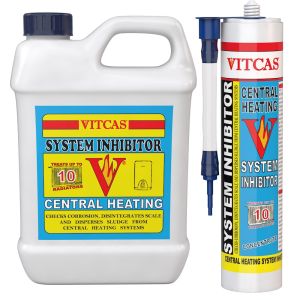 Central Heating Inhibitor – Corrosion & Limescale Protection£7.19 £5.99 Regular Price £19.19 £15.99
Vitcas Central Heating Inhibitor – Advanced corrosion, limescale, and sludge protection for sealed and open-vented heating systems. Enhances heat transfer and extends the life of boilers, radiators, and aluminium or mixed-metal pipework.
Read more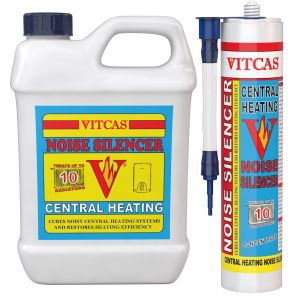 Boiler Noise Silencer – Reduces Noise & Restores Heating EfficiencyAs low as £5.99 £4.99 Regular Price £19.19 £15.99
Vitcas Boiler Noise Silencer is a long-lasting, non-acid treatment that eliminates boiler noise caused by limescale and sludge. Restores heating efficiency and requires no flushing. Suitable for fully indirect systems and safe for all metals, including aluminium.
Read more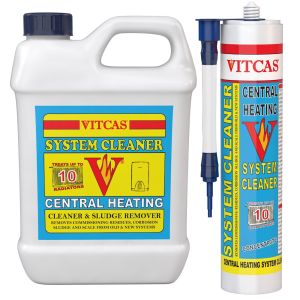 Central Heating Cleaner – Sludge & Limescale RemoverAs low as £5.99 £4.99 Regular Price £19.19 £15.99
Vitcas Central Heating System Cleaner and Sludge Remover effectively eliminates commissioning residues, flux deposits, and system debris from new installations. It also restores circulation in older heating systems affected by sludge build-up. Use is recommended when replacing components or extending existing central heating systems.
Read more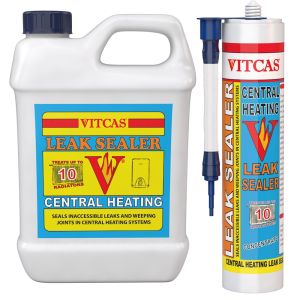 Central Heating Leak Sealer – Seals Hidden Leaks£7.19 £5.99 Regular Price £19.19 £15.99
Vitcas Central Heating Leak Sealer fixes hidden leaks and weeping radiator joints in sealed heating systems. Reduces pressure loss, improves circulation, and is safe for aluminium, underfloor heating, plastic tanks, and microbore pipework.
Read more
Choosing Central Heating Water Treatment Chemicals
VITCAS central heating treatments perform different maintenance functions within compatible fully indirect heating circuits. System Cleaner removes installation residues, flux, limescale and sludge; Inhibitor provides continuing corrosion, scale and sludge control; Boiler Noise Silencer addresses kettling associated with deposits on heat-exchanger surfaces; and Leak Sealer targets minor inaccessible water loss and weeping joints in sealed systems.
Select the treatment according to the system condition, water volume, system type and component materials. Product sequence is also important: cleaner is circulated and flushed out before inhibitor is added, while inhibitor, boiler silencer and leak sealer remain in the system as directed.
Central Heating Treatment Comparison
| Product | Primary Purpose | System Compatibility | After Treatment |
|---|---|---|---|
| Central Heating Cleaner | Removes installation debris, flux, limescale and sludge and helps restore circulation | Fully indirect systems with compatible common metals, aluminium, microbore pipework and plastic header tanks | Circulate for the specified period, then drain, flush thoroughly and refill |
| Central Heating Inhibitor | Controls corrosion, scale and sludge during normal operation | Sealed or open-vented, fully indirect systems with compatible metallic and non-metallic components | Remains in the circuit for continuing protection |
| Boiler Noise Silencer | Reduces knocking or kettling associated with limescale and baked-on sludge at the heat exchanger | Sealed, fully indirect systems with compatible common materials and microbore pipework | Remains in the circuit and does not require flushing |
| Central Heating Leak Sealer | Seals minor inaccessible leaks and weeping joints to reduce primary-circuit water loss | Sealed, fully indirect mixed-metal systems, including aluminium | Circulates to form a soft internal seal and remains in the system |
Central Heating System Cleaner
VITCAS Central Heating Cleaner is used in new systems containing flux, manufacturing debris or commissioning residues and in older circuits affected by sludge, limescale, restricted circulation or cold radiator areas. It is also suitable as part of maintenance following component replacement or system extension.
Cleaning is followed by draining and thorough flushing. Once the circuit has been refilled with clean water, inhibitor is added to provide continuing protection against corrosion, scale and sludge.
Cleaner Circulation Guide
| System Condition | Circulation Period | Next Action |
|---|---|---|
| Newly fitted component requiring a quick clean | 2 hours with hot circulation | Drain, flush thoroughly, refill and add inhibitor |
| New heating installation | Up to 2 weeks | Drain, flush and complete the protection procedure |
| Previously treated system | Up to 3 weeks | Flush until clear before adding inhibitor |
| Older system with sludge accumulation | Up to 4 weeks | Flush thoroughly and assess circulation before refilling |
Follow the individual product instructions for the circulation period appropriate to the installation and system condition.
Central Heating Inhibitor
VITCAS Central Heating Inhibitor is the continuing treatment used after cleaning, flushing and refilling. It helps protect internal metal surfaces against corrosion while controlling limescale and sludge formation, supporting effective circulation and heat transfer throughout the system.
The formulation is mineral-oil free and is suitable for compatible systems containing iron, steel, copper, brass, aluminium, plastic pipework and plastic or glass-fibre header tanks. The inhibitor remains in the circuit during normal operation and can be replenished following draining, repair or other significant water loss.
Boiler Noise Silencer
Knocking, rumbling and kettling can develop where limescale or baked-on sludge interferes with heat transfer at the boiler heat exchanger. VITCAS Boiler Noise Silencer is a non-acid treatment formulated to act on these deposits and reduce the associated noise.
The treatment remains in the system and does not require flushing. Its full effect can develop over approximately one to six weeks. Boiler Noise Silencer is intended for deposit-related kettling and should be used as part of a correctly maintained and protected heating circuit.
Central Heating Leak Sealer
VITCAS Central Heating Leak Sealer is designed for minor inaccessible leaks and weeping joints within compatible sealed primary heating circuits. The treatment circulates through the system and forms a soft internal seal at small leakage points while remaining compatible with pumps, valves and automatic air vents when correctly dosed.
Seal formation can occur within approximately 1 to 24 hours, depending on system conditions. The product is particularly useful where minor water loss originates from a location that is difficult to access directly. Accessible component faults or substantial recurring leaks should be addressed with the appropriate physical repair.
Recommended Treatment Sequence
- Identify the system condition and the required maintenance function.
- Confirm that the installation is a compatible fully indirect heating circuit.
- Calculate the circulating system-water volume.
- Use cleaner where flux, installation debris, scale or sludge needs to be removed.
- Circulate for the specified period, then drain and flush thoroughly.
- Refill the system, restore circulation and bleed trapped air.
- Add inhibitor for continuing corrosion, scale and sludge protection.
- Use boiler noise silencer or leak sealer where the identified system condition matches the intended treatment function.
System Type & Compatibility
VITCAS central heating treatments are intended for fully indirect primary heating circuits, where the circulating system water is separated from potable domestic hot water. Inhibitor is suitable for sealed and open-vented fully indirect systems, while boiler silencer and leak sealer have more specific sealed-system applications.
Check compatibility with the system materials, boiler manufacturer's requirements, antifreeze or glycol, existing chemical treatments and any specialist components before dosing.
Why Primatic Cylinders Are Excluded
Primatic cylinders use a single-feed arrangement in which the primary heating circuit and stored domestic-water system are not separated in the same way as a conventional fully indirect installation. VITCAS central heating treatments in this range are not suitable for Primatic single-feed cylinder systems.
Dosage & System Water Volume
For the 1-litre liquid treatments, one litre treats up to 100 litres of circulating system water, broadly equivalent to approximately ten standard radiators. Actual system volume is the more accurate dosing basis because radiator dimensions, pipework, boiler water content, cylinders, buffer vessels and underfloor circuits can significantly alter total capacity.
For systems above 100 litres, calculate the required treatment quantity from the system volume and the individual product dosing instructions.
Cleaning, Flushing & Magnetic Filters
Chemical cleaner loosens and disperses contamination so that sludge, scale and installation debris can be removed during flushing. Where a magnetic or combined system filter is installed, service it in accordance with the filter manufacturer's instructions as part of the cleaning process.
Chemical treatment and filtration perform complementary functions: filters collect circulating debris, while inhibitor helps control further corrosion and scale formation. Best results come from combining appropriate water treatment with good circulation, effective filtration and sound system maintenance.
Standards & System Requirements
For domestic installations, BS 7593:2019+A1:2024 provides guidance on the preparation, commissioning and maintenance of domestic central heating and cooling water systems, including cleaning, flushing and ongoing water treatment.
Central Heating Treatment as Part of System Maintenance
Central heating chemicals work most effectively as part of a complete maintenance programme that includes correct system pressure and circulation, suitable filtration, sound components and appropriate repair of mechanical faults where required.
Maintenance Records
For professional servicing, record the system volume, product and quantity used, cleaning period, flushing method and final treatment date. Recording later changes to radiators, boilers or pipework can also help maintain the correct treatment concentration during future maintenance.
Follow the individual product label and safety information for handling, storage and disposal.
Frequently Asked Questions
Which central heating treatment should I use?
Use Cleaner for sludge, scale, flux and commissioning debris; Inhibitor for continuing corrosion, scale and sludge protection; Boiler Noise Silencer for kettling associated with deposits; and Leak Sealer for suitable minor inaccessible leakage in a sealed primary circuit.
How much system water does one litre treat?
One litre treats up to 100 litres of system water, approximately ten standard radiators. Actual system volume provides the most accurate basis for dosing.
Should Central Heating Cleaner remain in the system?
No. Cleaner is circulated for the specified period and then drained and flushed out. Refill the circuit with clean water and add inhibitor for continuing protection.
Does Central Heating Inhibitor remain in the system?
Yes. Inhibitor is a leave-in treatment designed to provide continuing protection against corrosion, scale and sludge during normal heating-system operation.
What causes boiler kettling?
Limescale and baked-on sludge at the heat exchanger can interfere with heat transfer and contribute to knocking, rumbling or kettling. VITCAS Boiler Noise Silencer is formulated for this deposit-related type of boiler noise.
How long does Boiler Noise Silencer take to work?
The full effect can develop over approximately one to six weeks. The product remains in the heating circuit and does not require flushing after treatment.
What type of leak can Central Heating Leak Sealer treat?
It is intended for minor inaccessible leaks and weeping joints in compatible sealed primary heating systems. The treatment circulates within the circuit and forms a soft internal seal at suitable small leakage points.
Will Leak Sealer block pumps or valves?
The formulation is designed to circulate through a compatible heating system without blocking pumps, valves or automatic air vents when correctly dosed.
Can these treatments be used with aluminium radiators?
The range includes products compatible with aluminium and the common metals used in central heating systems. Check the individual treatment and boiler manufacturer's requirements for the specific installation.
Can these products be used in open-vented systems?
VITCAS Central Heating Inhibitor is suitable for sealed and open-vented fully indirect systems. Cleaner and remedial treatments should be selected according to their individual system-compatibility requirements.
Are these treatments suitable for Primatic cylinders?
No. The treatments in this range are specified for fully indirect heating circuits and are not suitable for Primatic single-feed cylinder systems.
Should a new central heating system be cleaned?
Yes. Cleaning helps remove flux, manufacturing residues and installation debris before the circuit is flushed, refilled and protected with inhibitor.