
Zircon Refractories
Zircon Refractory Coatings, Castables and Repair Materials
Zircon refractories provide specialised surface protection, precision lining and repair solutions for glass, aluminium, foundry, investment-casting, kiln and high-temperature process equipment. Every product currently listed has a maximum service temperature of 1750°C, but their functions differ substantially. The range includes ready-mixed and dry zircon coatings, a rapid-setting two-part cement for investment shells and heating-element bedding, a fine-grained hydraulic plaster for intricate refractory sections, a chemically bonded patching mix and a semi-dry ramming material. Select by installation method, required section thickness, substrate, furnace zone, repair temperature and exposure to molten glass, alloy, slag, flux or alkali—not by temperature alone. Zircon products can provide low-wetting and chemically resistant working surfaces in compatible processes, but performance must be confirmed for the actual melt chemistry and operating cycle. Observe the specified mixing ratio, working time, compaction, curing and controlled heat-up procedure for the chosen material.
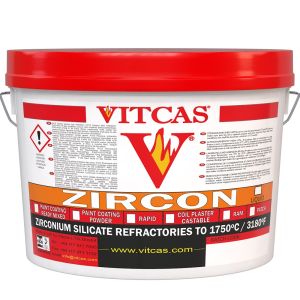 VITCAS Zircon Paint Coating 1750°CSpecial Price £47.99 £39.99 Regular Price £83.99 £69.99
VITCAS Zircon Refractory Paint Coating. It has a creamy consistency and can be applied directly. For spray application, it has to be thinned with water. Its maximum service temperature is of 1750°C / 3180°F. For use on furnaces, ladles, ceramic fibre linings and refractories in contact with molten alloys and glass.
Read more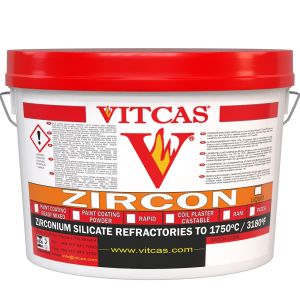 Zircon Paint Coating-Dry Powder 1750°CSpecial Price £59.99 £49.99 Regular Price £84.00 £70.00
Vitcas Zircon Refractory Paint Coating is supplied as a dry powder that is mixed with water. This zircon-based coating is resistant to temperatures up to 1750°C / 3182°F and is suitable for various industrial applications, including use in the aluminium industry and on alumina-silicate monolithic linings.
Read more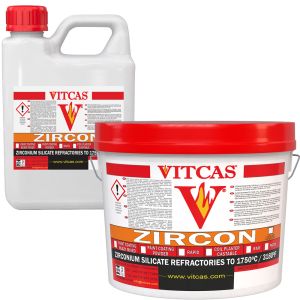 Zircon Rapid + Liquid 1750°CSpecial Price £59.99 £49.99 Regular Price £95.99 £79.99
Vitcas Zircon Rapid Setting Cement is resistant to high temperatures reaching 1750°C / 3180°F. It is a high quality refractory, zircon-based material which is of a semi-liquid, putty like texture and consistency. This makes it safe and easy to apply when repairing investment shells or element bedding.
Read more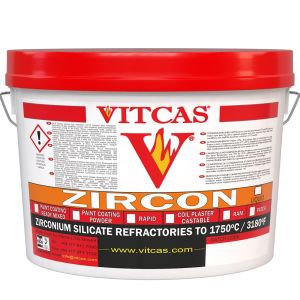 Zircon Coil Plaster Castable 1750°CSpecial Price £42.00 £35.00 Regular Price £58.80 £49.00
VITCAS Zircon Coil Plaster is a fine-grained, zircon-based refractory castable with excellent resistance to molten metal and glass. With a service temperature up to 1750°C / 3180°F, it is ideal for precision applications where standard castables are too coarse. Mixed with water to form a trowellable plaster, it is used in induction furnaces, petrochemical plants, glassworks, and high-temperature research environments.
Read more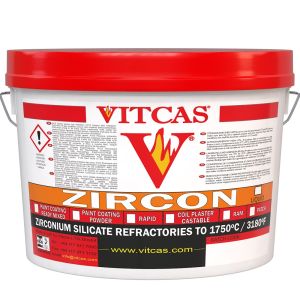 Zircon Patch - Chemically Bonded Refractory Patching Mix£118.80 £99.00
Vitcas Zircon Patch is a high strength, chemically bonded material which resists high temperatures reaching 1750°C. It is a refractory patching mix that can be used for hot and cold repairs due to its high moisture content. The zircon-based patch can be used for repairing silica, zircon, alumina refractories.
Read moreEnquire about this product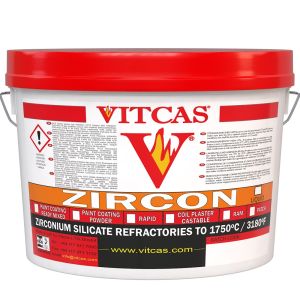 Zircon Ram - Chemically Bonded Refractory Ramming Mix£118.80 £99.00
Vitcas Zircon Ram is a zircon-based, chemically bound, refractory ramming mix. It is found in a semi-dry consistency with a 5% moisture content. The high strength zircon ram can be used in applications such as in the glass industry, specifically for lining glass tanks and furnaces.
Read moreEnquire about this product
Zircon Refractories for Demanding Industrial High-Temperature Applications
VITCAS manufactures specialist zircon refractories based on zirconium silicate (ZrSiO₄) for demanding high-temperature applications involving molten metals, glass, slags, fluxes and chemically aggressive process environments. Zircon-based materials combine high refractoriness, dimensional stability and valuable low-wetting characteristics, making them particularly useful where the working face of a refractory lining requires enhanced resistance to penetration, adhesion and process attack.
VITCAS zircon refractory technology is available in different installation forms, including protective coatings, rapid-setting repair materials, fine trowellable refractories, local patching compounds and ramming mixes. This allows refractory engineers to select the material form according to the actual function required in the furnace, ladle, launder, glass tank, induction system or other high-temperature equipment.
Zircon should not be confused with zirconia. Zircon is zirconium silicate, ZrSiO₄, while zirconia is zirconium dioxide, ZrO₂. Their chemistry and refractory behaviour are different, so correct material identification is important during specification.
Key Engineering Benefits of Zircon Refractories
- High-temperature performance – VITCAS zircon products are available for demanding service temperatures up to 1750°C / 3180°F, depending on the selected material and application.
- Resistance to process attack – zircon-based refractories can provide strong resistance to selected molten metals, glass, slags, fluxes and alkali-rich environments.
- Low-wetting behaviour – suitable zircon surfaces can reduce wetting, adhesion and penetration by compatible molten aluminium, glass and process deposits.
- Dimensional stability – zirconium silicate provides useful stability in demanding furnace and process conditions.
- Thermal shock performance – zircon-based refractory systems can perform effectively where equipment is exposed to repeated heating and cooling cycles.
- Multiple installation forms – coatings, fine plaster, rapid repair cement, patching material and ramming mixes allow the refractory solution to be matched to the required geometry and duty.
The actual performance of a zircon refractory depends on the selected product, installed structure, process chemistry, temperature profile and operating conditions. For critical applications, the complete refractory system should be assessed rather than specifying the material by temperature rating alone.
Industries & Applications
VITCAS zircon refractories are used across a range of demanding industrial sectors and high-temperature processes:
- Glass Industry – glass tanks, furnace superstructures, crowns, feeders, troughs, moulds and selected glass-contact zones.
- Aluminium, Foundry & Metal Casting – furnaces, ladles, launders and refractory surfaces exposed to compatible molten alloys, slags and fluxes.
- Steel & Metallurgical Processing – selected slag-contact, ladle, tundish and high-temperature refractory applications.
- Investment Casting – local repair of compatible ceramic investment shells and specialist lost-wax casting applications.
- Industrial Furnaces & Kilns – fine refractory sections, local repairs, surface protection and complex furnace geometry.
- Induction Furnaces & Electrical Heating – induction coil protection, confined refractory sections and bedding of electrical heating elements.
Zircon Refractory Product and Function Comparison
| Product | Supplied form | Primary function | Key data | Typical applications |
|---|---|---|---|---|
| Ready-Mixed Zircon Coating | Ready-mixed liquid coating | Thin zircon-rich surface barrier | Up to 1750°C; typically applied as a thin coating | Furnaces, ladles, launders, glass-contact refractories and compatible ceramic-fibre linings |
| Zircon Coating – Dry Powder | Water-activated dry powder | Site-mixed protective refractory coating | Up to 1750°C; approximately 300ml water per kg; approximately 3m²/kg | Alumina-silicate monolithic linings, refractory brick, aluminium, glass, slag and compatible fibre-sealing duties |
| Zircon Rapid | Two-part refractory repair system | Rapid local cementing, bonding and repair | Up to 1750°C; putty-like consistency after mixing; rapid setting | Investment-shell cracks and holes; bedding heating elements into ceramic blocks |
| Zircon Coil Plaster | Fine dry refractory castable | Trowelled fine refractory lining or plaster | Up to 1750°C; grain below 1mm; hydraulic setting; approximately 4 litres water per 25kg | Induction coils, confined furnace details, moulds, troughs, feeders, laboratory equipment and complex repairs |
| Zircon Patch | Chemically bonded semi-dry repair mix | Local hot or cold refractory repair | Up to 1750°C; high-strength patching consistency | Silica, alumina and zircon refractories, glass-furnace crowns and superstructures, selected ladle repairs |
| Zircon Ram | Chemically bonded semi-dry ramming mix | Compacted refractory sections and backing zones | Up to 1750°C; approximately 5% moisture content | Launders, ladles, glass tanks and furnace zones, including backing behind glass-contact bricks or blocks |
What Zircon Contributes to a Refractory System
Zirconium-silicate aggregate provides a combination of high refractoriness, dimensional stability and resistance to selected chemically aggressive environments. Its low-wetting characteristics are particularly useful where molten aluminium, molten glass, slag, flux or process deposits could otherwise adhere to or penetrate the refractory surface.
These characteristics can help reduce refractory contamination, penetration and build-up in compatible applications and can support longer, more controlled lining performance.
Process chemistry remains important. Glass composition, alloying elements, slag chemistry, fluxes, furnace atmosphere, exposure time, thermal gradients and cleaning practices can all influence corrosion and wear. For quality-critical applications, laboratory testing or controlled plant trials may form part of the refractory engineering programme.
Zircon Coatings – Surface Protection and Low-Wetting Performance
VITCAS zircon coatings are designed to modify the working surface of a compatible refractory without substantially changing the dimensions of the underlying lining. They create a thin zircon-rich barrier that can improve resistance to wetting, penetration and selected forms of chemical attack.
The ready-mixed coating can be stirred and applied directly by brush where suitable. Controlled dilution may be used where permitted for spraying or application to porous ceramic-fibre substrates.
The dry zircon coating is mixed on site using approximately 300ml of clean water per kilogram of powder and can be applied by brush or suitable spraying equipment.
For optimum performance, the substrate should be sound, stable and properly prepared. Deep defects or missing refractory thickness should first be restored using an appropriate repair or monolithic refractory before applying the protective coating.
Zircon Rapid – Fast Local Repair and Investment Casting
Zircon Rapid is a two-component refractory system developed for rapid local cementing, bonding and repair. When mixed with its supplied liquid component, it forms a putty-like refractory material with a short working and setting period.
This rapid-setting behaviour is particularly valuable where small, precise repairs must be completed efficiently before the next stage of production or firing.
In investment casting, Zircon Rapid can be used for local cracks, holes and defects in compatible ceramic shells. Its zircon-based chemistry is well suited to applications requiring high refractoriness and controlled interaction with the poured alloy.
Zircon Rapid is also suitable for bedding compatible electrical heating elements into ceramic blocks. Element geometry, expansion allowance, electrical clearances and drying requirements should form part of the installation design.
Working and hardening times can be influenced by ambient conditions, so the current product technical information should be used when planning time-critical installations.
Zircon Coil Plaster – Fine Refractory for Complex Geometry
Zircon Coil Plaster is a fine-grained hydraulic refractory castable designed for applications where conventional coarse refractory aggregate cannot follow the required geometry. With aggregate below 1mm, it forms a smooth trowellable refractory layer suitable for precise and confined installations.
Typical applications include induction coils, embedded heating components, small moulds, feeders, troughs, laboratory equipment and complex furnace details.
The product is mixed with approximately 4 litres of clean water per 25kg. Accurate water addition helps maintain the intended consistency, density, strength and dry-out characteristics.
Unlike a thin coating, Zircon Coil Plaster can form a substantial installed refractory section. Thickness, support, reinforcement and mechanical loading should therefore be incorporated into the engineering design where relevant.
Zircon Patch – Local High-Temperature Refractory Repair
Zircon Patch is a chemically bonded, semi-dry refractory repair material designed for local maintenance of compatible silica, alumina and zircon refractory surfaces.
Applications include glass-furnace crowns and superstructures, selected ladle areas and other high-temperature refractory zones requiring a packed local repair.
The repair area should be prepared back to sound refractory, with the geometry arranged to provide effective mechanical retention where required. This enables the patch material to be consolidated into a stable repair profile.
Zircon Patch is suitable for specified hot and cold repair duties. Hot-repair applications should follow the applicable VITCAS technical guidance and the plant's approved engineering and safety procedures.
Zircon Ram – Compacted Zircon Refractory Sections
Zircon Ram is a chemically bonded semi-dry refractory material designed for installation by controlled placement and compaction. It is supplied at a ramming consistency with approximately 5% moisture.
Typical applications include foundry launders, ladles, glass tanks and furnace zones, including backing sections behind glass-contact bricks or refractory blocks.
Uniform ramming develops the required installed structure and density. The installation method should define lift thickness, tooling, termination details and compaction quality so that the finished section achieves consistent performance.
Coating, Rapid Cement, Plaster, Patch or Ram?
| Required function | Recommended product form | Engineering benefit | Selection consideration |
|---|---|---|---|
| Modify wetting or chemical behaviour at the exposed refractory face | Zircon Coating | Creates a thin zircon-rich protective barrier with minimal dimensional change | Requires a sound underlying refractory and is not intended to rebuild substantial missing lining thickness |
| Rapid local shell repair or heating-element bedding | Zircon Rapid | Putty-like consistency and rapid setting support small, precise repairs | Best suited to defined local repairs rather than large-volume refractory construction |
| Form a fine, smooth refractory section in confined geometry | Zircon Coil Plaster | Fine aggregate allows accurate trowelling around complex shapes and components | Installed thickness and structural support should match the engineering design |
| Restore a locally damaged refractory area | Zircon Patch | Semi-dry chemically bonded material can be packed into a prepared repair profile | The underlying refractory and any anchors must remain structurally suitable for repair |
| Install a compacted refractory section or backing layer | Zircon Ram | Controlled ramming develops a dense installed refractory mass | Requires consistent lift depth and compaction throughout the installation |
Glass Industry Applications
Zircon refractory materials are particularly valuable in the glass industry because of their high-temperature stability and resistance to wetting and penetration in compatible glass environments.
Applications can include glass tanks, furnace superstructures, crowns, moulds, troughs, feeders and selected glass-contact zones. Zircon Coil Plaster can be used for intricate refractory sections, Zircon Patch for local crown and superstructure maintenance, and Zircon Ram for compacted zones including backing behind suitable glass-contact blocks.
Glass chemistry varies significantly between container, float, fibre and specialist compositions. Refractory selection should therefore consider the specific glass formulation, furnace zone, alkali content, operating temperature and contamination requirements.
Aluminium, Foundry and Metallurgical Applications
VITCAS zircon refractories can provide valuable performance in aluminium, foundry and metallurgical environments where low wetting and resistance to selected slags, fluxes and molten materials are required.
Zircon coatings can help reduce wetting and corundum build-up on compatible refractory surfaces in aluminium furnaces, ladles and launders. Where a thicker refractory section is required, Zircon Ram or Zircon Coil Plaster can provide an engineered installed layer rather than a thin surface treatment.
Alloy chemistry, treatment salts, fluxes, slag composition and mechanical cleaning methods should be considered during product selection because these factors can significantly influence refractory wear.
Investment Casting Applications
Zircon Rapid is particularly suited to local repair of compatible ceramic investment shells used in lost-wax casting. Its fine, rapidly setting refractory structure enables damaged shell contours to be restored before firing and pouring.
For demanding casting programmes, repair location, defect size, shell chemistry, drying, firing and inspection requirements should remain consistent with the foundry's quality procedure.
Induction Coils and Electrical Heating Elements
Fine-grained Zircon Coil Plaster is suitable for coating and sealing induction-furnace coils and for detailed refractory work where conventional coarse castables cannot accurately follow the geometry.
Zircon Rapid can also be used for bedding suitable resistance heating elements into ceramic blocks.
Electrical installations should maintain the required insulation resistance, clearances, cooling paths and allowance for thermal expansion. Water-containing refractory materials should be fully dried before electrical commissioning.
Industrial Kilns, Furnaces and Process Equipment
Zircon coatings and fine zircon refractory materials can be used in selected tunnel kilns, shuttle kilns, laboratory furnaces, sintering equipment and high-temperature process zones.
The selected product should be matched to the actual atmosphere, burner velocity, vapours, process materials, thermal cycling and furnace geometry.
Where a zircon-rich working surface is required over a larger lining thickness, an engineered system may combine a suitable structural refractory with a zircon working layer. Interfaces, thermal expansion and heat-flow requirements should form part of the lining design.
Substrate and Repair Assessment
Reliable refractory performance begins with correct assessment of the existing lining and the process duty.
- Identify the existing refractory chemistry, such as silica, alumina, zircon or alumino-silicate.
- Determine the normal hot-face temperature and expected upset conditions.
- Identify melt level, splash zones, gas paths and areas exposed to slag or flux.
- Establish the principal wear mechanism, including corrosion, abrasion, impact, thermal shock or restrained movement.
- Remove unsound material and confirm that the remaining refractory can support the repair.
- Design suitable keys, shoulders, anchors or termination profiles where mechanical retention is required.
- Maintain intentional expansion and movement allowances in accordance with the lining design.
Mixing and Water Control
Accurate mixing and liquid addition are essential to achieving the designed refractory properties.
- Dry Zircon Coating: approximately 300ml of clean water per kilogram of powder.
- Zircon Coil Plaster: approximately 4 litres of clean water per 25kg.
- Zircon Rapid: mix with the supplied liquid component.
- Zircon Patch and Zircon Ram: supplied at their designed application consistency.
Correct water or binder content helps control porosity, strength, setting behaviour and dry-out. The supplied formulation should be maintained unless adjustment is specifically authorised by the applicable VITCAS technical documentation.
Curing, Drying and Heat-Up
Setting and hardening are only part of the refractory commissioning process. Water and volatile components must be removed safely before the installed material is exposed to full thermal duty.
Product-specific curing and dry-out procedures should take account of repair thickness, substrate moisture, ventilation and equipment geometry. Controlled heating helps reduce the risk of steam pressure, cracking and spalling.
A maximum service temperature such as 1750°C / 3180°F defines the high-temperature capability of the selected refractory under suitable conditions; it does not define the permissible heating rate.
Engineering Specification Considerations
VITCAS zircon refractories are engineered for defined high-temperature and process duties. Product selection should therefore consider the complete operating environment and lining design.
- Maximum service temperature should be considered together with the limits of the complete refractory system.
- Low-wetting and corrosion-resistance performance should be matched to the actual molten metal, glass, slag, flux or process chemistry.
- Coatings provide a zircon-rich working surface and require a sound underlying refractory.
- Local patching materials rely on a mechanically stable remaining lining and suitable repair geometry.
- Ramming mixes require controlled and uniform compaction to achieve consistent installed density.
- Electrical and induction applications require compatibility with insulation, clearances and thermal movement.
- Hot-repair applications require defined substrate conditions and approved plant procedures.
- Thermal insulation requirements should be provided by the appropriate insulating layer within the engineered refractory system.
Where process chemistry, contamination limits or campaign life are critical, current VITCAS technical information and appropriate engineering validation should form part of the specification.
Why Specify VITCAS Zircon Refractories?
- Specialist refractory manufacturing expertise for demanding high-temperature industrial environments.
- Zirconium silicate technology offering high refractoriness, dimensional stability and useful low-wetting characteristics.
- Solutions for molten-metal and glass applications where resistance to penetration and process attack is important.
- Multiple installation forms including coatings, rapid repair materials, fine plaster, patching compounds and ramming mixes.
- High-temperature capability for demanding furnace, kiln, foundry, glass and metallurgical applications.
- Specialist products for investment casting and induction equipment.
- Engineering-focused selection based on chemistry, installation function, process exposure and operating conditions.
- Practical refractory maintenance solutions for both new installations and local repair programmes.
By combining specialist zircon refractory technology with a range of installation methods, VITCAS provides refractory engineers, furnace operators and maintenance teams with high-performance materials for protecting, repairing and maintaining demanding industrial refractory systems.
Frequently Asked Questions
What are zircon refractories?
Zircon refractories are specialist high-temperature materials based on zirconium silicate, ZrSiO₄. They are used in coatings, repair materials, fine castables and ramming mixes where high refractoriness, dimensional stability and resistance to selected molten materials or process environments are required.
Are zircon and zirconia the same material?
No. Zircon is zirconium silicate, ZrSiO₄, while zirconia is zirconium dioxide, ZrO₂. They have different chemistry and refractory properties and should be specified separately.
What temperature can VITCAS zircon refractories withstand?
Selected VITCAS zircon refractory products are rated for service temperatures up to 1750°C / 3180°F. The allowable operating temperature of the complete refractory system also depends on the substrate, lining design and other critical components.
Which zircon refractory product should I choose?
Select the material according to the required function. Use a zircon coating where a thin protective working surface is required, Zircon Rapid for fast local shell repair or heating-element bedding, Zircon Coil Plaster for fine trowelled refractory sections, Zircon Patch for local packed repairs and Zircon Ram for compacted sections or backing zones.
What is the difference between Zircon Patch and Zircon Ram?
Zircon Patch is designed primarily for local repair of compatible silica, alumina and zircon refractory surfaces. Zircon Ram is installed through controlled placement and compaction to form refractory sections or backing zones in applications such as launders, ladles and glass furnaces.
What is Zircon Coil Plaster?
Zircon Coil Plaster is a fine-grained hydraulic zircon refractory with aggregate below 1mm. It forms a smooth, trowellable refractory layer suitable for induction coils, confined furnace geometry, moulds, troughs, feeders and other detailed high-temperature installations.
Can Zircon Rapid repair investment-casting shells?
Yes. Zircon Rapid is designed for local cracks and holes in compatible ceramic investment shells. Repair dimensions, location, drying, firing and inspection should remain consistent with the foundry's approved casting procedure.
Can Zircon Rapid be used with electrical heating elements?
Yes. Zircon Rapid can be used for bedding suitable electrical heating elements into ceramic blocks. Element expansion, groove geometry, electrical clearances and drying requirements should be considered during installation.
Are zircon refractories suitable for molten aluminium?
Selected VITCAS zircon products are suitable for compatible aluminium applications and can provide useful low-wetting behaviour and resistance to penetration or corundum build-up. Actual alloy chemistry, fluxes, operating temperature and maintenance conditions should be considered during specification.
Can zircon refractories be used with molten glass?
Yes. VITCAS zircon materials are used in selected glass-contact and glass-furnace applications including tanks, superstructures, feeders, troughs and backing zones. Product selection should take account of the glass composition, furnace zone, temperature and contamination requirements.
Can Zircon Patch be applied hot?
Zircon Patch is suitable for specified hot and cold repair duties. The permitted substrate temperature, installation method and return-to-service procedure should follow the applicable VITCAS technical guidance and approved plant procedure.
Can Zircon Ram be used behind glass-contact bricks?
Yes. Zircon Ram can be used in suitable backing zones behind glass-contact bricks or blocks. Geometry, compaction, movement allowance and compatibility with the working lining should form part of the furnace design.
How much water is added to Zircon Coil Plaster?
Approximately 4 litres of clean water are added to a 25kg pack to produce a uniform trowellable consistency. Follow the current product instructions for the specified mixing procedure.
How is dry zircon coating mixed?
The dry zircon coating is prepared using approximately 300ml of clean water per kilogram of powder before application to a properly prepared compatible refractory substrate.
Can zircon coating replace damaged refractory thickness?
A zircon coating is designed primarily as a thin protective working layer. Deeper defects or missing refractory sections should first be rebuilt using an appropriately specified refractory repair material before applying the coating.
Do zircon refractories provide thermal insulation?
Zircon products are primarily dense refractory and surface-protection materials. Where thermal insulation is required, the refractory system should incorporate an appropriate insulating brick, fibre, board or other engineered insulating layer.
How should zircon refractory repairs be dried?
Drying should follow the requirements of the selected material and complete refractory system. Repair thickness, retained moisture, substrate condition, ventilation and equipment geometry all influence the appropriate dry-out and heat-up programme.
What industries use VITCAS zircon refractories?
Applications include glass manufacturing, aluminium and metal casting, steel and metallurgy, investment casting, industrial furnaces and kilns, induction furnaces, electrical heating systems and other specialised high-temperature process equipment.
What information is needed when specifying a zircon refractory?
Useful engineering information includes the furnace or process zone, substrate chemistry, operating temperature, atmosphere, molten material, glass, slag or flux chemistry, mechanical loading, repair geometry, required thickness, installation method and commissioning procedure.
Where can refractory engineers obtain further VITCAS technical information?
For demanding industrial applications, refer to the current VITCAS technical and safety documentation or contact VITCAS with details of the equipment, process conditions, existing refractory system and intended installation method to support appropriate product selection.