
Replacement Fire Bricks for Stoves & Fireplaces
Fireclay and Vermiculite Replacement Bricks for Stoves, Fireplaces and Ovens
VITCAS replacement fire bricks provide heat-resistant lining materials for compatible wood-burning and multi-fuel stoves, fireplaces, ovens and barbecue structures. Dense fireclay bricks provide greater mechanical durability and heat-storage capacity, while lightweight vermiculite bricks provide low thermal conductivity, low mass and easy shaping.
Fireclay and vermiculite perform different thermal and mechanical functions and should not be treated as direct substitutes. Match the replacement to the original liner material, thickness, dimensions and retaining arrangement wherever practical, as changing the lining material can alter heat transfer, firebox temperature and the thermal behaviour of the appliance.
 VITCAS 6 Fire Bricks Replacement Box for Stoves & FireplacesSpecial Price £14.39 £11.99 Regular Price £23.99 £19.99
VITCAS Fire Bricks Replacement Box contains six high-density fireclay bricks, specially designed for replacing worn or damaged firebox linings in fireplaces and compatible wood-burning or multi-fuel stoves. Also suitable for wood-fired ovens and barbecue grills, these durable refractory bricks withstand temperatures up to 1300°C (2370°F), providing excellent heat resistance, thermal durability and heat-retention properties.
Read more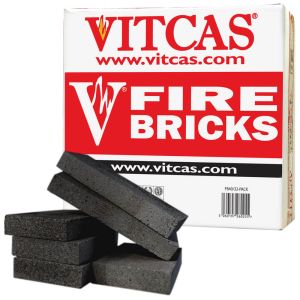 VITCAS Fire Bricks-6 Black for Stoves & FireplacesSpecial Price £17.99 £14.99 Regular Price £31.19 £25.99
VITCAS Black Fire Bricks Replacement Pack of 6 decorative black clay fire bricks for barbeque grills, outdoor ovens, stoves and fireplaces. Coloured fire bricks have a high temperature rating up to 1200oC.
Read more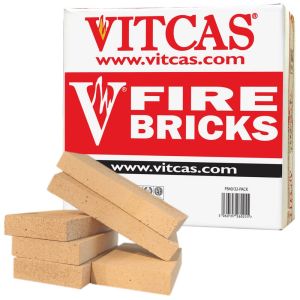 Vermiculite Fire BricksSpecial Price £14.40 £12.00 Regular Price £30.00 £25.00
Vermiculite Fire Bricks are a set of 6 fire-resistant bricks made from natural minerals. Measuring 200 x 90 x 25mm (7.8" x 3.5" x 1") each, these bricks have low thermal conductivity for greater energy efficiency and can be sawn, drilled, and sanded to fit any fireplace or wood-burning stove. Perfect for creating a heat-resistant barrier that contains heat and prevents damage to the surrounding area.
Read more
Choosing Replacement Fire Bricks for a Stove or Fireplace
VITCAS refractory fireclay and lightweight vermiculite materials for the repair and maintenance of stoves, fireplaces, ovens and other compatible high-temperature appliances. Replacement fire bricks form a protective heat-resistant lining between the combustion chamber and the appliance body, helping shield steel, cast iron and surrounding construction from direct thermal exposure while maintaining the intended firebox geometry.
Replacement should be based on the original liner material, thickness, dimensions, shape and position rather than temperature rating alone. Dense fireclay and vermiculite have fundamentally different thermal and mechanical properties, so changing from one material to another can alter heat transfer through the appliance.
Where possible, identify the original lining from the appliance manual or manufacturer specification before measuring, cutting or fitting a replacement. Model-specific moulded components, baffles and proprietary refractory shapes should not automatically be replaced with a rectangular cut-to-fit brick.
Replacement Fire Brick Comparison
| Product | Material and finish | Brick dimensions | Maximum service temperature | Principal characteristics | Typical selection |
|---|---|---|---|---|---|
| Fire Bricks Replacement Pack | High-density buff fireclay | 230 × 114 × 32mm | 1300°C / 2370°F | Dense, mechanically durable and heat-accumulating; approximately 1.75kg per brick | Compatible stove and fireplace liners, circulators, ovens, barbecues and suitable small high-temperature repairs |
| Black Fire Bricks Replacement Pack | Charcoal-black decorative fireclay | 220 × 110 × 30mm | 1200°C / 2190°F | Dense coloured refractory brick combining useful thermal mass with a dark visible finish | Compatible fireplaces, domestic stoves, barbecue structures and wood-fired ovens |
| Vermiculite Fire Bricks | Buff vermiculite insulation | 200 × 90 × 25mm | 1000°C / 1830°F | Lightweight, low-conductivity and easily shaped, with lower mechanical and abrasion resistance than dense fireclay | Compatible fireplace and wood-burning-stove liners originally designed for lightweight vermiculite insulation |
The stated temperature is a material classification rather than the normal operating temperature of the appliance or a rating for the complete stove or fireplace. The metal body, baffle, retainers, seals, surrounding construction and other components have their own operating limits and should remain within the appliance manufacturer's specification.
Dense Fireclay vs Vermiculite Replacement Bricks
Dense fireclay and vermiculite replacement bricks perform different functions within a firebox and should not be treated as direct substitutes simply because both are heat-resistant.
| Property | Dense Fireclay Replacement Brick | Vermiculite Replacement Brick |
|---|---|---|
| Density and weight | Heavy and compact | Lightweight and porous |
| Thermal behaviour | Absorbs and stores more heat | Reduces heat transfer and stores less heat |
| Mechanical resistance | Greater resistance to knocks, compression and general wear | Softer and more susceptible to impact, abrasion and excessive retaining pressure |
| Shaping | Normally requires suitable diamond masonry cutting equipment | Can be sawn, drilled and sanded using appropriate tools and dust control |
| Typical function | Durable refractory lining with useful heat-storage capacity | Lightweight insulating firebox panel that reduces heat transfer towards the appliance body |
Replacing an original vermiculite liner with dense fireclay can increase weight and heat transfer towards the appliance casing. Replacing dense fireclay with vermiculite can reduce thermal mass and mechanical durability. Either change can alter firebox temperature, external casing temperature and the thermal behaviour intended by the appliance manufacturer.
Use the original material type wherever practical unless the appliance manufacturer or appropriate technical documentation confirms a suitable alternative.
When Should a Fire Brick Be Replaced?
A fine, stable surface crack does not necessarily require immediate replacement where the brick remains secure, continues to protect the appliance body and the appliance instructions permit continued use. Replacement becomes more important when deterioration affects the position, thickness or protective function of the liner.
Replacement should normally be considered when:
- a section of brick is missing or has fallen away;
- the liner is loose, displaced or no longer retained correctly;
- a crack allows separate sections to move independently;
- erosion has substantially reduced the original thickness;
- the appliance body or previously protected construction behind the liner becomes exposed;
- the brick has suffered significant impact, chemical attack or distortion;
- the appliance manufacturer specifies replacement at a defined condition.
Do not continue operating an appliance where its instructions require an intact lining or where damaged refractory exposes components that were designed to remain protected from direct combustion-chamber heat.
Identify the Original Stove or Fireplace Lining
Before removing damaged refractory components, photograph the firebox and record the position and orientation of each brick, panel, retainer and baffle. Where available, identify the appliance model and serial number and consult the manufacturer's parts information.
Different areas of the same appliance can use different refractory technologies. Side liners, rear panels, base bricks, baffles and throat components should therefore be identified individually.
Vermiculite is generally lightweight, porous and comparatively soft. Dense fireclay is heavier and harder, with a fired ceramic structure. Where the original component is moulded, profiled or cannot be identified confidently, use an appropriate original component or confirm the replacement specification before modification.
Measuring Replacement Fire Bricks
- Allow the appliance to cool completely before accessing the lining.
- Record the height, width and thickness from an undamaged brick, original component or appliance documentation.
- Measure at several positions where an old brick may be eroded, chipped or broken.
- Record rebates, bevels, notches, fixing holes, air channels and retaining details.
- Check whether left- and right-hand components are mirror images.
- Identify intentional expansion clearances and combustion-air passages.
- Allow for normal manufacturing dimensional variation when dry-fitting the replacement.
VITCAS replacement fireclay products can show dimensional variation of approximately ±3mm. Representative bricks should therefore be measured and dry-fitted before final cutting where close appliance clearances are involved.
Do not automatically fill every visible space around the original liner. Some gaps are deliberately incorporated for thermal expansion, airflow or component removal.
Pack Sizes and Nominal Coverage
The replacement products described here are supplied in packs of six. Where the largest brick face forms the visible lining surface, the approximate theoretical area before cutting, joints and waste is:
| Brick type | Large face | Nominal area per pack of six |
|---|---|---|
| Buff fireclay | 230 × 114mm | Approximately 0.157m² |
| Black fireclay | 220 × 110mm | Approximately 0.145m² |
| Vermiculite | 200 × 90mm | Approximately 0.108m² |
For appliance repair, correct individual component geometry is normally more important than total area coverage. Allow additional material for saw cuts, trial fitting, damaged edges and future replacement.
Cutting Dense Fireclay Replacement Bricks
Dense buff and black fireclay bricks can be cut to the required shape using suitable diamond masonry or refractory cutting equipment. Mark the finished dimensions accurately, support the brick securely and avoid forcing the cutting tool.
Narrow pieces and complex notches should be planned carefully because small refractory sections can be more vulnerable to handling and thermal damage.
Cutting fired refractory materials can generate fine mineral dust, potentially including respirable crystalline silica. Use appropriate extraction or controlled wet-cutting methods where permitted, together with suitable respiratory, eye, hearing and hand protection. Wet-cut refractory should be allowed to dry thoroughly before exposure to heat.
Cutting and Shaping Vermiculite Fire Bricks
VITCAS vermiculite fire bricks are easier to shape than dense fireclay and can be sawn, drilled or sanded to suit compatible appliance geometry.
Support the material close to the working area because thin sections and edges can break relatively easily. Avoid excessively sharp internal corners in cut-outs where a more gradual profile can be used.
Dust control and appropriate personal protective equipment should still be used during machining. The finished panel should fit without excessive force against retainers or the appliance casing.
Installing Replacement Fire Bricks
- Clean the cold firebox carefully and inspect the steel or cast-iron body for corrosion, cracking or distortion.
- Check retaining clips, channels, brackets and the baffle before installing new liners.
- Dry-fit replacement pieces before final assembly.
- Confirm that combustion-air openings and intended expansion clearances remain unobstructed.
- Install components in the sequence specified by the appliance manufacturer where instructions are available.
- Refit retaining parts without applying excessive pressure to fragile refractory edges.
- Confirm that the baffle, grate, fuel retainer and door can operate normally before returning the appliance to service.
Many stove liners are installed dry and held in position by the appliance structure or dedicated retainers. Replacement bricks should therefore not automatically be mortared or bonded into place. A rigid joint can interfere with thermal movement, obstruct air passages and make future maintenance more difficult.
Use refractory mortar or cement only where the documented stove, fireplace or masonry construction specifically requires a bonded refractory joint.
Mortar, Cement and Fire Brick Repairs
The jointing method depends on the type of construction. A removable stove liner commonly operates without mortar, while a masonry fireplace, oven or barbecue may require a bonded refractory brick system.
For suitable internal firebrick masonry, VITCAS HPM Heatproof Mortar is a ready-mixed refractory mortar designed for thin firebrick joints in protected high-temperature applications.
For compatible exterior oven, barbecue and outdoor fireplace masonry, VITCAS OC Outdoor Oven Cement is designed for weather-exposed firebrick jointing.
These products should not be interpreted as a recommendation to mortar a removable appliance liner. Follow the original stove or fireplace construction method and use a jointing material only where a bonded system is required.
Ordinary Portland-cement mortar, gypsum plaster and general-purpose building adhesive are not appropriate substitutes for correctly specified refractory jointing materials within a high-temperature working area.
Wood-Burning and Multi-Fuel Stoves
A stove lining functions as part of the appliance's combustion and thermal design. Correctly specified refractory liners protect the appliance body while helping maintain the intended firebox environment.
Replacement material and thickness should match the original construction wherever practical. Do not obstruct secondary-air passages, alter retaining arrangements or reduce the designed clearance around moving components.
Inspect the baffle, grate, retainers and door seals at the same time as the fire bricks. Repeated lining failure can result from excessive firing, unsuitable fuel, excessive chimney draught, damaged retaining components or incorrect air-control operation rather than the refractory material alone.
Open Fireplaces and Fireplace Inserts
Replacement refractory bricks can be used in compatible fireplace side walls, firebacks and small inserts where their dimensions and material properties match the construction.
Where a fireplace lining is extensively cracked, moving, damp or detached from the surrounding masonry, the complete fire chamber should be assessed rather than treating the damage as an isolated cosmetic defect.
Changes to fireplace geometry can affect the throat, gather, flue entry and smoke movement. Structural or flue alterations should therefore be carried out according to the applicable installation requirements.
Wood-Fired Ovens and Barbecues
Dense buff and black fireclay replacement bricks can also be used in compatible wood-fired oven and barbecue construction. The required brick thickness and thermal behaviour should be selected according to whether the material forms a wall, dome, lining or other refractory component.
A thin replacement brick intended for stove or side-wall repair should not automatically be treated as the optimum material for a heavily loaded oven hearth or cooking floor. Where a replacement brick is intended to form a cooking surface, suitability for that specific duty should be confirmed separately rather than inferred from temperature resistance alone.
For a broader selection of dense, insulating, shaped and specialist refractory bricks, see VITCAS Fire Bricks.
Indoor and Outdoor Applications
The buff and black fireclay replacement bricks are suitable for compatible indoor and outdoor high-temperature applications. Vermiculite replacement bricks are intended primarily for protected indoor appliance lining applications.
Outdoor use requires more than a temperature-resistant brick. The complete construction should manage rain ingress, retained moisture, freeze-thaw exposure, drainage and weather protection.
Water-saturated refractory should be allowed to dry before heating. Rapid firing of wet porous material can generate internal steam pressure and contribute to cracking or spalling.
Initial Firing After Replacement
Dry-fitted replacement liners that have remained dry can normally be returned to service according to the appliance manufacturer's operating instructions.
Where bricks have been wet-cut, mortared or installed as part of new refractory masonry, allow the construction to dry fully before gradual heating. The required procedure depends on the jointing material, amount of retained moisture and complete refractory construction.
During initial operation, check that replacement liners remain correctly positioned and that retaining components, doors, baffles and surrounding appliance surfaces behave normally.
Preventing Premature Fire Brick Damage
- Place fuel into the firebox rather than throwing logs against the refractory lining.
- Use fuels approved for the appliance.
- Avoid sustained operation beyond the manufacturer's recommended fuel load and firing conditions.
- Protect vermiculite liners from pokers, grates and cleaning tools.
- Remove ash without catching tools behind exposed brick edges.
- Investigate repeated cracking for inadequate expansion clearance, poor fit or distorted retainers.
- Check for excessive chimney draught or operating practices that can contribute to over-firing.
- Keep outdoor refractory constructions protected from prolonged water ingress.
Engineering & Application Considerations
- Replacement fire bricks should reproduce the intended lining function, including material type, thickness, geometry and retaining arrangement.
- Dense fireclay and vermiculite are thermally different materials and should not be interchanged solely on the basis of dimensions or temperature rating.
- Cut-to-fit replacement bricks are not model-specific OEM components. Proprietary moulded liners, baffles and specialised shapes require separate confirmation.
- Many stove liners are designed for dry installation and should not automatically be mortared or bonded into place.
- Material temperature classification does not determine the operating limit of the complete appliance.
- Vermiculite provides lightweight insulation and should not be used as a heavily loaded or high-abrasion hearth unless the appliance design specifically permits it.
- Outdoor refractory installations require moisture management in addition to high-temperature resistance.
- Industrial furnaces and process equipment require separate refractory specification based on temperature, chemistry, abrasion, loading and complete lining design.
Why Choose VITCAS Replacement Fire Bricks?
- Refractory manufacturing expertise across fireclay, insulating and specialist high-temperature materials.
- Dense fireclay and lightweight vermiculite technologies for different thermal and mechanical lining functions.
- Cut-to-fit replacement formats suitable for maintenance of compatible stoves, fireplaces and high-temperature appliances.
- Defined dimensions and temperature classifications to support accurate replacement-material selection.
- Materials suitable for domestic heating, oven and barbecue maintenance as well as broader refractory repair applications.
- Compatible VITCAS refractory materials available for bonded masonry, oven construction and wider high-temperature repair systems.
Correct replacement begins by identifying what the original liner was designed to do. Matching material type, thickness, dimensions and thermal behaviour helps preserve the protective and insulating function of the firebox while allowing damaged refractory components to be replaced accurately.
Frequently Asked Questions
What are replacement fire bricks?
Replacement fire bricks are refractory or insulating components used to replace damaged lining material in compatible stoves, fireplaces, ovens and other high-temperature appliances. They help protect the appliance body and maintain the intended firebox geometry.
What is the difference between fireclay and vermiculite replacement bricks?
Fireclay is dense, mechanically stronger and stores more heat. Vermiculite is lightweight and insulating, transfers less heat and is easier to shape, but it is also softer and more vulnerable to impact and abrasion.
How do I know which replacement brick fits my stove?
Identify the appliance model where possible, check the original liner material and measure an undamaged component. Record thickness as well as height, width, notches, holes, bevels, retaining details and expansion clearances.
When should a cracked stove brick be replaced?
A fine stable crack may remain serviceable where the brick stays secure and continues to protect the appliance wall. Replacement is normally required when sections become loose or missing, erosion significantly reduces thickness, or the protected appliance body becomes exposed.
Can a stove be used with a missing fire brick?
Do not continue operating the appliance where its instructions require an intact lining or where a missing section exposes components that should remain protected from direct combustion heat.
Can dense fireclay replacement bricks be cut?
Yes. Dense fireclay can be cut with suitable diamond masonry or refractory cutting equipment. Secure the brick properly, control mineral dust and allow wet-cut material to dry before heating.
Can vermiculite fire bricks be cut?
Yes. Vermiculite can be sawn, drilled and sanded relatively easily. Handle thin sections carefully because the lightweight material is more fragile than dense fireclay.
Should replacement stove bricks be mortared in place?
Only where the appliance construction specifically requires a bonded liner. Many stove fire bricks are dry-fitted and retained mechanically, so adding mortar can interfere with expansion, airflow or future maintenance.
What dimensional tolerance should be allowed for replacement fire bricks?
VITCAS replacement fireclay products can show manufacturing dimensional variation of approximately ±3mm. Measure the received bricks and dry-fit them before final cutting where close tolerances are important.
Can replacement fire bricks be used in a pizza oven?
Dense fireclay replacement bricks can be used in compatible wood-fired oven construction. Their suitability depends on the required position, thickness, thermal duty and mechanical loading rather than temperature resistance alone.
Can replacement fire bricks be used in a barbecue?
Dense fireclay replacement bricks can be used in compatible barbecue structures. Outdoor construction should also incorporate suitable jointing materials, moisture protection and complete refractory detailing.
Why do replacement fire bricks crack repeatedly?
Repeated cracking can result from an excessively tight fit, inadequate expansion clearance, distorted retainers, impact from fuel, over-firing, retained moisture or use of an unsuitable replacement material. The underlying cause should be identified before another brick is installed.
How should replacement fire bricks be returned to service?
Dry-fitted liners that have remained dry should be used according to the appliance instructions. Wet-cut, mortared or newly constructed refractory sections should be allowed to dry before gradual heating so that retained moisture can leave progressively.