
Refractory Coatings
Refractory Coatings for Furnaces, Kilns and Molten-Material Contact
Refractory coatings form thin protective surfaces on refractory bricks, castables, alumino-silicate monolithic linings and compatible ceramic-fibre products. The range includes ready-mixed and water-activated zircon coatings rated to 1750°C for demanding furnace, kiln, ladle, launder, glass and aluminium applications, plus a silica-based glaze wash for refractory and monolithic linings operating up to 1000°C. Select by substrate, maximum temperature, furnace atmosphere, molten-metal or glass contact, alkali and slag exposure, and the required application method. These products are not decorative paints for steel stove bodies and do not replace refractory thickness, structural repairs or back-up insulation. They are intended mainly for controlled industrial lining work where process compatibility can be assessed and documented. Performance depends on sound surface preparation, complete coverage, controlled film thickness, correct water addition where applicable, drying and first firing. Confirm chemical compatibility and carry out a representative trial where process contamination, wetting behaviour or lining life is critical.
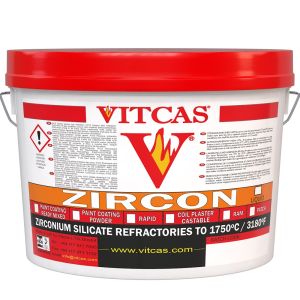 VITCAS Zircon Paint Coating 1750°CSpecial Price £47.99 £39.99 Regular Price £83.99 £69.99
VITCAS Zircon Refractory Paint Coating. It has a creamy consistency and can be applied directly. For spray application, it has to be thinned with water. Its maximum service temperature is of 1750°C / 3180°F. For use on furnaces, ladles, ceramic fibre linings and refractories in contact with molten alloys and glass.
Read more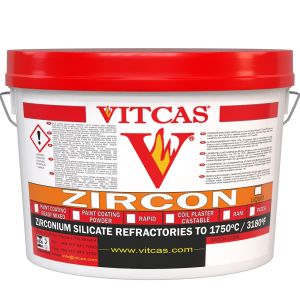 Zircon Paint Coating-Dry Powder 1750°CSpecial Price £59.99 £49.99 Regular Price £84.00 £70.00
Vitcas Zircon Refractory Paint Coating is supplied as a dry powder that is mixed with water. This zircon-based coating is resistant to temperatures up to 1750°C / 3182°F and is suitable for various industrial applications, including use in the aluminium industry and on alumina-silicate monolithic linings.
Read more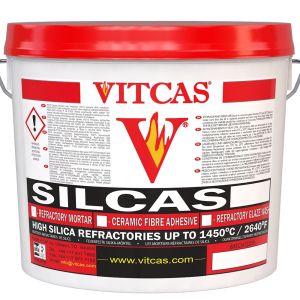 Silcas RGW- Refractory Glaze Wash CoatingSpecial Price £35.99 £29.99 Regular Price £59.99 £49.99
Vitcas Refractory Glaze Wash Coating - Silcas RGW is a silica-based, thixotropic refractory coating capable of withstanding temperatures up to 1000°C (1830°F). It is suitable for applications such as coating refractory bricks and glazing monolithic furnace linings, providing enhanced protection and durability under high-temperature conditions.
Read more
Refractory Coatings for Industrial High-Temperature Applications
VITCAS manufactures specialist refractory coatings for protecting and modifying the working surfaces of refractory bricks, castables, monolithic linings and compatible ceramic-fibre systems. Depending on the formulation, these coatings can provide low-wetting behaviour, improved resistance to selected slags, molten materials and process deposits, reduced surface permeability or a dense glazed working face.
VITCAS refractory coating solutions include zircon-based coatings for demanding high-temperature duties and silica-rich glaze coatings for applications where a vitrified refractory surface is required. Product selection should be based on substrate chemistry, service temperature, process atmosphere, contact with molten materials, coating thickness and the required surface function.
A refractory coating is an engineered surface layer rather than a replacement for the structural refractory lining. The underlying brick, castable, fibre or monolithic system must therefore remain suitable for the complete thermal, chemical and mechanical duty.
Key Benefits of VITCAS Refractory Coatings
- High-temperature surface protection for demanding furnace, kiln, foundry and process applications.
- Low-wetting zircon technology for selected molten aluminium, glass, slag and refractory-contact duties.
- Reduced penetration and build-up on compatible refractory working surfaces.
- Surface sealing to reduce open texture and direct process exposure.
- Glazed refractory finishes using silica-rich coatings where a vitrified working face is required.
- Multiple application methods including brushing, spraying and, for selected products, trowelling.
- Solutions for dense refractory and compatible ceramic-fibre substrates.
Refractory Coating Product Comparison
| Product | Supplied form | Service temperature | Typical substrate or duty | Application |
|---|---|---|---|---|
| Zircon Refractory Coating | Ready-mixed liquid coating | Up to 1750°C / 3180°F | Refractory brick, alumino-silicate monolithic linings and compatible ceramic-fibre products; selected molten-alloy, slag and glass duties | Brush application or suitably controlled spray application |
| Zircon Coating – Dry Powder | Water-activated powder | Up to 1750°C / 3180°F | Refractory brick and alumino-silicate monolithic linings in aluminium, glass, slag and compatible fibre-sealing applications | Mix with approximately 300ml of water per kilogram; apply by brush or suitable spray equipment |
| Silcas RGW Refractory Glaze Wash | Ready-to-use thixotropic paste | Up to 1000°C / 1830°F | Refractory bricks, castables and compatible monolithic linings requiring a dense silica-rich glazed face | Brush, spray or trowel according to the application; brushing is suitable where maximum bond strength is required |
Industries & Applications
VITCAS refractory coatings support surface protection and refractory maintenance across a range of high-temperature industries:
- Aluminium & Foundry – furnaces, ladles and launders requiring a compatible non-wetting zircon barrier and reduced corundum build-up.
- Glass Industry – selected refractory zones exposed to molten glass, alkali vapours and chemically aggressive furnace conditions.
- Steel & Metallurgical Processing – refractory working faces exposed to heat, slag and process deposits.
- Ceramics & Kilns – tunnel kilns, shuttle kilns, refractory brickwork and fibre-lined chambers requiring surface sealing or glaze formation.
- Furnaces, Boilers & Combustion Equipment – selected brick and monolithic surfaces where coating chemistry matches the operating environment.
- Industrial Process Equipment – selected high-temperature refractory-lined systems where surface protection or sealing is required.
Zircon Refractory Coatings – High-Temperature Surface Protection
VITCAS zircon refractory coatings are based on zirconium-silicate technology and are designed for demanding applications where the refractory working face requires improved resistance to wetting, penetration and selected chemical attack.
Suitable zircon-coated refractory surfaces can perform effectively in contact with compatible molten aluminium alloys, molten glass, slags, fluxes and process deposits. The zircon-rich surface can help reduce adhesion and penetration while protecting the underlying refractory from direct process exposure.
In aluminium processing, zircon coatings are particularly useful where reduced wetting and control of corundum build-up are important to maintaining cleaner working surfaces in furnaces, ladles and transfer launders.
Actual performance depends on alloy chemistry, fluxes, slag composition, glass formulation, temperature, dwell time, cleaning practice and coating condition. These process variables should form part of the engineering specification for demanding applications.
Ready-Mixed or Dry Zircon Coating?
The ready-mixed zircon coating provides convenient site application and can be used after thorough stirring. It is particularly useful where direct brush application is preferred or where the coating viscosity is adjusted in accordance with the applicable product guidance for spraying or porous compatible substrates.
The dry zircon coating allows controlled preparation on site. Mix with approximately 300ml of clean water per kilogram of powder and blend thoroughly to achieve a uniform application consistency.
Both formats provide high-temperature zircon-based surface protection. Selection between ready-mixed and dry coating can therefore be based on project logistics, application method, site preparation requirements and installation control.
Zircon Coatings in Aluminium Processing
Molten aluminium can progressively wet and penetrate unsuitable refractory surfaces, particularly where alloy chemistry, fluxes and repeated cleaning create severe operating conditions.
VITCAS zircon coatings can provide a compatible low-wetting barrier on refractory surfaces in aluminium furnaces, holding furnaces, ladles and transfer launders. This can help reduce adhesion, corundum build-up and progressive penetration into the working face.
For refractory engineers, coating selection should consider alloy composition, magnesium content, flux practice, melt temperature, dwell time, cleaning tools and expected wear pattern. The coating should be matched to the complete refractory system rather than considered independently of the substrate.
Molten Glass and Slag Applications
Zircon-based refractory coatings can also be used on compatible refractory surfaces exposed to selected molten glass and metal slags. Their zirconium-silicate chemistry provides a protective working layer suited to demanding alkali-rich and chemically active environments.
Applications may include selected refractory surfaces in glass furnaces, transfer zones and high-temperature process equipment where the coating can reduce direct exposure of the underlying lining.
Glass composition, furnace zone and operating conditions are particularly important. Tank, throat, melt-line, crown, splash and superstructure areas can experience very different temperature, movement and corrosion mechanisms.
Where product quality is sensitive to inclusions, blistering, colour change or other contamination, appropriate engineering validation or plant trials may be required.
Silcas RGW – Refractory Glaze Wash
Silcas RGW is a silica-rich, thixotropic refractory coating designed to form a dense glazed surface during the prescribed first firing. Its paste-like consistency at rest allows controlled application to refractory brick, castable and compatible monolithic surfaces.
During brushing, spraying or trowelling, shear allows the material to flow across the prepared substrate. This helps achieve a uniform coating on vertical and shaped refractory surfaces.
During the first firing, Silcas RGW vitrifies to create a denser glazed face. This can help reduce surface permeability and provide additional resistance to gas penetration, abrasion and selected slag or chemical exposure.
Silcas RGW is rated to 1000°C / 1830°F and should be selected according to the actual furnace atmosphere, substrate and process duty.
Suitable Refractory Substrates
Reliable coating performance depends on compatibility with the underlying refractory system. Suitable substrates can include:
- Dense refractory brick – provided the surface is sound, clean and suitably prepared.
- Refractory castable – after appropriate curing and dry-out unless the approved system procedure specifies otherwise.
- Gunned and monolithic linings – after removal of loose grains, rebound and friable surface material.
- Alumino-silicate refractories – suitable for compatible zircon coating applications.
- Ceramic-fibre blanket, board or module – selected ready-mixed zircon applications with a controlled light coating.
For each installation, the coating chemistry and application method should be matched to the substrate, temperature and process conditions.
Surface Preparation
Surface preparation is fundamental to coating adhesion and service performance. The refractory surface should be mechanically stable, clean and free from contaminants that could interfere with bonding.
- Remove dust, oil, grease, soot and process contamination.
- Remove loose or deteriorated refractory and any unstable existing coating.
- Roughen excessively smooth or glazed surfaces where appropriate for the substrate.
- Repair deep cracks, holes and missing refractory sections before coating.
- Maintain designed expansion and movement joints.
- Ensure repaired areas have set and dried according to the applicable technical instructions before coating.
A thin refractory coating performs best when applied over a stable underlying lining with a correctly prepared surface.
Application Thickness
The ready-mixed zircon coating is typically applied as a thin, controlled refractory film. General applications are approximately 1mm, while compatible porous ceramic-fibre surfaces may require a light coating of approximately 1–2mm according to the installation guidance.
Uniform thickness is more important than excessive build-up. A well-controlled coating should provide continuous coverage without heavy ridges, runs, pinholes or overloaded areas.
Multiple controlled passes may be appropriate on highly absorbent or complex refractory surfaces where this provides more uniform coverage.
Brush, Spray and Trowel Application
Brush application allows coating to be worked into the texture of refractory surfaces and is particularly useful for local work, irregular geometry and smaller areas.
Spray application can provide efficient, uniform coverage across larger areas where the selected coating and viscosity are suitable for the equipment used.
Trowel application is applicable to products such as Silcas RGW where the thixotropic formulation is designed for controlled manual placement.
Application equipment should be clean and suitable for refractory materials. Overspray should be controlled around burners, thermocouples, anchors, movement joints and other furnace components.
Ceramic-Fibre Surface Treatment
Compatible ready-mixed zircon coating can be applied to selected ceramic-fibre blankets, boards and modules to seal the working surface and reduce direct exposure of the fibre face.
A light, controlled coating is important so that the fibre system is not unnecessarily overloaded. Slight dilution may be appropriate where permitted by the product guidance to improve distribution over porous surfaces.
The fibre lining should remain securely installed and mechanically capable of carrying the coating during gas flow, thermal cycling and normal operation.
Coating, Repair Material or Insulation?
| Engineering requirement | Appropriate material type | Function |
|---|---|---|
| Low-wetting or chemically resistant refractory surface | Compatible zircon refractory coating | Modifies the exposed working face without rebuilding the full refractory lining |
| Dense silica-rich glazed refractory face | Silcas RGW glaze wash | Forms a vitrified refractory surface during the prescribed first firing |
| Deep crack, eroded joint or missing refractory | Compatible refractory repair material, mortar, castable or replacement brick | Restores the required refractory section before surface coating |
| Reduced casing temperature or lower heat loss | Engineered refractory insulation | Provides the required thermal resistance through insulating brick, fibre or another low-conductivity layer |
Coverage and Material Planning
Published coverage values are useful for initial material planning, but actual consumption depends on refractory porosity, surface profile, application method, wastage, overspray and the required film thickness.
The dry zircon coating is listed at approximately 3m²/kg under published conditions. Actual project quantity should include a suitable allowance for substrate condition and installation losses.
For larger industrial installations, representative trials or measured consumption on an initial area can provide more reliable project estimates.
Drying and First Firing
Controlled drying and commissioning are important to the performance of the coating and the complete refractory system.
The ready-mixed zircon coating is typically allowed to dry for approximately 24 hours at around 20°C before temperature is increased gradually according to the applicable procedure.
Silcas RGW also requires an initial curing period and develops its glazed surface during the prescribed first firing to approximately 1000°C.
The heating rate should always be suitable for the complete refractory system, including any castable, brick, fibre or repair material beneath the coating. Retained moisture can create steam pressure, blistering or damage if temperature is increased too quickly.
Engineering Specification Considerations
VITCAS refractory coatings are engineered surface treatments and should be specified as part of the complete refractory lining system.
- The service temperature of the coating should be matched to the substrate and complete lining design.
- Low-wetting and chemical-resistance performance should be assessed against the actual alloy, glass, slag, flux and process chemistry.
- The underlying refractory must remain mechanically stable and chemically suitable for the duty.
- Deep defects and missing lining thickness should be repaired before coating.
- Designed expansion and movement joints should remain functional.
- Coating thickness should remain controlled and consistent with the selected product and substrate.
- Application to hot equipment should follow the relevant technical guidance and approved plant procedure.
- Thermal insulation requirements should be addressed by the engineered insulation system rather than by the coating layer.
Where process chemistry, contamination risk or campaign life are critical, appropriate testing, plant trials or current VITCAS technical information should form part of the engineering specification.
Inspection and Maintenance
Regular inspection helps maintain the protective function of the coating and allows local wear to be addressed before the underlying refractory becomes exposed.
- Inspect for blistering, cracking, crazing, flaking and worn-through areas.
- Monitor coating condition around joints, penetrations and high-wear zones.
- Record changes in alloy, glass, slag or flux chemistry that coincide with accelerated wear.
- Remove loose coating and unstable refractory before recoating.
- Repair damaged substrate with a compatible refractory material before restoring the coating system.
- Use representative reference areas where practical to compare wear during service.
Why Specify VITCAS Refractory Coatings?
- Specialist refractory manufacturing expertise for industrial high-temperature applications.
- Zircon-based low-wetting technology for selected molten aluminium, glass and slag environments.
- High-temperature surface protection for demanding refractory systems.
- Silica-rich glaze technology for forming dense vitrified refractory surfaces.
- Ready-mixed and dry coating options to support different installation requirements.
- Application by brush, spray or trowel depending on product and project requirements.
- Compatibility with a range of refractory substrates, including brick, castable, monolithic and selected ceramic-fibre systems.
- Engineering-led selection based on process chemistry, substrate, operating temperature and required surface performance.
By combining specialist refractory coating technology with practical application options, VITCAS provides refractory engineers, furnace operators and maintenance teams with high-performance solutions for protecting and maintaining refractory working surfaces in demanding industrial environments.
Frequently Asked Questions
What is a refractory coating?
A refractory coating is a thin mineral surface treatment applied to compatible refractory bricks, castables, monolithic linings or ceramic-fibre systems. Depending on the formulation, it can provide a low-wetting, chemically resistant, sealed or glazed working face.
What are zircon refractory coatings used for?
Zircon refractory coatings are used where a high-temperature refractory surface requires improved resistance to wetting, penetration and selected molten materials, slags, fluxes or process deposits.
What temperature can VITCAS zircon coatings withstand?
Selected VITCAS zircon refractory coatings are rated for service temperatures up to 1750°C / 3180°F. The complete lining should also be checked against the operating limits of its brick, castable, fibre, anchors and other components.
What is the difference between ready-mixed and dry zircon coating?
The ready-mixed zircon coating provides convenient direct site application after appropriate stirring. The dry zircon coating is prepared on site using approximately 300ml of clean water per kilogram of powder. Both provide zircon-based high-temperature surface protection.
Is zircon coating suitable for molten aluminium?
Selected zircon coatings are suitable for compatible molten-aluminium applications and can help reduce wetting, penetration and corundum build-up on suitable refractory surfaces. Alloy chemistry, flux practice, temperature and maintenance conditions should be considered during specification.
Can zircon coating be used with molten glass?
Yes. Zircon coatings can be used on suitable refractory surfaces in selected molten-glass and glass-furnace applications. Compatibility should be assessed against the glass composition, furnace zone, operating temperature and quality requirements.
What is Silcas RGW?
Silcas RGW is a silica-rich thixotropic refractory glaze wash rated to 1000°C / 1830°F. During the prescribed first firing, it vitrifies to form a dense glazed refractory working surface.
Can refractory coating be applied to fire bricks?
Yes. VITCAS refractory coatings can be used on compatible fire bricks and other refractory surfaces where the substrate chemistry, operating temperature and process conditions are appropriate.
Can refractory coating be applied to castable?
Selected coatings can be applied to compatible refractory castables and monolithic linings after the substrate has been properly cured, dried and prepared according to the applicable system requirements.
Can zircon coating be used on ceramic fibre?
Compatible ready-mixed zircon coating can be used on selected ceramic-fibre blankets, boards and modules. A light, controlled application should be used to avoid overloading the fibre system.
How thick should zircon refractory coating be?
General ready-mixed zircon coating applications are approximately 1mm, while selected porous ceramic-fibre surfaces may use approximately 1–2mm according to the applicable installation guidance.
Can refractory coating be sprayed?
Yes. Suitable zircon coatings and Silcas RGW can be spray applied using appropriate equipment and controlled viscosity. Brush and trowel application are also available for selected products and applications.
How much water is added to dry zircon coating?
The dry zircon coating is prepared using approximately 300ml of clean water per kilogram of powder and mixed thoroughly to achieve a uniform application consistency.
How much area does dry zircon coating cover?
Published guidance indicates approximately 3m² per kilogram under suitable conditions. Actual coverage depends on substrate porosity, surface profile, coating thickness and application losses.
Can refractory coating repair deep cracks or missing lining?
Refractory coating is primarily a surface treatment. Deep cracks, eroded sections and missing refractory thickness should first be restored using an appropriately specified mortar, castable, repair compound or replacement refractory unit.
Does refractory coating provide thermal insulation?
Refractory coatings provide surface protection rather than bulk thermal insulation. Where reduced heat loss or casing temperature is required, the lining should incorporate an appropriate insulating brick, fibre, board or other engineered insulation layer.
How long should refractory coating dry before firing?
Drying requirements depend on the selected product and complete lining system. Ready-mixed zircon coating and Silcas RGW typically require an initial drying or curing period before controlled heat-up. The current product and equipment commissioning instructions should be followed.
What industries use VITCAS refractory coatings?
Applications include aluminium processing and foundries, glass manufacturing, steel and metallurgy, ceramics and kilns, furnaces and combustion equipment and selected high-temperature industrial process systems.
What information is needed when specifying a refractory coating?
Useful engineering information includes the substrate chemistry, operating temperature, process atmosphere, alloy or glass composition, slag or flux exposure, required coating function, application method, film thickness and commissioning conditions.
Where can refractory engineers obtain further VITCAS technical information?
For demanding industrial applications, refer to the current VITCAS technical and safety documentation or contact VITCAS with details of the equipment, refractory substrate, process conditions and intended coating application to support appropriate product selection.