
Acid Resistant Refractory Materials
Acid-Resistant Refractory Materials for Chemical and High-Temperature Service
VITCAS manufactures specialist acid-resistant refractory materials for protecting masonry, concrete and process equipment exposed to acidic liquids, vapours, condensates and chemically aggressive high-temperature environments. These materials are designed for applications where conventional masonry products or Portland-cement-based systems may not provide the required chemical resistance.
VITCAS acid-resistant solutions include low-porosity fireclay bricks for durable unit linings, Acidcas M mortar for bedding and jointing compatible bricks and tiles, Acidcas R render for protective surface layers, and Acidcas C concrete for monolithic construction and lining sections.
Consideration should be given to the complete service environment, including chemical composition, acid concentration, temperature, immersion or splash duty, exposure duration, abrasion, mechanical loading, substrate condition, movement and containment requirements.
Acidcas M, Acidcas R and Acidcas C provide refractory capability up to 1400°C where appropriate to the application, while acid-resistant bricks have a separate maximum service temperature of 400°C. These temperature ratings should be considered together with the chemical and mechanical requirements of the complete lining system.
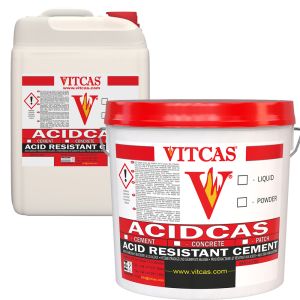 Acid proof Cement MortarSpecial Price £47.99 £39.99 Regular Price £59.99 £49.99
Acid proof Mortar Acidcas is a heat resistant, acid-proof cement, which can be utilised for different applications such as use in chemical and petrochemical industries, in the food and pharmaceuticals industry, and in jointing of acid resistant bricks and tiles and lining chimneys.
Read more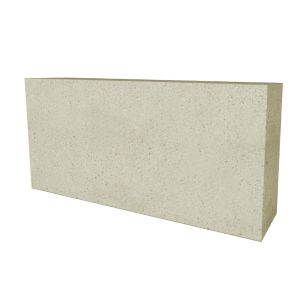 Acid Resistant BricksSpecial Price £3.60 £3.00 Regular Price £4.80 £4.00
Vitcas Acid Resistant Clay Firebricks are heat resistant to 400°C / 752°F. The acid resistant bricks are also resistant to chemicals including most mineral acids and resistant to abrasion. They are suitable for use in applications such as in power generation and in the cement, steel, and aluminium industries.
Read more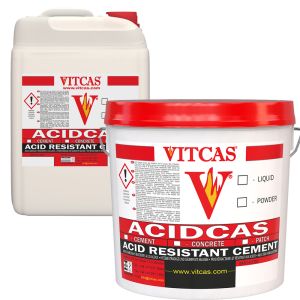 Acid-proof RenderSpecial Price £47.99 £39.99 Regular Price £59.99 £49.99
Vitcas Acidcas Render/Patch is an acid-proof, heat-resistant material designed to withstand temperatures up to 1400°C / 2550°F while offering strong resistance against acid corrosion. It is suitable for a wide range of industrial applications, including the petrochemical, food, and chemical industries, as well as for use in chimneys exposed to acidic gases.
Read more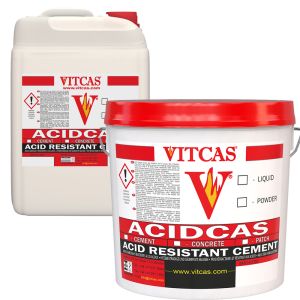 Acid Resistant ConcreteSpecial Price £47.99 £39.99 Regular Price £59.99 £49.99
Vitcas Acidcas Concrete is an acid resistant aggregate/concrete mix. Can be used in many industrial applications such as in petrochemicals and chemical industries, as well as in chimneys which deal with acidic gases and in laying floors which are vulnerable to attack by acids. Rates to 1400°C.
Read more
Choosing the Right Acid-Resistant Refractory System
The performance of an acid-resistant lining depends on selecting the correct material for each part of the installation. Bricks, mortar, render and monolithic concrete perform different functions within the system, so product selection should reflect the required lining geometry, chemical exposure, operating temperature, substrate condition and mechanical duty.
Acid-Resistant Material Selection Guide
| Product | Supplied form | Principal function | Temperature rating |
|---|---|---|---|
| Acidcas M Acid-Proof Cement Mortar | Two-part silicate-based mortar system | Bedding and jointing compatible acid-resistant bricks and tiles | Up to 1400°C |
| Acid-Resistant Bricks | Low-porosity fireclay units | Durable working surfaces for floors, channels, pits, chimneys and selected process linings | Up to 400°C |
| Acidcas R Acid-Proof Render | Two-part render-grade system | Protective acid-resistant layer on suitable prepared masonry and concrete surfaces | Up to 1400°C |
| Acidcas C Acid-Resistant Concrete | Two-part graded monolithic material | Floors, larger surfaces, formed details and compatible monolithic lining sections | Up to 1400°C |
These materials can be used as complementary elements within an engineered acid-resistant system, but each performs a different function. Acidcas M is designed for controlled bedding and jointing, Acidcas R for supported protective layers, Acidcas C for monolithic construction, and acid-resistant bricks for robust unit linings.
What Acid Resistance Means in Practice
VITCAS Acidcas materials are silicate-based systems developed for resistance to a broad range of hot and cold acids. Hydrofluoric acid is excluded, and prolonged exposure to alkaline substances is outside the intended service conditions.
The minimum acid-resistance value is 96% in relation to BS 784 testing. This provides a useful technical indication of material performance, but chemical compatibility should still be assessed against the actual process environment.
Acid resistance is influenced by more than the name or pH of the principal chemical. Concentration, temperature, exposure duration, vapour or condensate formation, salts, oxidising agents, cleaning chemicals and process contaminants can all affect long-term performance.
| Compatibility factor | Information required | Engineering significance |
|---|---|---|
| Chemical identity | Acids, alkalis, salts, solvents, oxidisers, cleaners and process contaminants | Complete chemistry is required to assess the actual exposure |
| Concentration | Normal, minimum and maximum credible concentrations | Corrosion behaviour can change significantly with concentration |
| Temperature | Liquid, vapour, condensate, lining-face and cleaning temperatures | Temperature can accelerate chemical attack and alter condensation behaviour |
| Exposure pattern | Immersion, wash-down, splash, fumes, condensate or occasional spill | Contact time and wet-dry cycling influence severity |
| Mechanical duty | Traffic, impact, abrasion, vibration, thermal cycling and cleaning method | Chemical resistance must be combined with suitable mechanical performance |
Industries & Applications
VITCAS acid-resistant refractory materials are used in chemically demanding industrial environments where a durable protective lining or surface is required:
- Chemical & Petrochemical Processing – vessels, tanks, bunds, channels, floors and splash-exposed process areas handling defined acidic media.
- Power Generation & Acidic-Gas Systems – chimneys, ducts, flue-gas zones, acidic-condensate areas and associated drainage or process surfaces.
- Steel & Aluminium Processing – pickling areas, pits, floors, drains, channels, flues and other zones exposed to compatible corrosive process media.
- Food & Pharmaceutical Processing – selected floors, walls, drains and process areas exposed to compatible acidic ingredients, by-products or cleaning regimes.
- Industrial Floors, Pits & Containment Areas – monolithic or brick-lined surfaces requiring resistance to specified acidic liquids and mechanical service conditions.
- Process Chimneys & Refractory Linings – acid-resistant brick, mortar, render or monolithic systems selected according to gas chemistry, condensate conditions and lining geometry.
Industry type is a useful starting point, but final material selection should be based on the actual chemical and mechanical duty. Food, beverage and pharmaceutical applications may also require separate hygiene, cleanability or sector-specific approval where relevant.
Acid-Resistant Bricks – Durable Unit Linings
VITCAS acid-resistant bricks are low-porosity fireclay units designed to provide a durable working face in chemically aggressive environments. They combine resistance to compatible mineral acids with useful abrasion resistance, making them suitable for installations where a robust replaceable brick lining is preferred.
Typical applications include floors, channels, pits, process areas, chimneys and selected equipment linings.
The bricks have a maximum service temperature of 400°C. Their performance should therefore be considered separately from the higher refractory temperature capability of Acidcas M, R and C.
The nominal brick size is 230 × 114 × 64mm. Project quantities should account for bond pattern, cutting, joint width, detailing and normal installation wastage.
Acidcas M – Acid-Resistant Brick and Tile Mortar
Acidcas M is a specialist two-part silicate-based mortar designed for bedding and jointing compatible acid-resistant bricks and tiles.
Its function is to create chemically resistant joints between individual refractory or acid-resistant units so that the working surface performs as a complete lining rather than as isolated resistant bricks separated by vulnerable conventional mortar.
Joints should be fully filled and maintained within the geometry specified for the installation. Large voids, excessive gaps or major substrate irregularities should be corrected using an appropriate repair or construction method rather than compensated for with excessive mortar thickness.
When Acidcas M is used together with acid-resistant bricks, the complete assembly should respect the operating limits of both materials. The 400°C brick limit remains relevant even though the mortar itself has a higher refractory temperature rating.
Acidcas R – Acid-Resistant Protective Render
Acidcas R is formulated to create a protective acid-resistant layer over compatible prepared masonry or concrete surfaces. It is particularly suited to applications where the existing structure provides support and a continuous chemically resistant working layer is required.
The substrate should be sound, stable and properly prepared. Dust, laitance, oil, salt deposits, unstable coatings and deteriorated material should be removed before application.
Vertical applications require particular attention to layer thickness, support, adhesion and movement. Where required by the installation design, suitable reinforcement or mechanical support should be incorporated to maintain the integrity of the rendered system.
Corners, penetrations, terminations and construction joints should be detailed so that the chemical barrier remains continuous while allowing any necessary structural or thermal movement.
Acidcas C – Acid-Resistant Monolithic Concrete
Acidcas C is a graded acid-resistant material designed for monolithic construction where a larger continuous section is preferable to brick or tile construction.
Typical applications can include acid-exposed floors, channels, pits, bunds, plinths, formed details and compatible process-lining sections.
The graded aggregate structure allows Acidcas C to form thicker monolithic sections than a render or mortar. Installation design should consider thickness, support, joints, falls, drainage, abrasion and anticipated mechanical duty.
The term “concrete” describes the form of the material and should be considered within the context of the specific Acidcas formulation. Structural loading, reinforcement and other engineering properties should be established where these are required by the project design.
Brick, Mortar, Render or Concrete?
| Required function | Material type | Typical use |
|---|---|---|
| Durable replaceable working face | Acid-Resistant Brick | Floors, pits, channels, chimneys and unit-lined process areas |
| Jointing and bedding resistant units | Acidcas M | Filled joints between compatible acid-resistant bricks or tiles |
| Protect an existing supported surface | Acidcas R | Acid-resistant render on suitable masonry or concrete |
| Form a continuous monolithic section | Acidcas C | Floors, pits, channels, bunds and formed lining details |
Matching the material form to the geometry and function of the installation improves lining continuity, installation quality and long-term chemical performance.
Temperature Ratings and Chemical Service
The maximum service temperature of a refractory material and its chemical-resistance capability are separate specification parameters.
Acidcas M, Acidcas R and Acidcas C are rated up to 1400°C as refractory materials. This rating does not mean that every acid or chemical can contact the material at that temperature.
Chemical state, concentration, vapour pressure, condensate formation and corrosion mechanisms all vary with temperature. In flues, chimneys and process vessels, the most severe chemical attack can sometimes occur at cooler locations where acidic vapours condense.
Where acid-resistant bricks are combined with Acidcas M, the brick limit of 400°C remains part of the system specification. Membranes, insulation, anchors, seals, steelwork and other lining components may introduce additional temperature limits.
Chemical Exposure and Process Conditions
For reliable material selection, the complete chemical service envelope should be defined wherever practical.
- Identify all acids and process chemicals present during normal operation.
- Include cleaning chemicals, solvents, alkalis, salts and credible contaminants.
- Define normal and maximum concentrations.
- Establish liquid, vapour and condensate temperatures.
- Determine whether exposure is continuous immersion, splash, wash-down, fumes or intermittent spill.
- Consider concentration changes caused by evaporation or dilution.
- Include thermal cycling and shutdown conditions.
Hydrofluoric acid requires particular attention because it is excluded from the Acidcas range. Fluoride-containing mixtures should also be reviewed carefully where their chemistry could introduce similar compatibility concerns.
Substrate, Joints and Containment
The performance of an acid-resistant lining depends not only on the exposed material but also on joints, interfaces, penetrations and the condition of the supporting structure.
| Detail | Potential issue | Engineering consideration |
|---|---|---|
| Concrete or masonry substrate | Weakness, contamination, moisture or continuing chemical attack | Confirm preparation, surface integrity and moisture condition |
| Movement or construction joint | Cracking or separation under structural movement | Maintain suitable flexible or movement-tolerant detailing |
| Pipe, drain or anchor penetration | Local leak path or difficult chemical seal | Provide compatible termination and inspectable detailing |
| Floor-to-wall junction | Stress concentration and liquid retention | Design suitable radius, falls, drainage and cleaning access |
| Brick or monolithic joint | Voids, incomplete filling or excessive joint width | Control geometry and placement quality |
| Secondary containment | Chemical reaches supporting structure after local damage | Assess need for membrane, drainage, leak detection or secondary barrier |
Chemical resistance and liquid containment should be considered separately. Where leakage could create significant safety, environmental or production consequences, the complete system may require additional membrane, drainage, leak-detection or secondary-containment measures.
Movement and Thermal Stress
Rigid acid-resistant materials perform best when movement is properly managed by the lining and substrate design.
Thermal gradients, structural movement, vibration and differential expansion between dissimilar materials can generate stresses even when each component remains within its individual temperature limit.
Construction joints, expansion details, penetrations and transitions should therefore be designed so that the chemical barrier remains continuous without preventing necessary movement.
Mixing and Placement
Acidcas M, R and C are supplied as matched multi-component systems. Correct component ratio and controlled mixing are important to chemical resistance, setting behaviour and final material performance.
- Keep matched components together and identify the correct liquid for each Acidcas formulation.
- Use controlled mixing ratios according to the applicable product instructions.
- Prepare the substrate by removing weak material, contamination and incompatible residues.
- Plan batch size so the mixed material can be installed within its available working time.
- Control geometry including mortar joints, render thickness, concrete depth, falls and termination details.
- Protect the installed material during curing from premature chemical exposure, water, freezing, traffic, vibration or uncontrolled heating.
Water or other modifiers should only be introduced where specifically permitted by the applicable technical instructions. Altering the designed liquid ratio can change strength, setting and chemical resistance.
Curing and Commissioning
Correct curing is essential before an acid-resistant lining enters chemical or thermal service.
Installed brickwork, mortar, render and concrete should be protected throughout the specified curing period. Temperature, humidity, layer thickness, substrate condition and ventilation can all affect the development of the completed lining.
Where the system will also experience elevated temperature, commissioning should include the appropriate controlled heating procedure. Initial chemical exposure should only begin after the lining has developed the required cured condition.
Engineering & Application Considerations
VITCAS acid-resistant refractory materials are designed for demanding chemical and high-temperature environments. Optimum performance depends on matching the selected material and installation system to the actual service conditions.
- Chemical compatibility should be assessed against the complete process chemistry rather than acid name alone.
- Hydrofluoric acid is excluded from the intended service range.
- Prolonged alkaline exposure is outside the normal Acidcas application conditions.
- Refractory temperature rating and chemical-service temperature should be evaluated separately.
- The complete lining is governed by the relevant limits of its bricks, mortar, render, concrete, joints, substrate and ancillary components.
- Movement, penetrations and interfaces require appropriate detailing to maintain continuity of the chemical barrier.
- Heavy mechanical loading, abrasion or impact should be incorporated into the lining design.
- Containment requirements should be specified independently where leakage presents a significant process, environmental or safety risk.
Inspection and Maintenance
Quality control during installation and regular inspection during service can significantly improve the reliability of an acid-resistant lining.
Useful installation records include component batch numbers, mixing ratios, placement times, ambient conditions, applied dimensions, curing period and photographs of joints or penetrations that will later become inaccessible.
During operation, inspect for:
- Open or deteriorated joints.
- Hairline or progressive cracking.
- Softening or surface loss.
- Blistering or local debonding.
- Staining or damp areas indicating possible leakage.
- Deterioration around drains, corners and penetrations.
- Damage associated with chemical excursions or cleaning cycles.
Local repairs should be based on the identified failure mechanism and the condition of the surrounding lining rather than simply covering visible deterioration.
Why Specify VITCAS Acid-Resistant Materials?
- Specialist refractory and chemical-resistant material technology for demanding industrial environments.
- Acid-resistant brick and monolithic solutions for different lining geometries and installation methods.
- High-temperature Acidcas formulations for applications requiring combined refractory and chemical performance.
- Compatible mortar, render and concrete technologies for building integrated acid-resistant systems.
- Solutions for chemical, petrochemical, metallurgical, power-generation and process industries.
- Engineering-led material selection based on chemistry, temperature, exposure pattern, mechanical duty and lining design.
By combining acid-resistant brickwork with specialist mortar, render and monolithic technologies, VITCAS provides practical materials for engineering durable protective systems in chemically aggressive and high-temperature industrial environments.
Frequently Asked Questions
What are acid-resistant refractory materials?
Acid-resistant refractory materials are bricks, mortars, renders and monolithic materials designed for environments where conventional masonry or cement-based products may be attacked by acidic liquids, vapours or condensates.
What is Acidcas M used for?
Acidcas M is a two-part acid-resistant mortar used for bedding and jointing compatible acid-resistant bricks and tiles.
What is Acidcas R used for?
Acidcas R is an acid-resistant render designed to form a protective layer over suitable prepared masonry or concrete surfaces.
What is Acidcas C used for?
Acidcas C is a graded acid-resistant monolithic material used for applications such as floors, pits, channels, bunds, formed details and compatible lining sections.
Can VITCAS acid-resistant materials be used with hydrofluoric acid?
No. Hydrofluoric acid is excluded from the intended Acidcas service range. Fluoride-containing process chemistry should also be reviewed carefully when selecting the lining system.
Are Acidcas materials suitable for alkaline chemicals?
Acidcas materials are designed primarily for acidic service and are not intended for prolonged alkaline exposure. Cleaning chemicals and temporary pH excursions should therefore be included in the compatibility assessment.
What temperature can Acidcas materials withstand?
Acidcas M, Acidcas R and Acidcas C have refractory temperature ratings up to 1400°C where appropriate to the application. Chemical compatibility at elevated temperature should be assessed separately from the refractory temperature rating.
What temperature are acid-resistant bricks rated to?
VITCAS acid-resistant fireclay bricks have a maximum service temperature of 400°C. When combined with higher-rated Acidcas mortar, the brick temperature limit remains part of the complete lining specification.
Which mortar should be used with acid-resistant bricks?
Acidcas M Acid-Proof Cement Mortar is designed for bedding and jointing compatible acid-resistant bricks and tiles, creating a chemically resistant joint network within the lining.
Can ordinary cement mortar be used between acid-resistant bricks?
A conventional mortar can become the chemically vulnerable part of an otherwise resistant brick lining. The jointing material should therefore be selected to provide chemical compatibility with both the bricks and the intended process exposure.
What is the difference between Acidcas Render and Acidcas Concrete?
Acidcas R is formulated as a protective rendered layer over a suitable supported surface. Acidcas C contains graded aggregate and is designed for thicker monolithic construction such as floors, pits, channels and formed lining sections.
Is Acidcas C ordinary structural concrete?
Acidcas C is a specialist acid-resistant graded material. Where structural loading is part of the design, the required strength, reinforcement, support and section properties should be established for the specific project.
Can Acidcas materials be used on existing concrete?
Suitable existing concrete can provide a substrate where it is structurally sound, chemically compatible and correctly prepared. Weakness, contamination, active chemical attack, moisture, cracks and movement should be assessed before installation.
Can acid-resistant materials be used for industrial floors?
Yes, selected acid-resistant bricks and Acidcas monolithic materials can be used in suitable industrial floor applications. Chemical exposure, traffic, impact, abrasion, drainage, cleaning methods and substrate movement should form part of the floor specification.
Can these materials be used in acidic-gas chimneys?
Yes, acid-resistant brick, mortar, render or monolithic materials can be used in suitable acidic-gas and condensate applications. Gas chemistry, condensate composition, acid dew point, wall temperature, thermal cycling and support conditions should be considered when designing the lining.
Does a 1400°C refractory rating mean the material can be immersed in hot acid at 1400°C?
No. Refractory temperature capability and chemical-service conditions are separate parameters. Acid identity, concentration, physical state, contact duration and actual chemical temperature must also be assessed.
Does an acid-resistant lining automatically provide liquid containment?
Chemical resistance and liquid containment are separate design requirements. Joints, penetrations, movement, cracks and interfaces may require additional detailing, membranes, drainage or secondary containment depending on the consequences of leakage.
Can Acidcas materials be used in food or pharmaceutical facilities?
Selected acid-resistant materials may be suitable for process areas exposed to compatible acidic media or cleaning conditions. Any direct food-contact, hygienic, cleanroom, GMP or other sector-specific requirements should be evaluated separately for the intended installation.
How should an acid-resistant material be selected?
Selection should consider the complete chemical composition, concentration, temperature, exposure pattern, substrate, geometry, movement, abrasion, mechanical loading, containment requirements and commissioning conditions. The most reliable specification is based on the complete service environment rather than temperature or acid name alone.