Fire protection seeks not only to harness the power of fire but also to ensure the safeguarding of lives, property and the continuation of vital services. Oftentimes, new safety legislation is a reaction to a tragedy that exposes existing vulnerabilities, such legislation is colloquially known as 'stable door' legislation. A poignant example of this is the Fire Precautions Act of 1971, introduced after a catastrophic hotel fire in Saffron Walden.
Evolution of Fire Safety Laws
The Regulatory Reform (Fire Safety) Order, which came into force in October 2006, established a new regime based on risk assessment for all non-domestic premises.
Significant changes to the Fire Safety Order came into effect on 1 October 2023 under Section 156 of the Building Safety Act 2022. These amendments require "Responsible Persons" to:
-
Fully record fire risk assessments.
-
Document the identity of the fire assessor.
-
Share fire safety information during transitions in building management.
These updates increase accountability and ensure fire safety knowledge is maintained across ownership changes. Following Scotland's lead, the first Building Regulations for England and Wales came into force in 1965, establishing a uniform regime to replace around 1400 sets of local bye-laws, some dating back to medieval times.
Currently, there are fourteen Approved Documents guiding these regulations. Document B is specifically dedicated to fire safety and is divided into two volumes for dwelling houses and other buildings. This legal framework serves as testimony to the elevated importance of fire resistance in modern construction and contemporary law.
Changes to Approved Document B (2025-2029)
-
Effective from 2 March 2025: Sprinklers will be mandatory in all newly built care homes, regardless of building height.
-
Effective from 30 September 2026: Second staircases will be required in new residential buildings over 18 meters.
-
Effective from 2 September 2029: Complete removal of BS 476 references from UK building regulations.
These changes aim to improve fire suppression, evacuation routes, and material safety classification.
Passive Fire Protection
When constructing or renovating buildings, the laws mandate passive fire protection, emphasising building design and material choice that prevents fire spread. For instance:
-
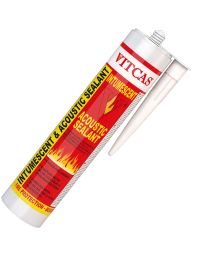
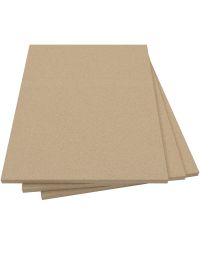
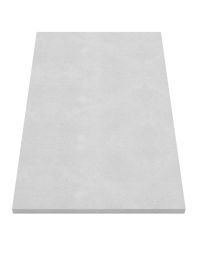
Fire doors: Designed to compartmentalise fires and protect escape routes. High-performance boards, such as Vitcas vermiculite fire boards and calcium silicate (CS) fireplace construction boards, provide excellent fire resistance, dimensional stability, and compliance with Approved Document B. To maintain integrity around the frame, intumescent acoustic sealant is used to seal gaps, expanding under heat to block fire and smoke while also reducing sound transmission.
-
Pipes and Ductwork: To prevent fire and smoke from spreading through service routes, pipes and ductwork are fitted with intumescent grilles, collars, and wraps. Where services penetrate compartment walls and floors, firestop mortar is required to fully reinstate the fire resistance of the barrier, sealing voids and preventing fire and smoke migration through service openings.
-
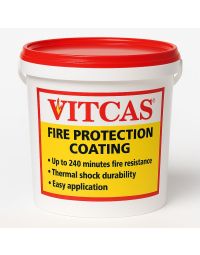
Structural Integrity: Structural elements such as steel girders and columns must retain load-bearing capacity during a fire. This can be achieved through the use of fire protection coatings and fire protection cementitious systems (Vitcas FPC-S). Products such as Vitcas Fire Protection Coating and Vitcas FPC-S are designed to insulate structural steel, delay temperature rise, and maintain stability for critical evacuation and firefighting periods.
-
Escape Routes: Ensuring clear signage, protected corridors and emergency lighting is a fundamental part of ensuring safe evacuation in the event of a fire.
-
Fire Risk Assessment: Responsible Persons must fully document fire risk assessments and record the assessor’s identity for all non-domestic buildings, in force since 1 October 2023.
-
Service Penetrations: Fire-resistant sealants, mastics, and fire mortars are essential for sealing gaps around pipes, cables, and ductwork, preventing the spread of fire and smoke between compartments. This includes the use of certified Vitcas fire-resistant boards, renders, mortars, coatings, and seals, which meet high-performance standards for thermal insulation and fire containment.
Active Fire Protection
While passive measures are critical, active fire protection systems, such as smoke detectors, have seen a surge in adoption, rising from 25% household coverage in 1989 to 86% in 2008. These systems are instrumental in offering early fire detection, allowing occupants more time to evacuate. Furthermore, sprinkler systems, which actively suppress fires, have proven to be the most effective safety measure available. In light of this, from 2 March 2025, all newly built care homes in England must have sprinklers installed, regardless of building height.
Manual Fire Safety Equipment
For immediate action against fires:
-
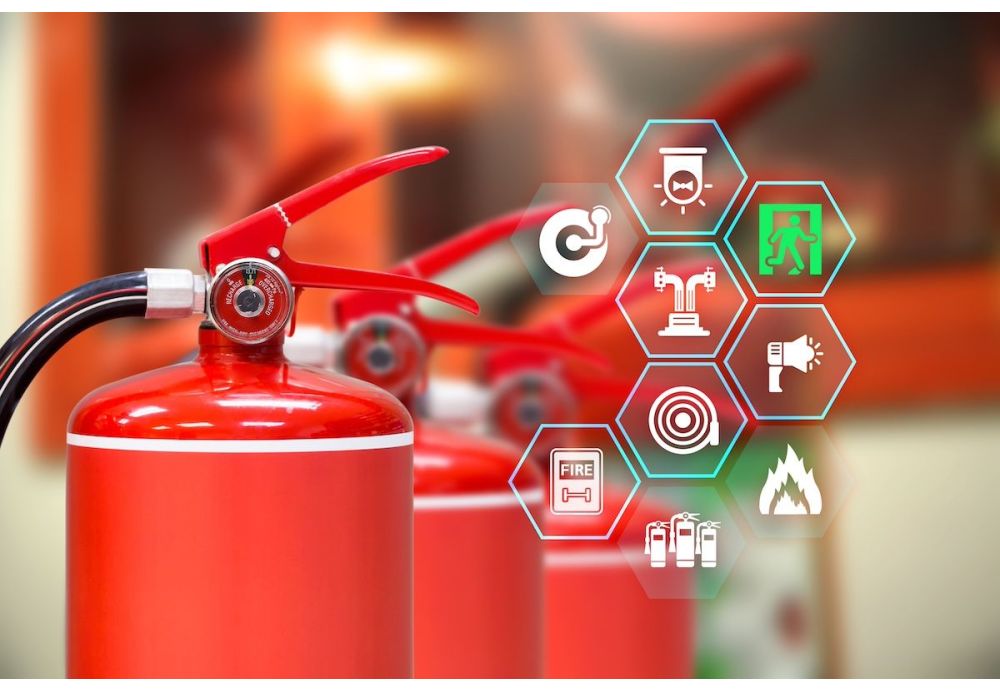
Fire Extinguishers: Depending on the class of the fire, different extinguishers like water, wet chemical, carbon dioxide, dry powder, and foam can be employed.
-
Fire Blankets: Ideal for smothering fires by depriving them of oxygen. They can be life-saving when someone's clothing catches fire.
-
Fire Alarm and Detection Systems: Smoke, heat, and multi-sensor detectors provide early warning of fire, allowing occupants to evacuate before conditions become life-threatening. These systems are designed and installed in accordance with BS 5839 to ensure reliability and coverage.
Positive Outcomes of Fire Protection
The proactive and evolving approach to fire safety in Britain has yielded results. Since the mid-1980s, there's been a marked decrease in fire incidents, fatalities, and injuries, affirming the efficacy of the safety measures in place.
Reliable Fire-Resistant Products
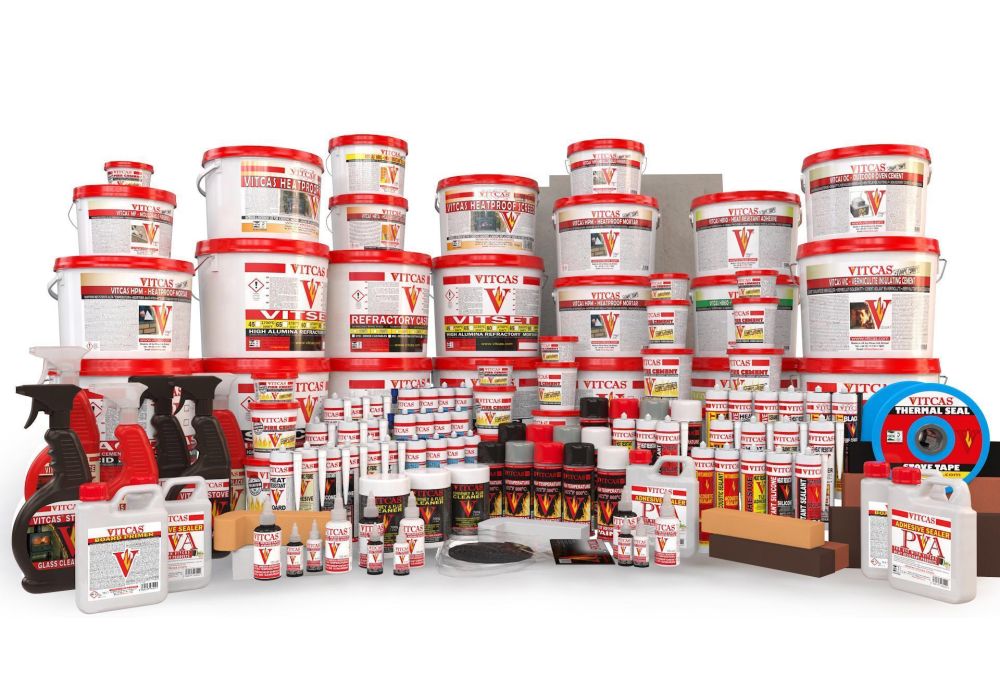
For those in search of products that meet and exceed British fire resistance standards, Vitcas offers a range of products available in our online shop. Understanding the nuances of fire protection, both passive and active, is pivotal in ensuring safety. With comprehensive regulations and advancements in fire-resistant materials, there's a collective stride towards a safer environment.
Understanding the Fire Ratings and Classifications in the UK Construction Industry
When it comes to the construction industry, ensuring fire safety is paramount. Every element of a building, from the foundational materials to the final finishing touch, has a role to play in its overall safety profile.
British Building Regulations and Classifications
In the UK, building regulations are strict, ensuring that every component of a structure adheres to the highest safety standards. UK building regulations have a clear classification system for building materials and their fire performance rating. One of the primary standards referenced in these regulations is the BS EN 13501-1, which phased out the BS 476 fire classification system.
Fire Performance Rating
The building materials undergo stringent tests for fire resistance, known as fire tests. Depending on their fire performance, materials receive a fire rating which classifies them based on their contribution to fire growth, propagation of fire and smoke emission. Fire testing is essential to ensure that construction materials meet safety standards and can withstand high temperatures without contributing to the spread of fire.
Class 0, Class 1 and Euroclass Ratings
Class 0 and Class 1 are terms that frequently appeared in the British construction lexicon. These classifications, especially Class 0, denote materials that have a high fire rating i.e. the lowest flame spread and limited combustibility. This classification relates to the materials' fire performance, whereby materials receive a fire rating based on their contribution to fire growth.
For a long time, there existed a dual specification system which required having to pass British standard tests under BS 476, as well as the European "Euroclass" specification standards under BS EN 13501. However, the British standard tests, which include the Class 0 and Class 1 ratings, are being phased out on 2 March 2025 and the Euroclass classifications (A1, A2, B, etc.) under EN 13501-1 will become the sole specification within Approved Document B of the UK Building Regulations.
The Euroclass system offers a comprehensive fire classification, from the safest (non-combustible) to the least safe (E or F rated products). Therefore, an F rating would depict lowest performance in situations involving fires.
The Euroclass system, specifically under BS EN 13501-1, classifies materials based on their fire performance. Class A1 and A2 represent non combustible materials and Class B denotes materials with limited contribution to fires. Whilst materials that are categorised as Class C are typically considered to have a medium contribution to fires.
Non-combustible materials are obviously the safest in fires, but fire resistant materials are also designed to withstand high temperatures and prevent flame spread for a certain period of time. They may still burn or degrade under extreme heat which surpasses their temperature resistance but they are engineered to resist fire for a specific duration, allowing more time for evacuation or firefighting efforts.
Smoke Emission and Materials
Smoke emission is a critical factor in fire safety. Materials that release significant amounts of smoke when burning can exacerbate the danger in a fire situation. Therefore, materials are also subjected to smoke emission classifications. For instance, certain flooring materials might be tested for smoke release and flaming droplet particles. If the material emits excessive flaming droplets, it might receive a D2 flaming droplet classification, indicating a higher risk.
Fire Propagation and Thermal Insulation
A fire propagation test determines how quickly and extensively fire spreads across the surface of a material. Materials with high thermal insulation, for instance, may slow down fire spread, making them more desirable in construction.
Euroclass System and Powder Coating
As previously mentioned, there also exists a European standard, known as the Euroclass rating system, which has an intricate scale that measures everything from heat levels to the production of flaming droplets' particles. Powder coating, often used for its aesthetic appeal, undergoes these tests to ensure it doesn't compromise safety. A high Euroclass rating on a powder-coated material would mean it contributes minimally to fire and smoke.
Conclusion
Before embarking on your next project, understanding the fire ratings and fire regulations is essential. The use of fire proof and non-combustible construction products with a high Euroclass fire rating or Class 0 rating can make buildings safer. Beyond adhering to British standard tests, ensuring that building elements, from natural stone to advanced construction products, offer limited contribution to fire and smoke is of paramount importance. Always consult the British and Euroclass system when choosing materials to ensure the highest level of safety.
For a comprehensive list of British and European standards and classifications, consult the official BS and EN directories