We offer a wide range of high-quality products supplied directly by the manufacturer.
Fast shipping – dispatch even within 24 hours
Tooltip
Orders placed by 12:00 (with correct details and product availability) are usually dispatched on the same business day. Deliveries are carried out in cooperation with reputable external courier companies. The delivery time depends on the selected carrier as well as the size and weight of the shipment — whether courier or pallet freight.
UK warehouse dispatch – Worldwide shipping
Tooltip
Quick dispatch from our UK warehouse with international shipping available.
Secure payments – Visa, Mastercard, AmEx, PayPal, Apple Pay & Google Pay
Tooltip
All transactions are encrypted and secure. We accept payments via Visa, Mastercard, American Express, PayPal, Apple Pay and Google Pay.
14-day returns guarantee
Tooltip
If you change your mind after receiving your order, you have 14 days to return the goods. Please contact us to request a returns form.
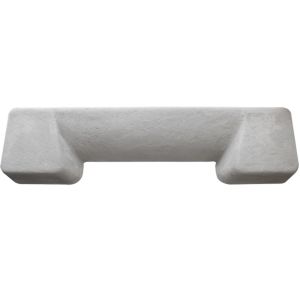
Vitcas Heat Resistant Concrete Fireback is a single-piece refractory fireback designed for traditional open fireplaces. Made from durable, heat-resistant material, it offers excellent wall protection and conforms to BS 1251: 1987 standards. Best used with throat forming lintels for improved efficiency and safety in open fireplaces.
Front width: internal 15.5 inches (39.5cm), external 19 inches (48.5cm)
Overall height:22.25 inches (56.5cm)
Overall depth: 8.5 inches (21.6cm)
Size 18 inches nominal:
Front width: internal 17.5 inches (44.5cm), external 22 inches (56cm)
Overall height: 22.25 inches (56.5cm)
Overall depth: 8.5 inches (21.6cm)
Installation Instructions for Vitcas 16" / 18" Firebacks and Lintels
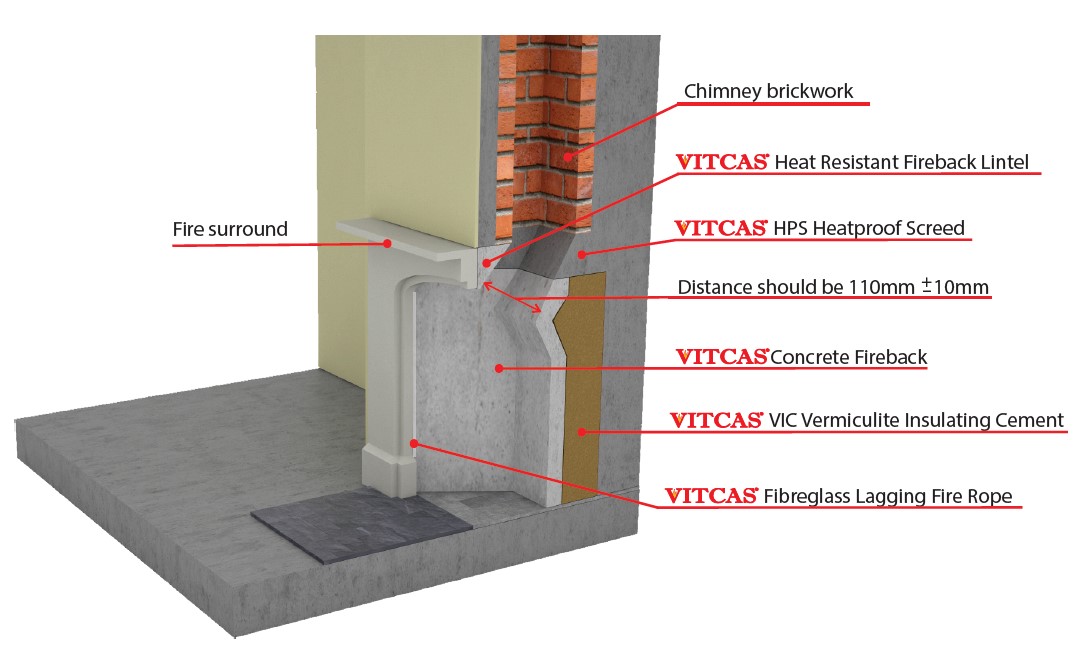
The fireback should be placed in position with the lintel so that the distance between the fireback and lintel at the throat is 110mm +- 10mm. This is important for the air flow into the chimney.
The position should allow for expansion and contraction of the fireback at high temperatures particularly at the back and sides.
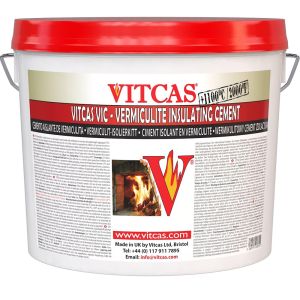
Corrugated cardboard should be placed around the back of the fireback in order to create an expansion gap. Then the space behind should be filled with Vitcas Vermiculite Insulating Cement.
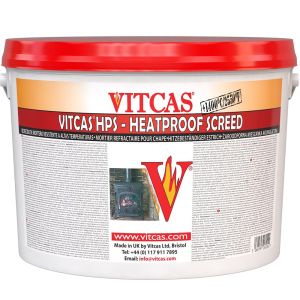
The space between the top of the fireback and the back of the chimney should be flaunched with Vitcas Heatproof Screed.
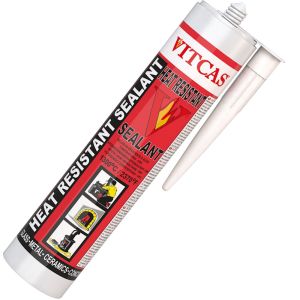
Any gap between the front of the fireback and the fire surround should be filled with a suitable lagging rope then covered with Vitcas Heat Resistant Sealant. This is important to avoid combustion gases escaping around the sides of the fire surround.
Firebacks should be stored undercover prior to installation and if they are taken from open storage the fire should not be used for 3 days after installation.
To prevent cracking it is important that the first firing should take the temperature up slowly. Initially a small fire should be lit of relatively short duration and only slowly built up to higher temperatures.
Please provide me with the internal dimensions of the fireback to enable me to purchase a fire grate and ash pan to suit.
We supply two types of Concrete Fireback. One comes in 16 inches and its internal dimensions are 15.5 inches for the front width. The second fireback comes in 18 inches and its internal dimensions are 17.5 inches.
Please, mind that only logged in users can submit questions
Is this fireback suitable for a traditional open fireplace?
Answer
The VITCAS Heat Resistant Concrete Fireback is specifically designed for traditional open fireplaces. Its single-piece refractory construction protects the wall behind the fire from high temperatures. It is intended to be installed with suitable fireplace components, including a throat-forming lintel, rather than used as a general-purpose lining for stoves or other heating appliances.
Question
Which fireback size should I choose for my fireplace?
Answer
Choose between the 16-inch and 18-inch nominal sizes by checking the available fireplace space and the required internal front width. The 16-inch version has an internal front width of 39.5cm, while the 18-inch version measures 44.5cm internally. Check the full external width, height and depth before ordering to ensure the fireback and associated grate will fit correctly.
Question
Why should the fireback be used with a throat-forming lintel?
Answer
A throat-forming lintel helps create the correct fireplace throat and supports effective airflow into the chimney. During installation, the distance between the fireback and lintel at the throat should be 110mm ± 10mm. Maintaining this spacing is important for the fireplace to draw correctly, so the dimensions should be checked carefully before the components are fixed in position.
Question
How should expansion around the fireback be accommodated?
Answer
The fireback must not be installed rigidly against the surrounding structure because it expands and contracts at high temperatures. Expansion space is particularly important at the back and sides. VITCAS advises placing corrugated cardboard around the rear to form an expansion gap, then filling the space behind it with VITCAS VIC Vermiculite Insulating Cement.
Question
What materials are needed above and behind the fireback?
Answer
VITCAS VIC Vermiculite Insulating Cement is used to fill the prepared space behind the fireback while preserving the required expansion arrangement. The space between the top of the fireback and the rear of the chimney should be flaunched with VITCAS HPS Heatproof Screed. Using the specified heat-resistant materials helps create a properly supported installation without restricting thermal movement.
Question
How should gaps beside the fireplace surround be sealed?
Answer
Any gap between the front of the fireback and the fire surround should first be filled with a suitable lagging rope and then covered with Vitcas HRS Heat Resistant Sealant. This closes the joint while using materials intended for elevated temperatures. Sealing this area correctly is important because open gaps could allow combustion gases to escape around the sides of the surround.
Question
How should the fireplace be used after installation?
Answer
The first firing should raise the temperature gradually to reduce the risk of cracking. Begin with a small fire of relatively short duration, then increase the heat slowly over subsequent use. Firebacks should be stored undercover before installation. When a fireback has been taken from open storage, the fire must not be used for three days after installation.