We offer a wide range of high-quality products supplied directly by the manufacturer.
Fast shipping – dispatch even within 24 hours
Tooltip
Orders placed by 12:00 (with correct details and product availability) are usually dispatched on the same business day. Deliveries are carried out in cooperation with reputable external courier companies. The delivery time depends on the selected carrier as well as the size and weight of the shipment — whether courier or pallet freight.
UK warehouse dispatch – Worldwide shipping
Tooltip
Quick dispatch from our UK warehouse with international shipping available.
Secure payments – Visa, Mastercard, AmEx, PayPal, Apple Pay & Google Pay
Tooltip
All transactions are encrypted and secure. We accept payments via Visa, Mastercard, American Express, PayPal, Apple Pay and Google Pay.
14-day returns guarantee
Tooltip
If you change your mind after receiving your order, you have 14 days to return the goods. Please contact us to request a returns form.
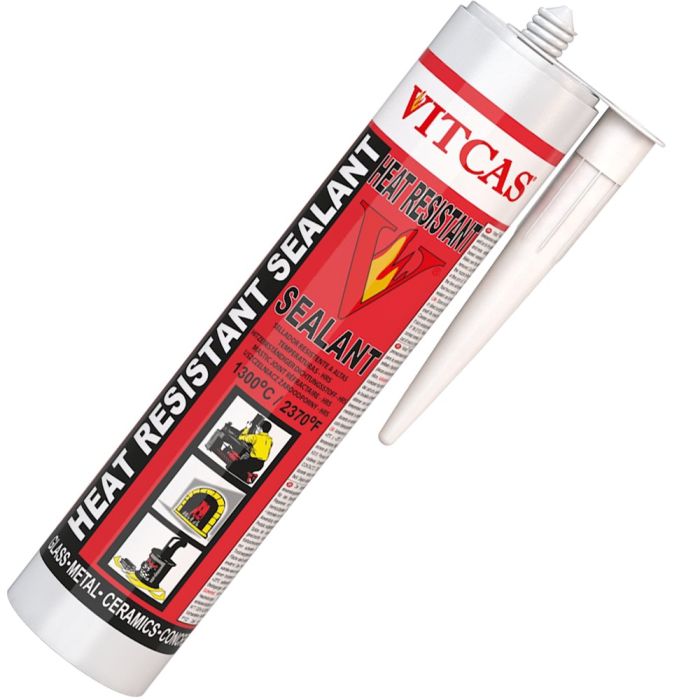
High-temperature sealant with enhanced fire protection up to 1300°C
VITCAS HRS Heat Resistant Sealant is a high-performance sealing compound engineered to maintain bond strength under extreme thermal conditions. Formulated as a caulking-grade paste, it provides reliable sealing and jointing for ceramics, metals, silica-based materials and glass. With a temperature resistance of up to 1300°C / 2370°F, it ensures long-term stability and effective fire protection in both industrial and domestic applications.
Key Characteristics
High-temperature resistance up to 1300°C / 2370°F, suitable for continuous use in extreme thermal environments.
Caulking-grade paste formulation enabling accurate and controlled application.
Forms a robust, durable bond on a wide range of refractory and high-temperature substrates.
Excellent resistance to thermal cycling and thermal shock, preventing cracking or failure during repeated heating.
Easy to apply and finish, requiring minimal surface preparation.
Long-lasting performance, maintaining mechanical integrity under demanding operating conditions.
Compatible with ceramics, metals, silica-based materials and glass, ensuring broad industrial versatility.
Provides effective fire protection, contributing to safety in high-risk installations.
Fire safety certified according to EN 45545-2:2020, meeting requirement sets R22 and R23 for hazard levels HL1, HL2 and HL3.
Uses
Metal-to-metal sealing: Ideal for joints exposed to extreme thermal expansion and contraction.
Glass bonding: Maintains a stable bond on glass components subjected to high temperatures.
Ceramic and pottery repairs: Suitable for filling cracks or chips prior to refiring or glazing.
Sealing silica-based materials: Effective for firebricks, refractory tiles, and other siliceous substrates.
General industrial and domestic high-temperature use: Fireplaces, stoves, kilns, furnaces, ovens, and thermal processing equipment.
Industry Applications
Railway and rolling stock manufacturing – Fully compliant with EN 45545-2 R22/R23 (HL1–HL3), suitable for sealing and fire protection in train interiors, engine compartments, HVAC housings, and electrical enclosures.
Public transport systems – For use in trams, metros, and light-rail vehicles requiring low-smoke, low-toxicity materials.
Railway infrastructure – Fire-resistant sealing of signalling cabinets, trackside housings, cable ducts, and safety-critical electrical systems.
Aerospace and defence support equipment – For ground-support and maintenance systems where rail-grade fire certification is advantageous.
Industrial enclosures and electrical installations – Suitable for switchgear, power modules, control panels, and thermal housings requiring certified fire-safety materials.
High-risk industrial facilities – Furnaces, process equipment, energy plants, and heat-treatment systems requiring validated fire-performance sealing.
Marine and offshore auxiliary zones – For exhaust housings, machinery rooms and non-structural sealing where low smoke and flame-spread properties are desirable.
HVAC systems in transport and public buildings – High-temperature joints where flame retardancy must meet transport-grade standards.
Instructions
Ensure the surface is clean and free from dust, rust, grease and contaminants.
Cut the cartridge tip, attach the nozzle, and trim it to the desired bead size.
Apply using a cartridge gun, aiming for a joint thickness of 2–3 mm.
The sealant sets at room temperature; curing is accelerated by gradually applying heat for approximately four hours.
Once cured, the sealant can be sanded and over-painted.
How thick should the heat resistant sealant joint be?
Answer
Apply the sealant at a joint thickness of 2–3 mm. Trim the cartridge nozzle to produce the required bead and apply the paste steadily with a standard cartridge gun. Fill the joint evenly without leaving gaps or applying a layer thicker than necessary.
Question
How does the VITCAS HRS sealant cope with repeated heating and cooling?
Answer
The VITCAS HRS sealant is resistant to thermal cycling and thermal shock, helping it cope with repeated temperature changes. It is suitable for metal-to-metal joints affected by thermal expansion and contraction, provided the surfaces are compatible, properly prepared and used within the maximum service temperature of 1300°C.
Question
Why might the HRS sealant fail to bond properly?
Answer
Dust, rust, grease and other contaminants can prevent the sealant from bonding effectively. Remove loose material and clean the joint thoroughly before application. The sealant bonds to compatible ceramics, metals, glass and silica-based materials, but it must be applied directly to a clean, stable surface.
Question
Does the heat resistant sealant need heat to cure?
Answer
The HRS sealant sets at room temperature, so heat is not required for the initial setting process. Allow it to dry for 4–5 hours at +20°C, then apply heat gradually and maintain a temperature above +100°C for 12 hours to complete the curing process. Follow the application instructions carefully and do not bring the installation into normal use until curing is complete.
Question
Can the cured sealant be sanded and painted?
Answer
Yes. Once fully cured, the sealant can be sanded and painted where a smoother or less visible finish is required. Do not sand or decorate the material while it is still setting. Complete the curing process first, then prepare the cured surface carefully before applying a suitable finish.
Question
Can VITCAS HRS sealant repair a broken gas fire matrix?
Answer
VITCAS HRS Heat Resistant Sealant can be used to attempt repairs to broken gas fire radiants or matrix elements when a suitable replacement is unavailable. Thoroughly soak the parts in water, join them with the sealant and remove any excess without disturbing the assembly. Heat the repaired component in an oven at approximately 100°C for 3–4 hours, then allow it to cool. A successful repair is not guaranteed, and the repaired area will not glow red like the original material.
Question
Can the HRS sealant fill cracks or chips in ceramic items?
Answer
The VITCAS HRS heat resistant sealant can be used to fill cracks and chips in compatible ceramic and pottery items before refiring or glazing. Remove all dust and loose fragments before applying the HRS sealant to the solid ceramic surface underneath. Suitability will depend on the item, repair location and subsequent firing conditions.
Question
Does VITCAS HRS Heat Resistant Sealant have fire safety certification?
Answer
Yes. VITCAS HRS Heat Resistant Sealant is certified to EN 45545-2:2020 and meets requirement sets R22 and R23 for hazard levels HL1, HL2 and HL3. This certification supports its use in relevant railway and rolling-stock applications.