
Insulation Jackets & Flue Wraps
Insulation Jackets & Flue Wraps for High-Temperature Thermal Protection
VITCAS supplies flexible high-temperature insulation products for chimney flues, liners, pipework, ducts and other heat-exposed equipment where reducing unwanted heat transfer is important. Solutions include glass fibre flue wraps, aluminium-faced insulation and higher-temperature bio-soluble fibre blankets for domestic, commercial and industrial thermal applications.
Glass fibre flue wraps provide flexible insulation for compatible chimney and flue systems, with the underlying glass fibre rated up to 550°C. Aluminium-faced versions add a reflective and vapour-resistant outer surface, while the aluminium layer has a lower temperature capability than the insulation beneath it. For more demanding duties, bio-soluble fibre blanket provides low-mass insulation rated up to 1200°C.
Correct selection depends on the actual temperature at the insulation layer, required thickness, flue or equipment geometry, moisture exposure and the fixing or containment method. Insulating a suitable flue can help retain flue-gas temperature and reduce conditions that contribute to condensation and tar formation, while insulation around other equipment can reduce unnecessary heat loss and help control surrounding surface temperatures when used as part of a correctly designed system.
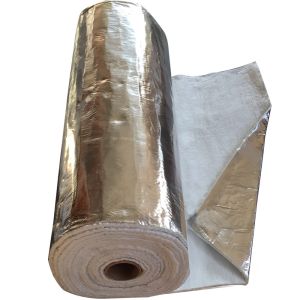 Aluminium Coated Insulation - Flue Wrap 12mm x 1mSpecial Price £166.80 £139.00 Regular Price £300.00 £250.00
Vitcas Aluminium Coated Insulation Flue Wrap provides high-performance thermal insulation for flues and liners in stove chimneys, enhancing efficiency and safety by minimising heat loss, condensation, and the risk of chimney fires.
Read more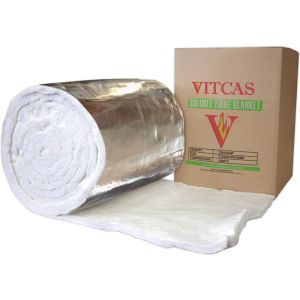 Bio Insulation Blanket with Aluminium Foil£94.80 £79.00 Regular Price £106.80 £89.00
Bio Insulation Blanket with Aluminium Foil is a high-performance thermal insulation solution resistant up to 1200°C (2190°F). Made from bio-soluble fibres, it offers excellent thermal resistance while being eco-friendly and safe. The aluminium foil layer boosts insulation by reflecting radiant heat, making it ideal for high-temperature applications and thermal processing equipment.
Read more Flue Insulation WrapSpecial Price £59.99 £49.99 Regular Price £96.00 £80.00
Vitcas Flue Insulation Wrap Jacket is made from e-glass which is safe for the environment. The insulation wrap can withstand temperatures reaching 550°C /1020°F and has a very low thermal conductivity. The wrap is used inside chimney flues for insulation and to prevent chimney fires and reduce tar, etc.
Read more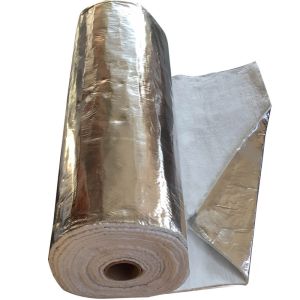 Aluminium Coated Insulation - Flue Wrap 12mm x 1m -per MetreSpecial Price £24.00 £20.00 Regular Price £30.00 £25.00
Flue Chimney Wrap Insulation Blanket suitable for insulating flues and flue liners inside the chimney. Aluminium Coated Glass Fibre Insulating Mat will reduce risk of condensation, tar formation, as well as chimney fires and hence elongate the life of your flue liner and maximise its performance.
Read more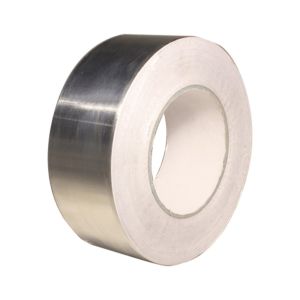 Aluminium Foil TapeSpecial Price £5.99 £4.99 Regular Price £7.19 £5.99
Aluminium Foil Tape with self-adhesive backing is perfect for applications which require thermal and electrical conductivity such as in pipe lagging, central heating systems and ventilation.
Read more
Selecting Insulation Jackets, Flue Wraps & Flexible Thermal Insulation
Flexible insulation jackets, flue wraps and high-temperature blankets are used where rigid insulation is difficult to install or where the material must conform to cylindrical, curved or irregular surfaces. VITCAS solutions cover applications ranging from stove flues and chimney liners to pipework, ducts, furnaces, kilns, turbines and other thermal-processing equipment.
The products use different fibre and facing constructions, so they should not be selected by headline temperature alone. Glass fibre flue insulation provides practical thermal protection up to 550°C, while bio-soluble fibre blanket extends the available insulation duty up to 1200°C. Where aluminium foil is used as a facing, its temperature capability must be considered separately from that of the underlying insulation.
Key Technical Characteristics of Flexible Thermal Insulation
- High-temperature insulation: E-glass flue wraps provide thermal insulation up to 550°C, while bio-soluble fibre blanket is available for more severe thermal duties up to 1200°C.
- Reduced heat transfer: low-conductivity fibrous insulation helps limit unwanted heat loss through flues, pipework, ducts and equipment casings when the correct material and thickness are used.
- Flexible construction: blankets and wraps can conform to round, curved and irregular geometries that would be more difficult to insulate with rigid boards.
- Low thermal mass: lightweight fibre insulation stores relatively little heat, making it suitable for equipment where reduced heat storage and responsive heating or cooling are desirable.
- Reflective facing: aluminium-faced products provide a reflective outer surface and can also act as a vapour-resistant facing, but the aluminium layer may have a lower temperature limit than the insulation beneath it.
- Practical fabrication: flexible products can be cut, wrapped and fitted around compatible equipment. Abrasion resistance, moisture resistance, removability and long-term durability depend on the complete fibre, facing, fixing and protective construction.
Glass Fibre Flue Wrap vs Bio-Soluble Insulation Blanket
| Insulation Type | Published Temperature Capability | Typical Function | Important Selection Point |
|---|---|---|---|
| Aluminium-Coated Glass Fibre Flue Wrap | Glass fibre: up to 550°C Aluminium facing: best suited up to approximately 300°C |
Flues, chimney liners, pipes, ducts and reflective thermal insulation | Above the facing limit, position the glass fibre towards the hotter surface and the aluminium face away from the heat source |
| E-Glass Flue Insulation Wrap | Up to 550°C | Flexible insulation around compatible flues and chimney liners | Confirm flue diameter, installation geometry and compatibility with the chimney system |
| Bio-Soluble Insulation Blanket with Aluminium Foil | Blanket rated up to 1200°C | Higher-temperature insulation for furnaces, kilns, turbines, pipework, exhausts and thermal-processing equipment | Consider the blanket and its facing as separate layers when assessing temperature exposure |
Flue & Chimney Insulation
Flue insulation is one of the principal applications for flexible glass fibre wraps. Insulating a compatible flue or chimney liner helps reduce heat loss from the flue gases as they travel through the chimney.
Keeping the liner warmer can reduce the conditions that encourage condensation and tar formation and can support more stable chimney draught. This is particularly relevant where flue gases would otherwise cool rapidly as they pass through colder chimney spaces.
Flue wrap should not be used to compensate for an unsuitable chimney design, defective liner or inadequate clearance from combustible materials. The insulation must be compatible with the flue system, and required access for inspection, cleaning and maintenance should be maintained.
Glass Fibre and Aluminium Facing Have Different Temperature Limits
With VITCAS Aluminium-Coated Insulation Flue Wrap, the glass fibre layer is suitable for continuous temperatures up to 550°C, while the aluminium foil facing is best suited to temperatures up to approximately 300°C.
These values apply to different parts of the same product. The 550°C rating of the glass fibre should therefore not be interpreted as a 550°C direct-exposure rating for the aluminium surface. Where temperatures exceed the facing limit, the glass fibre side should face the hotter surface and the aluminium side should be orientated away from the direct heat source.
Pipework, Ducts & Thermal Equipment
Flexible insulation can be wrapped around compatible hot pipes, steam lines, ducts and other thermal equipment where reducing heat transfer is required. The ability of fibre insulation to conform to curved surfaces helps reduce the number of joints that may be required with rigid insulation products.
The correct thickness depends on operating temperature, pipe or duct diameter, ambient conditions and the required thermal result. Where accessible surface temperature is important, it should be assessed from the complete insulation construction rather than assumed from the blanket temperature rating.
Furnaces, Kilns & High-Temperature Process Equipment
VITCAS Bio-Soluble Insulation Blanket with Aluminium Foil provides higher-temperature flexible insulation for applications up to 1200°C. Typical uses include furnaces, kilns and other thermal-processing equipment where low thermal conductivity, low heat storage and flexibility are required.
Flexible fibre blanket may be used as primary insulation in suitable protected positions or as a backup layer within a multi-material refractory system. It should not automatically be treated as a mechanically durable hot face where abrasion, impact, high gas velocity or direct process contact is severe.
Boilers, Steam Systems & Power Generation
Bio-soluble fibre blanket can be used for compatible boiler, steam-system and turbine insulation where the operating temperature is within the material's published capability. Flexible insulation is useful around equipment with curved or complex geometries and can help reduce unwanted thermal losses from hot surfaces.
For industrial insulation systems, temperature is only one design variable. Mechanical retention, vibration, access requirements, weather exposure and the design of the outer protective layer can all affect long-term performance.
Petrochemical & Process Industry Insulation
High-temperature fibre blankets are also used around suitable reactors, pipework and process equipment in petrochemical and other thermal-processing environments.
Process compatibility must be considered separately from temperature capability. Oils, chemicals, vapours, pressure conditions and contamination can affect facings, adhesives, fixings and other components even where the fibre insulation itself remains within its thermal limit.
Automotive, Marine & Exhaust Applications
Flexible high-temperature fibre insulation can be used in compatible exhaust systems, heat shields and engine-related thermal barriers in automotive, aerospace, industrial and marine applications.
These applications may combine high temperature with vibration, restricted installation space, air movement, oil contamination and repeated thermal cycling. The insulation therefore needs suitable containment or facing where exposed to demanding mechanical conditions.
Use in Low-Temperature & Cryogenic Insulation
Fibrous insulation materials can also be used in selected low-temperature and cryogenic systems where limiting heat ingress is required. Suitability depends on the specific insulation material, moisture and vapour control, facing construction, operating temperature and the design of the complete system. Products in this category should therefore only be specified for cryogenic duty where their individual properties and installation requirements are compatible with the application.
Temperature Rating Does Not Define the Complete Insulation System
The published temperature of an insulation fibre describes the thermal capability of that material under its stated conditions. It does not automatically apply to every facing, tape, adhesive, fixing or adjacent component used in the installation.
When specifying flexible high-temperature insulation, consider:
- normal operating temperature at the insulation position;
- short-duration temperature peaks and thermal cycling;
- temperature capability of the fibre and facing separately;
- required insulation thickness;
- thermal conductivity at the relevant mean temperature;
- flue, pipe or equipment diameter and geometry;
- moisture, weather and chemical exposure;
- abrasion, vibration and mechanical damage;
- fixing, wrapping or containment method;
- access required for inspection and maintenance.
A blanket rated to 1200°C does not mean that the external face of an insulated component will remain at a particular safe temperature. Cold-face temperature depends on insulation thickness, thermal conductivity, hot-face temperature, ambient conditions, thermal bridges and the complete construction.
Reducing Heat Loss with Flexible Insulation
Correctly specified insulation reduces heat transfer between hot equipment and its surroundings. This can reduce unnecessary energy loss and support more efficient operation, particularly on systems that remain hot for long periods.
The actual energy saving cannot be determined from temperature rating alone. Surface area, operating temperature, insulation thickness, thermal conductivity, operating hours and ambient conditions all influence the thermal and economic result.
Flexible Insulation vs Removable Insulation Jackets
A flexible insulation blanket or flue wrap is not automatically a finished removable insulation jacket. Removable jackets for valves, flanges, turbines and process equipment are fabricated systems that may combine an internal insulation layer with an outer technical fabric, stitching, closures and mechanical fixings.
Where a removable cover is required, every part of the assembly should be suitable for the temperature, mechanical load and environmental exposure. The outer fabric, sewing thread, fasteners and closures can have different limits from the insulation enclosed within the jacket.
Frequently Asked Questions
What temperature can VITCAS flue wrap withstand?
The glass fibre insulation in the aluminium-coated flue wrap is rated up to 550°C. The aluminium facing has a separate lower limit and is best suited to temperatures up to approximately 300°C.
Which side of aluminium flue wrap should face the heat?
Where temperatures exceed approximately 300°C, the glass fibre side should be positioned towards the hotter surface and the aluminium-facing side away from direct high-temperature exposure.
Why insulate a chimney flue or liner?
Flue insulation reduces heat loss from the flue gases and helps the liner remain warmer. This can reduce conditions that contribute to condensation and tar formation and can support more stable chimney draught.
Can flue wrap reduce the required clearance to combustible materials?
Not automatically. An insulation wrap should not be used to justify a reduction in the clearance specified for the appliance or chimney system unless the complete installation has been designed and approved for that arrangement.
What is the highest-temperature flexible insulation in this group?
VITCAS bio-soluble fibre blanket provides insulation for compatible applications up to 1200°C. It is suited to higher-temperature thermal-processing equipment where standard E-glass insulation would exceed its temperature capability.
Can insulation jackets prevent burns from hot equipment?
Insulation can reduce heat transfer and may reduce accessible surface temperatures when correctly designed, but the external temperature depends on the complete insulation system. A material temperature rating by itself does not establish a safe-touch temperature.
Can these materials be used around pipes and ducts?
Yes, selected flexible fibre insulation products can be used around compatible hot pipework, ducts and thermal equipment. Select the material according to temperature, diameter, insulation thickness, environmental exposure and fixing method.
Are flexible insulation blankets reusable?
Some fabricated insulation covers are designed to be removable and reusable, but a blanket or flue wrap should not automatically be treated as a reusable jacket. Reusability depends on the complete construction, fixing system, condition of the fibre and facing, and the maintenance procedure.
Is a 1200°C blanket suitable for every furnace or kiln?
No. Temperature capability is only one selection criterion. Mechanical exposure, gas velocity, abrasion, lining position, thickness, containment and process atmosphere must also be considered before specifying fibre insulation.