
Heat Resistant Tile Adhesive & Tile Grout
Heat-Resistant Tile Adhesive and Grout for Fireplaces, Stoves and Cookers
A durable tiled finish around fireplaces, stoves, range cookers and other heat-exposed indoor surfaces requires an adhesive and grout system matched to the substrate, tile type and operating temperature. VITCAS Heat Resistant Tile Adhesive is supplied ready mixed, rated to 1000°C and applied in a maximum 3mm finished bed, while Heat Resistant Tile Grout fills the joints after the adhesive has set completely.
The system is suitable for compatible ceramic, porcelain, terracotta, quarry and mosaic tiles, together with selected natural stone such as marble, granite and slate. Porous substrates and absorbent tile backs should be prepared with VITCAS PVA Adhesive Sealer, while heavier tiles and stone require suitable physical support during fixing and curing.
Selection should consider substrate stability, tile weight and porosity, joint design, expected surface temperature and appliance clearances. The 1000°C rating applies to the heat-resistant adhesive and grout and does not make the complete tiled construction suitable for direct flame, an unstable substrate or applications outside the specified installation conditions.
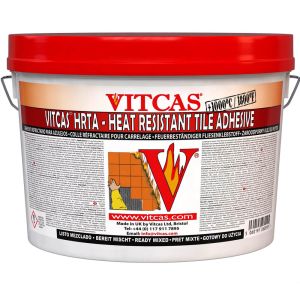 HRTA - Heat Resistant Tile Adhesive 1000ºC 5kgSpecial Price £23.99 £19.99 Regular Price £43.19 £35.99
Vitcas Heat Resistant Tile Adhesive, a ready-to-use tile cement, specially engineered for high-temperature conditions. This adhesive guarantees exceptional long-term tile retention where traditional tile cements falter. Featuring excellent bonding properties and a heat resistance rated up to 1000ºC, this ensures an easy and reliable solution for all your high-temperature tiling needs.
Read more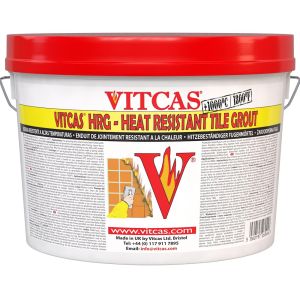 HRG - Heat Resistant Grout£23.99 £19.99 Regular Price £35.99 £29.99
VITCAS Heat Resistant Tile Grout. For grouting tiles which have been fixed with VITCAS Heat Resistant Tile Adhesive. Resistant to 1000°C. The tile grout fills in the gaps around tiles in a high temperature setting such as a fireplace, a tiled stove, or on the back wall of a range cooker.
Read more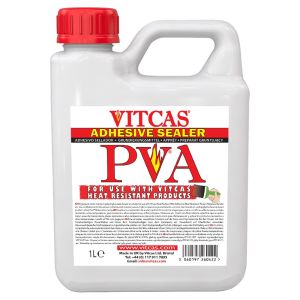 PVA - Adhesive SealerSpecial Price £9.59 £7.99 Regular Price £14.39 £11.99
VITCAS PVA Adhesive Sealer is a high-viscosity, water-resistant, rapid-drying emulsion primer designed for use in conjunction with VITCAS Heat Resistant Products. It is ideal for application on fireboards, tiles, and other porous surfaces.
Read more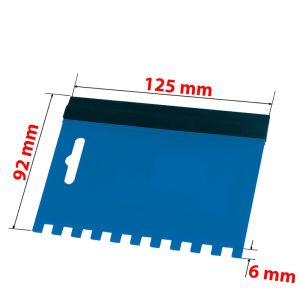 VITCAS Adhesive & Grout SpreaderSpecial Price £2.39 £1.99 Regular Price £4.79 £3.99
VITCAS Adhesive and Grout Spreader is designed for spreading Heat Resistant Tile Adhesive, levelling, and finishing. It can also be used with products requiring a 3mm bed, such as Board Adhesive and Heatproof Mortar. Features a 6mm notched side for spreading adhesives and a rubber strip for precise grouting.
Read more
Selecting a Heat-Resistant Tiling System
A reliable tiled finish around a fireplace, stove, range cooker or other heat-exposed surface depends on the complete fixing system rather than temperature rating alone. The substrate must remain stable, the tile must tolerate the expected thermal conditions, the adhesive bed must remain within its specified thickness and the grout should be applied only after the adhesive has developed a secure bond.
VITCAS Heat Resistant Tile Adhesive and Heat Resistant Grout provide complementary fixing and jointing functions for compatible high-temperature tiled surfaces. PVA Adhesive Sealer prepares porous substrates and tile backs, while suitable application tools help maintain controlled adhesive coverage and joint finishing.
Heat-Resistant Tile System Components
| Product | Function | Key specification | Selection consideration |
|---|---|---|---|
| HRTA Heat Resistant Tile Adhesive | Fixes compatible tiles and natural stone to prepared heat-exposed surfaces | Ready mixed; maximum temperature 1000°C; maximum 3mm finished adhesive bed; indoor use | Requires a sound, stable and sufficiently flat substrate; it is not a levelling compound or grout |
| HRG Heat Resistant Grout | Fills joints between tiles after the adhesive has set fully | Powder mixed with water; maximum temperature 1000°C; available in white or grey | Grouting should follow complete adhesive curing rather than being used to accelerate or stabilise the tile bond |
| PVA Adhesive Sealer | Seals porous substrates and absorbent tile backs before adhesive application | Ready to use; applied undiluted; approximate coverage 3m² per litre | Controls suction and improves preparation but is not tile adhesive, grout or a separately rated high-temperature finish |
| Adhesive & Grout Spreader | Combs adhesive and assists grout application | 6mm notched adhesive edge with rubber grouting edge | The finished adhesive thickness still depends on trowel angle, tile profile and embedding pressure |
Compatible Tiles and Natural Stone
HRTA Heat Resistant Tile Adhesive is suitable for compatible ceramic, porcelain, terracotta, quarry and mosaic tiles. Marble, granite and slate can also be fixed where their porosity, weight and surface condition are properly considered.
Porous natural stone and absorbent tile backs should be sealed before fixing. Heavy tiles and stone should also be physically supported during installation and curing because the uncured adhesive should not be relied upon to prevent downward movement.
The supporting construction must be capable of carrying the combined weight of the tile, adhesive and grout at the expected operating temperature. Natural stone can also vary in absorption, surface finish and susceptibility to staining, so a representative test is advisable where appearance is particularly important.
Brick Slips and Slipstone
Brick slips and slipstone should not automatically be treated as conventional tiles. For these materials, VITCAS HPM Heatproof Mortar is the more appropriate fixing material where the installation is compatible with its specification.
Unit thickness, rear profile, substrate and intended joint geometry should determine the fixing method rather than appearance alone.
Assessing the Substrate
A heat-resistant adhesive can only perform correctly when the supporting surface remains sound and stable. Before tiling, confirm that the substrate is rigid, securely fixed, clean and capable of resisting the combined thermal and mechanical loading of the installation.
Suitable applications can include compatible masonry, ceramic and metal surfaces together with specified high-temperature construction and insulation boards.
Heat Accumulation Boards, Fireplace Construction Boards, Vermiculite Boards and suitable rigid Ceramic Fibre Boards should be installed according to their own fixing, support and joint-treatment requirements before tiling. Tile finishes should not bridge unstable joints or conceal movement that the underlying board construction is intended to accommodate.
Preparing Porous Surfaces
Remove soot, dust, grease, loose coatings and friable material before fixing tiles. The substrate should be sound, clean and dry.
Porous masonry, fresh cement, plaster, fireboards and absorbent tile backs can draw moisture from the adhesive and interfere with bonding. Apply VITCAS PVA Adhesive Sealer undiluted to compatible porous surfaces and apply the adhesive once the treated surface becomes tacky.
Porous tile or natural-stone backs should also be sealed where required. PVA is a preparation product and should not be mixed directly into HRTA adhesive or HRG grout.
Adhesive-Bed Thickness and Surface Flatness
HRTA Heat Resistant Tile Adhesive requires a maximum 3mm finished adhesive bed. It should not be used to compensate for a substantially uneven wall, hearth or board surface.
Where additional levelling or build-up is required, prepare the background first with a compatible material such as HB60 Hydraulic Bonded Adhesive where appropriate, allow that layer to cure and then apply HRTA within its specified thickness.
A 6mm notched tile comb is used to distribute HRTA before the tile is pressed into position. The notch dimension does not itself guarantee a 3mm finished bed because tool angle, pressure, substrate condition and tile-back profile all influence the final thickness.
Applying HRTA Heat Resistant Tile Adhesive
- Confirm that the substrate, tile type, appliance clearances and expected surface temperature are suitable for the installation.
- Stir the ready-mixed adhesive thoroughly before application; do not add water.
- Prepare compatible porous substrates and absorbent tile backs with PVA Adhesive Sealer.
- Apply HRTA using a 6mm notched spreader while maintaining a maximum 3mm finished adhesive bed.
- Press the tiles firmly into position and check that adequate adhesive contact has been achieved.
- Provide temporary physical support for heavy tiles and natural stone during application and curing.
- Remove excess adhesive from tile faces and open joints before it hardens.
- Protect the tiled surface from movement, moisture and significant heat while the adhesive develops its bond.
Periodically lifting a tile during installation can help confirm that the selected spreading and embedding method provides suitable adhesive contact without exceeding the permitted bed thickness.
Allowing the Adhesive to Set Before Grouting
Allow HRTA Heat Resistant Tile Adhesive to set fully before applying grout. Dense porcelain, large-format tiles, sealed natural stone and low-absorption substrates can slow moisture loss from the adhesive, so additional curing time may be required before the joints are filled.
Where HRG Heat Resistant Grout will be used, allowing the fixed tiles to remain undisturbed for several days provides time for the adhesive bond to develop before grouting, particularly in installations where moisture can escape only slowly.
Do not use appliance heat as a substitute for the normal curing process. The tiled surface should remain stable before grout is introduced into the joints.
Mixing and Applying HRG Heat Resistant Grout
HRG Heat Resistant Grout is supplied as a powder and mixed with clean water to produce a workable trowelling consistency.
Prepare only the amount that can be used within the available working period. Excess mixing water can increase shrinkage, weaken the grout and affect the finished colour.
- Confirm that the tile adhesive has set completely.
- Mix the grout with clean water to the specified working consistency.
- Fill the joints evenly using a suitable grouting float or rubber-edged spreader.
- Compact the grout through the required joint depth rather than filling only the visible surface.
- After approximately 30 minutes, remove excess grout from the tile faces with a damp cloth without washing material out of the joints.
- Allow the completed joints to dry and cure before exposing the tiled installation to significant heat.
HRG is available in white and grey. Porous, textured or polished tiles and natural stone should be tested before full grouting where staining or final appearance is a concern.
Coverage and Quantity Planning
| Product | Published coverage | Factors affecting consumption |
|---|---|---|
| HRTA Heat Resistant Tile Adhesive | Approximately 1m² per 4kg at a 3mm bed; a 5kg tub provides a theoretical coverage of approximately 1.25m² | Uneven backgrounds, profiled tile backs, application thickness, edge detailing and wastage |
| HRG Heat Resistant Grout | Approximately 2m² with 200 × 200mm tiles and 3mm joints | Tile size, joint width and depth, edge texture and application loss |
| PVA Adhesive Sealer | Approximately 3m² per litre | Surface porosity, texture and whether both substrate and tile backs require treatment |
Coverage values are planning figures rather than guaranteed yields. Calculate the actual tiled area and joint geometry, then allow for cuts, substrate variation and normal installation waste.
Indoor and External Tiling
HRTA Heat Resistant Tile Adhesive is designed for indoor use. It should therefore not be specified as an exterior bonding system where the installation is exposed to rain, frost or persistent moisture.
HRG Heat Resistant Grout can be used in suitable indoor and outdoor applications, but the grout's own exposure capability does not make an HRTA-bonded installation suitable for exterior use.
For compatible outdoor construction requiring weather-resistant bonding, HB60 Hydraulic Bonded Adhesive may be appropriate. Every layer of an external tiled system — substrate, board, adhesive, tile, grout, movement detailing and weather protection — should be suitable for both thermal and environmental exposure.
Temperature Rating and Installation Position
HRTA Heat Resistant Tile Adhesive and HRG Heat Resistant Grout are rated to 1000°C. This rating applies to those individual products and does not automatically extend to the tile, natural stone, PVA, substrate, board, fixings or complete fireplace or stove construction.
Maximum material temperature also does not establish the required clearance between a heating appliance and combustible construction or provide a fire-resistance classification for the completed wall or enclosure.
The tiling system is intended for compatible heat-exposed surfaces around heating equipment. Direct flame, combustion chambers and refractory hot-face linings involve different thermal, mechanical and atmospheric conditions and require materials specified for those duties.
Avoiding Common Tiling Failures
- Do not tile over soot, dust, loose paint, weak plaster or unstable construction boards.
- Do not exceed the 3mm maximum HRTA adhesive bed to compensate for poor substrate flatness.
- Prepare porous substrates and absorbent tile backs before adhesive application.
- Support heavy tiles and stone while the adhesive is curing.
- Do not grout until the tile adhesive has developed a secure bond.
- Allow movement within the underlying construction rather than bridging unstable joints with rigid tile finishes.
- Do not expose a newly tiled surface to significant appliance heat before the adhesive and grout have cured.
- Select every layer according to its function rather than relying solely on the highest published temperature rating.
Engineering & Application Considerations
- HRTA is an adhesive and HRG is a grout. They perform complementary functions and should not be substituted for one another.
- The maximum HRTA finished bed is 3mm. Uneven backgrounds require separate preparation before tiling.
- Porous surfaces require controlled preparation to prevent excessive suction from interfering with the adhesive bond.
- Heavy tiles and natural stone require mechanical support during curing rather than relying only on uncured adhesive.
- Brick slips and slipstone require a suitable mortar system such as HPM Heatproof Mortar rather than being treated automatically as conventional tiles.
- HRTA is intended for indoor use. An outdoor-rated grout does not convert an HRTA installation into an exterior tiling system.
- The 1000°C rating applies to HRTA and HRG individually and does not establish the temperature capability of the complete tiled construction.
- Substrate movement and support remain critical. A high-temperature adhesive cannot stabilise a flexible, loose or inadequately supported background.
Why Choose the VITCAS Heat-Resistant Tiling System?
- Heat-resistant adhesive and grout rated to 1000°C for compatible high-temperature tiled surfaces.
- Ready-mixed HRTA adhesive for controlled thin-bed tile fixing.
- HRG grout in white and grey for heat-resistant tile joints after the adhesive has set.
- Compatibility with ceramic, porcelain, terracotta, quarry and mosaic tiles together with selected natural stone.
- Dedicated PVA preparation system for compatible porous substrates and absorbent tile backs.
- Complementary VITCAS products including HPM Heatproof Mortar for brick slips and HB60 for suitable levelling and exterior bonding applications.
Successful high-temperature tiling depends on matching the tile, substrate, adhesive thickness, jointing material and thermal conditions as a complete system. Proper preparation, controlled adhesive application, sufficient curing and correct grouting help create a durable tiled finish around suitable fireplaces, stoves, cookers and other heat-exposed installations.
Frequently Asked Questions
What is heat-resistant tile adhesive used for?
HRTA Heat Resistant Tile Adhesive is used for fixing compatible tiles and natural stone to prepared indoor surfaces around fireplaces, stoves, range cookers, boilers, radiators and other heat-exposed installations.
What is the difference between heat-resistant tile adhesive and grout?
The adhesive bonds the tile to the substrate. HRG Heat Resistant Grout fills the joints between tiles after the adhesive has developed a secure bond. Neither product should be used as a substitute for the other.
What temperature are HRTA adhesive and HRG grout rated to?
Both are rated to a maximum of 1000°C / 1830°F. The tiles, substrate and other components must also remain suitable for the actual operating conditions.
Which tiles can be fixed with HRTA?
HRTA is suitable for compatible ceramic, porcelain, terracotta, quarry and mosaic tiles. Marble, granite and slate can also be fixed where porous surfaces are correctly sealed and heavy units are suitably supported during curing.
Can HRTA be used for brick slips or slipstone?
For brick slips and slipstone, use a compatible refractory mortar such as VITCAS HPM Heatproof Mortar rather than HRTA Tile Adhesive.
Do porous tiles and substrates need priming?
Yes. Compatible porous substrates and absorbent tile backs should be prepared with undiluted VITCAS PVA Adhesive Sealer. Apply the adhesive once the treated surface is tacky.
How thick can HRTA Heat Resistant Tile Adhesive be applied?
The maximum finished adhesive bed is 3mm. Significant unevenness should be corrected with a compatible levelling or bonding material before HRTA is applied.
Which tile comb should be used?
A 6mm notched tile comb is recommended for spreading HRTA. The finished bed should still be checked because tool angle, tile profile and embedding pressure affect the final adhesive thickness.
When can tiles be grouted?
Grout only after the HRTA adhesive has set fully and the tiles are securely bonded. Allow additional curing time for dense tiles, large-format units, sealed stone or low-absorption substrates before applying HRG.
Does HRG Heat Resistant Grout require mixing?
Yes. HRG is supplied as a powder and should be mixed with clean water to the specified trowelling consistency before application.
What colours of HRG grout are available?
HRG Heat Resistant Grout is available in white and grey.
Can HRTA and HRG be used outdoors?
HRTA Heat Resistant Tile Adhesive is intended for indoor use, so an HRTA-bonded installation should not be specified as an exterior tiling system. HRG grout can be used in suitable external applications, but outdoor construction requires a compatible weather-resistant adhesive and suitable materials throughout the complete system.
Can HRTA be used inside a firebox?
The 1000°C temperature rating alone does not establish suitability for direct flame or refractory hot-face service. Combustion chambers require materials designed for the thermal, mechanical and atmospheric conditions present in that location.
Why do tiles or grout crack after heating?
Possible causes include substrate movement, inadequate support, excessive adhesive thickness, premature heating, incompatible tiles, unaccommodated expansion or grouting before the adhesive has developed a sufficient bond. The underlying cause should be identified before carrying out a cosmetic repair.