
Lagging Ropes
High-Temperature Lagging Ropes for Pipes, Flues & Thermal Equipment
VITCAS lagging ropes provide flexible thermal insulation and gap filling around hot pipework, flues, heat exchangers and other heat-exposed equipment. Their soft, pliable construction allows them to wrap around curved or irregular surfaces and fill larger gaps where rigid insulation or compact gasket rope would be unsuitable.
The range includes glass fibre lagging rope rated up to 550°C and ceramic fibre lagging rope rated to 1000°C continuous service with short-term resistance up to 1100°C. These materials cover applications from domestic flue and hot-pipe insulation to higher-temperature industrial pipework, kiln, furnace and heat-exchanger duties.
Lagging rope is intended primarily for wrapping, flexible insulation and larger gap-filling applications rather than direct substitution for a compact stove-door gasket. Select the material according to service temperature, rope diameter, required compressibility, installation geometry, mechanical exposure and whether the rope will be used for insulation, gap filling or another part of the complete thermal system.
 Glass Fibre Lagging RopeAs low as £3.00 £2.50 Regular Price £6.00 £5.00
Fibreglass Lagging Fire Rope – Stove Fire Rope Seal, available in diameters from 20mm to 50mm, is rated up to 550°C (1020°F). It offers excellent thermal insulation and resistance to chemicals, oils, and solvents, making it perfect for wrapping around flue pipes and hot pipes in high-temperature environments.
Read more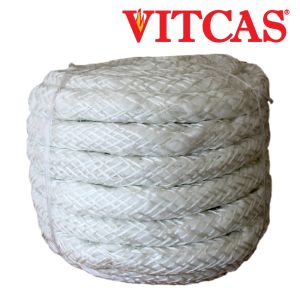 Ceramic Fiber Rope LaggingAs low as £3.59 £2.99 Regular Price £4.20 £3.50
Vitcas Ceramic Fibre Rope Lagging is ideal for high-temperature industrial applications, such as insulating pipes, sealing kiln and furnace doors, flues, heat exchangers, and filling expansion joints in boilers and turbines. Rated up to 1100°C (2012°F), it offers superior thermal insulation and low thermal conductivity in demanding environments.
Read more
Lagging Ropes for Flexible High-Temperature Insulation
VITCAS lagging ropes provide flexible insulation, wrapping and gap-filling solutions for hot pipework, flues, heat exchangers and other thermal equipment. Their soft, pliable construction allows them to conform around curved or irregular surfaces and fill larger gaps where rigid insulation or compact gasket rope would be less suitable.
Key Characteristics of Lagging Ropes
- Material-specific temperature capability: glass fibre lagging rope is rated up to 550°C, while ceramic fibre lagging rope is rated to 1000°C continuous service with short-term resistance up to 1100°C.
- Flexible thermal insulation: the fibrous construction helps reduce heat transfer when the rope is used for wrapping, gap filling or local insulation around compatible hot components.
- Soft and conformable profile: lagging rope can follow curved pipework, flues and irregular equipment geometry more readily than rigid insulation products.
- Suitable for larger gaps: the rope can be used where a thicker, more compressible insulation profile is required around joints, penetrations or expansion spaces.
- Different duties for glass and ceramic fibre: glass fibre covers moderate high-temperature applications, while ceramic fibre is intended for more severe thermal exposure.
- Mechanical protection may be required: lagging rope is a soft fibrous insulation product and should be protected where abrasion, impact, vibration or direct high-velocity gas exposure is significant.
Glass Fibre vs Ceramic Fibre Lagging Rope
| Lagging Rope Type | Temperature Capability | Typical Function | Selection Consideration |
|---|---|---|---|
| Glass Fibre Lagging Rope | Up to 550°C | Wrapping hot pipes, flues, gap filling and flexible insulation | Suitable where the verified service temperature remains within the glass fibre limit |
| Ceramic Fibre Lagging Rope | 1000°C continuous; 1100°C short-term | Higher-temperature pipework, flues, heat exchangers, kiln and oven applications | The 1100°C figure is a short-term limit and should not be used as the normal operating temperature |
Applications of Lagging Ropes
- Hot Pipework: provides flexible insulation around compatible industrial and domestic pipework where the rope diameter and temperature rating suit the installation.
- Flues & Chimney-Adjacent Components: can be wrapped around suitable flues or used to fill larger heat-exposed gaps where flexible insulation is required.
- Heat Exchangers & Boilers: ceramic and glass fibre lagging ropes can provide local insulation around compatible equipment, joints and access areas where the service temperature remains within the relevant material limit.
- Expansion Gaps: the soft compressible profile is suitable for filling larger thermal gaps where movement or irregular geometry makes rigid insulation impractical.
- Kiln Cars, Oven Doors & Furnace-Related Equipment: ceramic fibre lagging rope is suited to higher-temperature insulation and gap-filling duties up to 1000°C continuous service.
- Exhaust-Adjacent Applications: glass or ceramic fibre rope can provide flexible thermal protection around compatible exhaust-related components where temperature, movement and mechanical exposure are appropriate.
- Selected Vessels & Hot-Water Systems: lagging rope may also be used around compatible tanks, vessels and heating equipment where the geometry favours rope-format insulation rather than a blanket or rigid board.
Chemical & Process Compatibility
Glass fibre lagging rope provides resistance to selected chemicals, oils and solvents, but chemical compatibility should not be assumed for every industrial environment. Temperature, concentration, exposure time and process medium can all influence performance.
For ceramic fibre lagging rope, selection should focus on verified temperature capability, mechanical exposure and compatibility with the actual process atmosphere rather than assuming the same chemical-resistance characteristics as the glass fibre product.
Lagging Rope vs Fire Rope
Lagging rope and fire rope are both flexible high-temperature textile products, but they perform different functions. Compact round fire rope is primarily used as a compressed gasket in stove doors, appliance panels and compatible flue joints, while lagging rope has a softer and generally larger profile for wrapping, insulation and gap filling.
Do not select lagging rope as a direct replacement for a stove-door gasket simply because its temperature rating is suitable. The required profile, diameter, compression and joint geometry must match the appliance or equipment design.
Continuous vs Short-Term Temperature
The 1000°C rating of ceramic fibre lagging rope applies to continuous service, while 1100°C refers to short-term exposure. The higher short-term value should not be used as the normal design temperature.
Temperature capability alone does not determine the external surface temperature or total heat loss of an installation. Thermal performance also depends on rope diameter, installed thickness, compression, contact with the hot surface, surrounding conditions and the complete insulation system.
Frequently Asked Questions
What size lagging rope should I choose?
Select the lagging rope diameter according to the gap, pipe geometry and required installed thickness. For packing and sealing duties, the rope should maintain consistent contact without being compressed so heavily that its flexible fibrous structure and insulating thickness are unnecessarily reduced.
How does compression affect the thermal performance of lagging rope?
Compression reduces the thickness and air volume within the fibrous structure, which can influence insulation performance. The installed rope should therefore provide the contact required by the joint or gap while retaining sufficient thickness for the intended thermal duty.
Where is lagging rope more suitable than insulation blanket or rigid board?
Lagging rope is particularly useful around small-diameter pipes, curved surfaces, penetrations, irregular equipment geometry and narrow gaps where a flexible rope format is easier to position than sheet, blanket or rigid insulation. Larger continuous surfaces are generally better suited to broader insulation formats.
What should be considered when using lagging rope in expansion joints?
For compatible expansion spaces, consider the joint width, expected movement, rope diameter, compressibility and service temperature. The rope should accommodate the designed movement while maintaining sufficient contact and resilience throughout the operating cycle.
Which temperature rating should be used for ceramic fibre lagging rope?
For continuous operation, use the 1000°C continuous-service rating. The 1100°C rating applies to short-term exposure and should not be treated as the normal continuous operating temperature.
Is lagging rope sufficient as the only insulation on a hot pipe?
Lagging rope can provide effective local insulation, but the performance of the finished system depends on rope diameter, installed thickness, compression, coverage, surface temperature and surrounding conditions. Where a specific heat-loss or external surface-temperature target must be achieved, the complete insulation build should be considered.
What mechanical conditions affect lagging rope selection?
Vibration, abrasion, repeated movement and contact with adjacent metalwork can affect the service life of soft fibrous rope. In mechanically demanding installations, consider suitable containment, protective covering or retention so that the rope remains correctly positioned and protected during service.
Can lagging rope be layered to increase insulation thickness?
Yes, multiple layers can be used where the installation geometry allows and where additional insulation thickness is required. The final arrangement should maintain stable positioning, consistent coverage and suitable compression rather than creating loose or uneven sections.
What is the difference between glass fibre and ceramic fibre lagging rope?
Glass fibre lagging rope is suited to lower-temperature insulation and sealing duties, while ceramic fibre lagging rope is selected for substantially higher-temperature applications. Material choice should also consider flexibility, mechanical exposure, process conditions and the required service temperature.
How should lagging rope be retained around pipework or equipment?
Retention depends on the installation and may be provided by the joint geometry, mechanical containment, suitable wire, clips or another high-temperature fixing method. The retention system should remain secure under the same temperature, vibration and movement conditions experienced by the rope.