
Fire Cement
Ready-Mixed Fire Cement for Stoves, Fireplaces and Internal Flue Joints
VITCAS ready-mixed Fire Cement for rigid, heat-resistant sealing and minor repairs in compatible indoor fireplaces, stoves, heating appliances and internal flue systems. Available in buff and black, both versions are rated to a maximum of 1250°C and can be applied directly from the container without adding water.
Typical uses include sealing suitable internal flue-pipe joints, securing firebacks and repairing small cracks or localised damage in firebricks, ranges, ovens and boilers. Fire Cement is intended for fine rigid joints and minor repairs rather than flexible sealing, large refractory rebuilds or general-purpose firebrick jointing. Select the colour to suit the visible repair and follow the specified drying and gradual heat-curing procedure before full-temperature service.
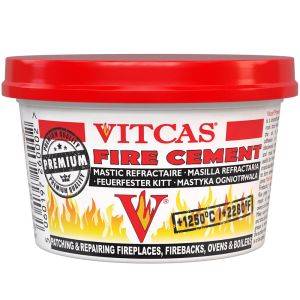 VITCAS Premium Fire CementAs low as £2.39 £1.99 Regular Price £3.11 £2.59
Vitcas Premium Fire Cement – Ready Mixed, rated to 1250°C (2280°F), is ideal for patching and repairing fire bricks, fireplaces, solid fuel ovens, range cookers, boilers, and central heating systems. Its high heat resistance ensures a strong, durable bond in demanding environments.
Read more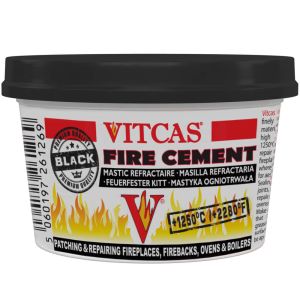 BLACK Fire Cement - VITCASAs low as £3.11 £2.59 Regular Price £4.19 £3.49
Vitcas® BLACK Fire Cement is a high-temperature resistant sealant specifically designed for repairing and patching firebricks, fireplaces, solid fuel ovens, and boilers. Withstanding temperatures up to 1250ºC / 2280°F, it provides excellent adhesion and durability, making it ideal for sealing joints and cracks in high-heat environments.
Read more
Choosing and Applying Fire Cement
VITCAS manufactures ready-mixed Fire Cement for fine rigid joints, heat-resistant sealing and minor refractory repairs in compatible indoor fireplaces, stoves, heating appliances and internal flue systems. The putty-like material is applied directly from the container and cures to form a hard joint capable of withstanding temperatures up to 1250°C.
Fire Cement is available in buff and black finishes. Colour is primarily an appearance consideration; both formulations are intended for similar high-temperature sealing and repair duties. Selection should also consider joint geometry, substrate, operating temperature, moisture exposure and whether movement must be accommodated between the components.
Buff or Black Fire Cement?
| Product | Colour | Maximum temperature | Typical selection |
|---|---|---|---|
| Premium Fire Cement | Buff | 1250°C / 2280°F | Firebrick, masonry, fireback and fireplace repairs where a neutral refractory finish is preferred |
| Black Fire Cement | Black | 1250°C / 2280°F | Stoves, ranges, dark flue components and visible repairs where a black finish is preferred |
Both buff and black Fire Cement are ready mixed and intended for compatible indoor high-temperature applications. The black finish does not indicate a higher temperature capability. Where appearance is important, allow for the possibility that the cured surface may differ slightly from the wet material and can change during heating and service.
Typical Fire Cement Applications
- Sealing suitable rigid joints in internal flue-pipe connections.
- Forming fine heat-resistant joints in fireplaces and solid-fuel heating appliances.
- Repairing small stable cracks and localised damage in firebricks.
- Securing or sealing compatible firebacks where the construction requires Fire Cement.
- Minor repairs to ranges, ovens, boilers and heating components operating within the product specification.
- Sealing compatible rigid metal-to-masonry or metal-to-metal interfaces where movement is negligible and the appliance design permits a cemented joint.
The 1250°C temperature rating applies to the Fire Cement itself. It does not increase the operating capability of the adjoining firebrick, metal component, seal, flue or complete appliance.
Choosing Fire Cement or an Alternative Jointing Material
VITCAS produces different sealing, jointing and refractory repair materials because rigid cement, refractory mortar, flexible silicone and compressible rope perform different functions. Select the material according to the behaviour required from the joint.
| Application | Typical VITCAS solution | Selection principle |
|---|---|---|
| Fine rigid indoor joint or minor refractory repair | Premium Fire Cement or Black Fire Cement | For compatible heat-exposed joints and small repairs that are intended to cure hard and remain substantially rigid |
| Laying and jointing firebricks | HPM Heatproof Mortar or another correctly specified refractory mortar | Use a purpose-designed mortar where complete firebrick masonry or controlled brick joints are required |
| Outdoor oven, barbecue or weather-exposed refractory masonry | OC Outdoor Oven Cement | Use a jointing material designed for compatible exterior high-temperature construction and moisture exposure |
| Larger compatible refractory gaps or repairs | HPS Heatproof Screed or another suitable refractory repair material | Fire Cement should not be spread thickly to replace substantial missing refractory material |
| Flexible heat-exposed joint | Heat Resistant Silicone where its temperature limit and substrate compatibility are suitable | Use a flexible product where the joint is designed to accommodate movement rather than cure rigidly |
| Stove door, glass or compressible gasket | VITCAS thermal rope or gasket system | Match rope profile, diameter and compression to the appliance specification rather than replacing a compressible seal with hard cement |
Check the Cause Before Repairing a Crack
A small, stable crack or localised defect may be suitable for Fire Cement, but repeated or widening cracks can indicate a problem that sealing alone will not correct. Possible causes include thermal movement, excessive joint thickness, retained moisture, rapid heating, loose components, impact, corrosion or an unsuitable joint design.
Severely fractured, loose or extensively deteriorated firebricks should be replaced rather than covered with a superficial repair. Where a damaged joint affects the integrity of a flue or other safety-critical appliance component, the underlying fault should be corrected before the appliance is returned to service.
Preparing the Surface
Good adhesion depends on a sound and properly prepared substrate. Allow the appliance to cool completely before work begins and remove soot, dust, rust, grease, loose refractory material and remnants of failed cement.
The edges of the repair should be firm enough to retain the new material. Do not apply Fire Cement over loose residue or use it simply to cover an unidentified gap.
Preparation requirements can differ between individual Fire Cement formulations and packaging formats. Follow the instructions supplied with the selected product, including any requirement concerning a dry or lightly dampened substrate. Do not add water or other binders to a ready-mixed Fire Cement unless the specific instructions require it.
Applying Fire Cement
- Confirm that the substrate and joint are suitable for a rigid Fire Cement repair.
- Prepare the surface according to the selected product instructions.
- Work the ready-mixed cement firmly into the crack or joint using a suitable trowel, filling knife or application tool.
- Compact the material to maintain contact with the prepared joint surfaces and avoid unnecessary voids.
- Remove excess material and finish the visible surface before the cement stiffens.
- Protect the repair from moisture, disturbance and premature full-temperature exposure during drying and curing.
Fire Cement performs best as a fine-joint and minor-repair material. A thick layer spread over a large void can dry unevenly, crack and fail to reproduce the geometry or mechanical function of missing refractory material.
Drying and Heat Curing
Published VITCAS Fire Cement data specifies an initial drying period of approximately 4–5 hours at 20°C and a curing requirement of approximately 12 hours above 100°C. The repaired area should then be heated gently, increasing the temperature progressively over approximately 3–4 hours rather than immediately exposing fresh cement to full operating conditions.
Actual drying behaviour depends on joint dimensions, substrate absorbency, ambient temperature and ventilation. Follow the current instructions supplied with the selected product.
Rapid heating can remove retained moisture too quickly and contribute to shrinkage cracks or loss of adhesion. After curing and cooling, inspect the repair. Fine drying cracks may be treated according to the product instructions, but recurring or widening cracks should be investigated for movement or another underlying defect.
Fire Cement, Stove Rope and Flexible Sealants
Fire Cement, thermal rope and heat-resistant silicone are different sealing technologies. Fire Cement cures hard, stove rope remains compressible and heat-resistant silicone remains flexible within its specified operating range. The correct choice depends on how the joint is designed to behave.
For a compatible connection between a stove and its flue pipe, VITCAS guidance specifies filling the first joint adjacent to the stove with thermal rope and covering it with Black Fire Cement. Other suitable flue joints may use VITCAS Heat Resistant Silicone, subject to the temperature and component requirements of the installation.
The appliance and flue manufacturer's specified joint arrangement takes priority. Rope diameter, insertion depth, socket engagement and the location of rigid or flexible sealing materials should match the design of the components being connected.
Indoor Use and Moisture Exposure
VITCAS buff and black Fire Cement are intended for compatible dry indoor applications. They should not be used as general exterior refractory cements or where joints are exposed to prolonged rain, persistent damp or other unsuitable moisture conditions.
For compatible exterior firebrick construction, use a product specifically designed for outdoor exposure, such as OC Outdoor Oven Cement or HPS Heatproof Screed, according to the required joint or refractory repair function.
Internal Flues and Appliance Sealing
A durable smoke- and gas-tight rigid joint depends on correct component alignment, sound substrates, appropriate joint geometry, full material contact and proper curing. Fire Cement cannot compensate for a damaged flue, inadequate socket engagement, distorted components or a joint designed to move.
Before returning a repaired appliance to normal operation, inspect the joint and surrounding components. Flue and appliance work should comply with the relevant manufacturer instructions and installation requirements.
Storage and Handling
- Keep unused Fire Cement tightly sealed to minimise drying and contamination.
- Store the product in accordance with the temperature and environmental conditions stated on the pack.
- Protect stored material from unsuitable moisture, frost or excessive heat where specified.
- Wear the personal protective equipment required by the product safety information.
- Consult the current safety data sheet for handling, first aid and disposal guidance.
Engineering & Application Considerations
- Fire Cement is a rigid sealing and repair material and should be used where a hard joint is compatible with the assembly.
- Maximum temperature is only one selection parameter. Joint movement, substrate, geometry and moisture exposure are also important.
- Fire Cement is intended for fine joints and minor localised repairs rather than large refractory rebuilds or substantial missing sections.
- Complete firebrick masonry normally requires a suitable refractory mortar rather than Fire Cement used as a general bricklaying material.
- Flexible or compressible joints require the appropriate sealing technology, such as heat-resistant silicone, thermal rope or a specified gasket system.
- Outdoor refractory construction requires weather-resistant materials selected for the specific joint or repair duty.
- The 1250°C Fire Cement rating does not determine the operating limit of the complete appliance or flue system.
Why Choose VITCAS Fire Cement?
- VITCAS refractory manufacturing expertise for fireplaces, stoves, flues and high-temperature maintenance applications.
- Ready-mixed formulation for direct application without site mixing or water addition.
- Heat resistance up to 1250°C for compatible rigid high-temperature joints and repairs.
- Buff and black finishes for different visible refractory and appliance applications.
- Fine putty-like consistency for working into small joints, cracks and localised defects.
- Compatible with wider VITCAS sealing and refractory systems, including Heatproof Mortar, Outdoor Oven Cement, Heatproof Screed, thermal ropes and heat-resistant sealants.
Correctly selected and applied Fire Cement provides a convenient high-temperature solution for fine rigid joints and minor refractory repairs. Matching the product to the joint geometry, substrate and thermal conditions is essential to achieving a durable repair without compromising the intended movement or construction of the appliance.
Frequently Asked Questions
What is Fire Cement?
Fire Cement is a ready-mixed refractory compound for sealing fine rigid joints and carrying out minor repairs in compatible indoor fireplaces, stoves, flues and heating appliances. After drying and heat curing, it forms a hard heat-resistant joint.
Is VITCAS Fire Cement ready to use?
Yes. VITCAS buff and black Fire Cement are supplied ready mixed with a putty-like consistency and can be applied directly from the container. Follow the instructions for the selected product rather than adding water or another binder.
What is the difference between buff and black Fire Cement?
The principal difference is colour. Both buff Premium Fire Cement and Black Fire Cement are rated to a maximum of 1250°C and are intended for compatible rigid indoor sealing and minor refractory repairs. Select the finish according to the application and visible appearance.
What temperature can Fire Cement withstand?
VITCAS buff and black Fire Cement are rated to a maximum of 1250°C / 2280°F. The adjoining components and complete appliance must also remain suitable for the actual operating conditions.
Can Fire Cement repair cracked firebricks?
Yes, Fire Cement can be used for small stable cracks and minor localised damage where a rigid repair is appropriate. Severely broken, loose or extensively deteriorated firebricks should normally be replaced.
Can Fire Cement be used to seal an internal flue pipe?
Yes, where the flue or appliance design specifies a rigid Fire Cement joint. For a compatible first connection adjacent to a stove, VITCAS guidance uses thermal rope in the gap with Black Fire Cement over the joint. Follow the appliance and flue manufacturer's installation requirements.
Can Fire Cement be used outdoors?
VITCAS buff and black Fire Cement are intended for compatible indoor applications and should not be used for general weather-exposed refractory construction. Use an outdoor refractory product such as OC Outdoor Oven Cement or HPS Heatproof Screed where appropriate to the construction.
Is Fire Cement flexible?
No. Fire Cement cures to form a hard, rigid joint. Where movement or compression must be accommodated, use the correctly specified flexible sealant, thermal rope or gasket system instead.
How should the surface be prepared before applying Fire Cement?
Remove soot, dust, rust, grease, loose material and failed cement so that the repair is applied to a sound substrate. Follow the preparation requirements of the selected Fire Cement formulation because individual products can differ in whether the surface should be dry or lightly dampened.
How long does Fire Cement take to dry and cure?
Published VITCAS data specifies approximately 4–5 hours of initial drying at 20°C and approximately 12 hours of curing above 100°C, followed by gradual heating over around 3–4 hours. Actual drying can vary with joint size, substrate and ambient conditions, so follow the instructions supplied with the product.
Why has Fire Cement cracked after heating?
Possible causes include excessive material thickness, rapid heating, retained moisture, poor surface preparation or movement between the joined components. Recurring or widening cracks should be investigated rather than repeatedly covered with additional cement.
Can Fire Cement form a smoke- and gas-tight joint?
Fire Cement can form a hard sealed joint when compatible components are correctly aligned, prepared, filled and cured. It cannot compensate for a damaged flue, inadequate component engagement or movement in a joint that requires a flexible sealing system.