
Tandoor Oven Construction
Heat Resistant Materials for Building Traditional Tandoor Ovens
Build a tandoor as a layered high-temperature system comprising a stable base, combustion zone, refractory hot face, insulation and protective outer enclosure. Dense 230 × 114 × 64 mm fire bricks provide thermal mass and refractory strength, while Outdoor Oven Cement joints exterior firebrick construction and Heatproof Screed forms compatible protective or moulded sections. Observe every product’s installation, curing and exposure limits.
VITCAS Ceramic Fibre Blanket and Ceramic Fibre Board, both rated to 1260°C, insulate enclosed zones; CFA bonds them to brick or metal. Fibrous insulation must be fully contained against damage, airborne fibres and food contamination. Premium Fire Cement, rated to 1250°C, is limited to fine internal seals and minor dry repairs; it is not the main construction mortar. The complete oven still requires a purpose-designed liner, controlled combustion air, casing, lid and food-safe fittings. Confirm food-contact suitability wherever bread touches the wall, cure every wet-applied layer and obtain competent combustion and ventilation advice for indoor, gas-fired or commercial installations.
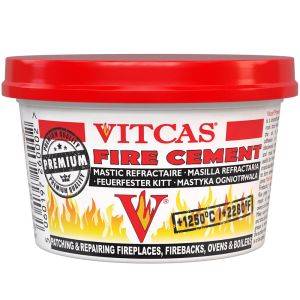 VITCAS Premium Fire CementAs low as £2.39 £1.99 Regular Price £3.11 £2.59
Vitcas Premium Fire Cement – Ready Mixed, rated to 1250°C (2280°F), is ideal for patching and repairing fire bricks, fireplaces, solid fuel ovens, range cookers, boilers, and central heating systems. Its high heat resistance ensures a strong, durable bond in demanding environments.
Read more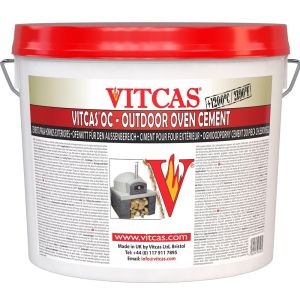
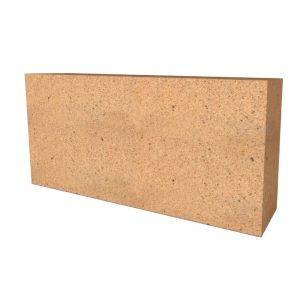 Fire Bricks 230x114x64mmSpecial Price £2.40 £2.00 Regular Price £4.79 £3.99 As low as £2.04 £1.70
Fire Bricks – VITCAS Refractory Fire Clay Bricks 230x114x64mm. High-temperature fire bricks engineered for domestic and outdoor use, including fireplaces, stoves, pizza ovens, barbecue grills, heating appliances and furnaces. Suitable for both indoor and outdoor pizza ovens, these durable refractory fire bricks deliver excellent heat resistance and long-lasting thermal performance.
Read more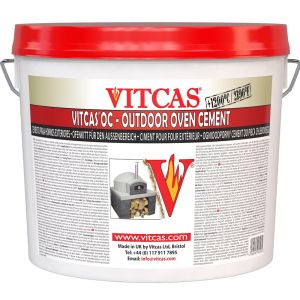 OC - Outdoor Oven CementAs low as £17.99 £14.99 Regular Price £23.99 £19.99
Vitcas Outdoor Pizza Oven Cement is an hydraulic-set mortar designed for exterior jointing with fire bricks in applications such as pizza ovens, barbecues, smokehouses, bread ovens, fire pits and other high-temperature applications. This kind of outdoor fire cement is water-insoluble, resistant to rain and frost and cures without the need for heat.
Read more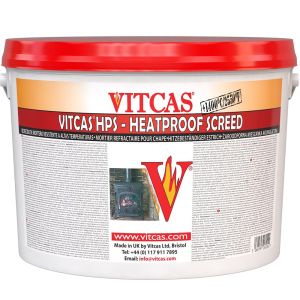 HPS - Heatproof ScreedAs low as £23.99 £19.99 Regular Price £35.99 £29.99
Fireproof Screed, a cement-like product, is resistant to 1400°C / 2550°F. For interior and exterior use. Its function is for Screeding Masonry and making replacement fire bricks for Kilns, Fireplaces, Barbeques and Pizza Ovens. Protects vulnerable materials, which are in danger of being damaged by high heat exposure.
Read more Bio Soluble Insulation Fibre Blanket 1200°C£72.00 £60.00 Regular Price £72.00 £60.00
Vitcas Bio-soluble fibre insulation blanket offers exceptional thermal performance, withstanding temperatures up to 1200ºC (2192ºF). Its low bio-persistence and biodegradable fibres ensure safety and minimal environmental impact. With a density of 128 kg/m³, it provides reliable insulation for high-temperature applications..
Read more
Planning and Building a Traditional Tandoor Oven
A tandoor is a vertically arranged cooking chamber in which the fire burns near the base and food is introduced through the top. Its distinctive performance comes from several heat-transfer mechanisms operating together: radiation from the hot inner wall, convection from rising combustion gases, conductive baking against the wall and direct grilling above the fuel bed. A successful self-build project must control all of these effects without exposing users, food or surrounding construction to avoidable hazards.
The seven VITCAS products shown in this application category cover refractory masonry, exterior firebrick jointing, protective screeding, flexible and rigid ceramic fibre insulation, fibre adhesive and minor internal repair. Together they support several parts of the wall build-up, but they do not amount to a complete oven kit. The finished appliance also needs a purpose-designed cooking liner or hot-face shell, a structurally stable base, a protective casing, controlled combustion air, a safe top opening and heat-resistant food-handling equipment.
How Heat Moves Through a Tandoor
| Heating Effect | Where It Occurs | Cooking Function | Design Implication |
|---|---|---|---|
| Thermal radiation | From the heated inner wall and fuel bed | Browns and roasts exposed food rapidly | The hot face must tolerate repeated severe heating without releasing loose material |
| Convection | As hot gases rise towards the mouth | Transfers heat around skewered meat, fish and vegetables | Chamber profile, air entry and mouth area influence the flow |
| Conduction | At the interface between dough and the cooking wall | Bakes flatbread against the inner surface | The exposed wall requires suitable thermal, mechanical and food-contact characteristics |
| Direct grilling | Above glowing solid fuel or a designed burner | Provides intense heat to food held on skewers | Fittings must remain stable and prevent food from falling into the fire |
Essential Parts of a Complete Tandoor
| Part | Primary Duty | Selection Requirement |
|---|---|---|
| Foundation or supporting plinth | Carry the appliance mass and keep it stable during loading and operation | Non-combustible construction sized for the weight, ground conditions and installed height |
| Inner cooking liner | Form the hot chamber and, in some designs, provide the bread-baking surface | Thermal-shock resistance, adequate strength, compatible expansion and confirmed suitability wherever food touches it |
| Fuel and ash zone | Hold the fire and allow spent ash to be removed | Direct-flame capability, controlled air entry and service access that does not destabilise the liner |
| Thermal insulation | Limit heat loss and moderate the casing temperature | Temperature rating based on its actual position, complete containment and resistance to settlement |
| Outer casing | Protect insulation, support fittings and shield the thermal body from weather or impact | Structural stability, expansion allowance, corrosion or frost resistance and safe surface temperatures |
| Mouth, collar and lid | Provide cooking access and regulate heat loss at the top | Safe reach, secure support for skewers and a lid that cannot fall into the chamber |
| Flue or extraction interface | Remove combustion products where the installation design requires it | Competent design for fuel type, draught, temperature, corrosion, make-up air and safe discharge |
Correct Roles for the Listed Refractory Materials
| Product | Published Rating | Appropriate Tandoor Role | Important Limitation |
|---|---|---|---|
| VITCAS-HPS Heatproof Screed | Up to 1400°C | Protective refractory screeding or forming compatible moulded sections at the required thickness | Coarse screed or casting material rather than a fine-joint adhesive, flexible insulation or certified bread-contact finish |
| VITCAS-OC Outdoor Oven Cement | Up to 1200°C | Jointing dense fire bricks in suitable exterior and weather-exposed high-temperature masonry | Use at the specified joint width and water ratio; it does not replace structural design or establish food-contact approval |
| FB40/64MM VITCAS Dense Fire Bricks | Rated to 1300°C | Refractory masonry, fuel-zone protection and thermal mass; each brick measures 230 mm by 114 mm by 64 mm | Dense brick is not low-conductivity insulation; confirm suitability wherever the face can touch bread |
| RCF-BLT-1260 VITCAS Ceramic Fibre Blanket | Up to 1260°C | Flexible insulation around a suitable hot-face body inside a closed wall assembly | RCF blanket must be handled under its safety data sheet and fully enclosed against fibre release, damage and contamination |
| VITCAS-CFA Ceramic Fibre Adhesive | Up to 1260°C | Bonding compatible ceramic fibre blanket or board to clean brickwork, steel or other approved metal substrates | Apply a thin layer to the substrate, not to the fibre; allow the adhesive to dry before gradual heat curing |
| RCF-BD-1260 VITCAS Ceramic Fibre Board | Up to 1260°C | Rigid insulation or a shaped thermal barrier within an enclosed and supported construction | Insulating board is not load-bearing masonry or an exposed food-contact lining |
| VITCAS PREMIUM Fire Cement | Up to 1250°C | Fine internal sealing and small repairs to compatible refractory components in dry service | Not recommended for laying a complete firebrick structure; not suitable for prolonged moisture or exterior exposure |
The service rating of a material is not the planned cooking temperature. Some tandoor designs may approach chamber conditions around 480°C, but the surface, gas and food temperatures can differ substantially. Choose every layer for its own location and exposure rather than applying the highest number in the product table to the entire oven.
Premium Fire Cement Is a Repair Material, Not the Main Building Mortar
Premium Fire Cement is supplied ready to use with a putty-like consistency. Its strength lies in working into cleaned fine joints, seals and local defects. The current product instructions specifically direct full firebrick laying and mortar work to a dedicated heatproof mortar. They also exclude outdoor service and prolonged moisture contact.
On a tandoor project, reserve this cement for a compatible small internal repair or fine seal that remains dry and is not an unverified direct food-contact surface. It should not be used to bond an entire clay pot, build a full masonry cylinder, fill wide moving joints or weatherproof an external casing. Applying more material does not convert a fine repair compound into a structural mortar.
Using Heatproof Screed Correctly
Heatproof Screed is a powder mixed with water to a stiff trowelling consistency. It contains aggregate up to 5 mm and is intended for refractory screeding, protection of masonry and formation of suitable cast sections. The published rating is 1400°C, and the stated coverage is approximately 0.35 m² from a 20 kg bag at 25 mm thickness.
Prepare existing masonry by removing weak material and contamination, provide a mechanically sound key, and lightly dampen the substrate as directed. New supporting work must cure before the screed is added. Do not apply pigments or alter the mix to create a decorative cooking surface. Any proposal to expose the screed where dough or other food will touch it requires written confirmation of suitability for that contact condition.
Dense Fire Bricks and Outdoor Oven Cement
Each listed fire clay unit measures 230 mm long, 114 mm wide and 64 mm thick. The published limit is 1300°C, the stated bulk density is 2200 kg/m³ and the minimum alumina content is 40%. This dense body provides refractory strength and useful heat storage around the fuel zone or within an engineered hot-face structure. It transmits and retains heat, so it does not perform the same task as lightweight insulation.
OC is supplied as a dry hydraulic-setting powder for exterior refractory firebrick joints. Its temperature rating is 1200°C; after setting, the material is water-insoluble and intended to resist rain and frost. Current instructions specify approximately 200 ml of water per kilogram, joint widths beginning at 3 mm and a nominal yield of about 15 standard bricks from 10 kg at 10 mm joints. The manufacturer directs gaps wider than 15 mm to Heatproof Screed. Keep masonry layout and bread-contact requirements separate from the mortar’s weather and temperature ratings.
Ceramic Fibre Blanket, Board and CFA Adhesive
RCF-BLT-1260 is a flexible ceramic fibre blanket rated to 1260°C with a stated density of 128 kg/m³. It can follow a curved liner and reduce outward heat flow when installed as a continuous layer. RCF-BD-1260 is a vacuum-formed ceramic fibre board with the same published temperature limit and a higher density of 300 kg/m³. It provides a more rigid thermal barrier where the assembly offers suitable support.
CFA Ceramic Fibre Adhesive is a ready-to-use paste rated to 1260°C for fixing compatible ceramic fibre blankets, boards, modules or papers to clean brickwork or metal. Apply a thin coating to the solid substrate rather than saturating the fibre. Drying can take up to 24 hours depending on temperature and humidity, after which the bonded layer is brought up to temperature gradually. The stated consumption is approximately 5 kg/m².
Blanket and board bearing RCF product codes require controlled handling. Consult the current product safety data before cutting, fitting, removing or disposing of them; prevent airborne fibres, use the specified protective equipment and cleaning method, and keep the insulation sealed behind a durable facing in the completed tandoor. It must not project into the cooking chamber, air inlet or any location where fibres could reach food.
Choosing the Inner Cooking Liner
The liner is the most specialised part of a tandoor. It faces flame, hot gases, abrasion from tools, rapid temperature changes and repeated cooling. Where bread is applied directly to the wall, it also becomes a food-contact surface. A liner therefore needs more than a nominal heat-resistance claim.
- Use a manufactured tandoor liner or engineered refractory body with documented operating and installation requirements.
- Confirm whether the exposed surface is intended for direct contact with dough.
- Allow the liner to expand without being rigidly trapped by the cooler outer shell.
- Avoid abrupt changes in wall thickness that concentrate stress during heating.
- Support the base and neck without point loads that can start vertical cracks.
An ordinary terracotta flowerpot, glazed garden pot or unidentified clay vessel should not be assumed suitable. Unknown clay bodies, glazes, pigments and firing histories can create thermal-shock, spalling or contamination risks. Use such a component only when its manufacturer confirms the intended temperature cycle and food-contact duty.
Geometry, Mouth Size and Working Height
The traditional chamber is generally wider through the body and narrower at the mouth. This shape retains radiant energy while guiding combustion gases upwards. There is no single correct diameter, neck ratio or height for every tandoor because capacity, fuel, cooking method, liner design and extraction arrangement differ.
Dimension the opening around real operating tasks. The user must be able to place and recover skewers without leaning over the hot centre, apply bread with the intended pad or tool, remove ash and inspect the lower air path. Set the finished rim at a safe working height and protect it with a stable collar that does not create sharp or excessively hot exposed edges.
Combustion Air, Fuel Bed and Ash Access
A solid-fuel tandoor needs a defined path for combustion air near the base. The opening must be controllable but must not weaken the plinth or allow embers to escape onto combustible surfaces. Provide a compatible grate or fuel support only where the chosen liner design calls for it.
Ash access should permit removal after the appliance is fully cold. Do not create a concealed ledge where embers or grease can accumulate. Doors, dampers and metal frames expand differently from refractory materials, so they need independent support or movement allowance instead of being forced tightly into brittle work.
Insulation and the Outer Enclosure
The inner body stores and releases heat, whereas the insulation reduces outward heat flow. These are different functions. A dense screed may provide refractory protection and thermal mass, but it should not automatically be described as the main insulation layer.
Select the Ceramic Fibre Blanket, Ceramic Fibre Board or combination by calculating or conservatively estimating the temperature at the installed insulation face. Blanket accommodates curves and irregularities; board provides a rigid shape but is not structural. Keep all fibrous edges fully contained so that they cannot enter the cooking chamber, settle into the air inlet or become contaminated by grease and water. The external shell must protect the insulation while allowing the hot liner to move independently.
For a garden tandoor, design a cap, cover or enclosure that prevents rain from saturating the liner and interlayer spaces. The cover must be removed or placed in its operating position before firing, and it must not obstruct the combustion route. Never seal a damp tandoor and then drive out the retained water with an intense fire.
Solid Fuel and Gas-Fired Designs
Wood and charcoal create different flame patterns, ember beds, ash volumes and combustion products. Use only clean fuel recommended for the specific appliance. Do not burn painted or preservative-treated timber, engineered board, building waste or fuel contaminated with chemicals. Petrol, paraffin and other volatile accelerants are unsuitable for lighting.
A gas-fired tandoor is a combustion appliance, not a masonry oven with a loose burner inserted underneath. Do not design a homemade gas conversion or modify a solid-fuel chamber to accept gas. In the UK, gas installation, commissioning, inspection and repair must be undertaken by a Gas Safe-registered engineer holding competence for the relevant appliance and fuel.
Outdoor, Indoor and Commercial Installation
A self-built solid-fuel tandoor should normally be positioned outdoors on a stable non-combustible base, clear of roofs, fences, vegetation, openings and other items that may ignite. Smoke and carbon monoxide must not be able to enter a house, outbuilding, marquee or neighbouring property. Never operate a solid-fuel tandoor in a tent, gazebo, garage, shed or improvised enclosure.
An indoor installation requires a purpose-designed appliance and a professionally engineered combustion, flue, make-up air and mechanical extraction system. It is not made safe merely by opening a window or placing a domestic cooker hood above it. Changes to extraction can alter draught and pull combustion products back into the room.
The Health and Safety Executive guidance for solid-fuel appliances in commercial kitchens specifically covers tandoori ovens. It calls for competent advice on installation, ventilation, extraction and maintenance, safe flue termination, carbon-monoxide monitoring and continued extraction until the fuel is extinguished. Gas-fired commercial equipment is covered separately by HSE catering gas-safety guidance.
Food Safety During Tandoori Cooking
Intense wall heat can colour the exterior of food before its centre is cooked. Judge doneness with a clean probe thermometer rather than colour, cooking time or chamber heat alone. For foods that need a cooking kill step, current Food Standards Agency advice specifies a centre treatment of 70°C held for two minutes, with recognised equivalent time-and-temperature combinations.
- Keep raw ingredients, cooked food, utensils and preparation surfaces separated.
- Insert the probe into the thickest relevant part without measuring against a skewer or bone.
- Use food-grade skewers, racks, hooks and tools suitable for the chamber temperature.
- Control dripping marinades and fat so that flare-ups do not burn the user or deposit excessive soot.
- For commercial production, document cooking limits, monitoring, corrective action, cleaning and staff training.
Construction and Commissioning Sequence
- Define the intended fuel, batch capacity, wall-baking requirement and indoor or outdoor location.
- Select a proven liner design and obtain its temperature, support, expansion and food-contact information.
- Prepare a dimensioned assembly drawing covering the plinth, air entry, liner, insulation, casing, mouth and lid.
- Check planning, fire, building-control, environmental-health and commercial kitchen requirements where applicable.
- Construct a level, non-combustible support for the full installed mass.
- Position the fuel and air components without introducing point loads into the liner.
- Install dense fire bricks and Outdoor Oven Cement only where the selected masonry and exposure design specifies them.
- Add Heatproof Screed and Premium Fire Cement solely in their respective protective, formed or minor-repair locations.
- Fix Ceramic Fibre Blanket or Board with CFA where appropriate, without leaving fibres exposed to food or airflow.
- Complete the casing, collar, lid and operating fittings while preserving movement allowances.
- Cure and dry each material according to its own instructions and the needs of the complete assembly.
- Commission with small controlled firings, then inspect the liner, joints, casing, air path and extraction before cooking.
Curing and Initial Heat-Up
Moisture held in clay, mortar, screed, insulation or surrounding masonry turns to vapour as the tandoor heats. If it cannot escape gradually, pressure and thermal stress can cause cracking, delamination or spalling. Dry-out must consider the thickest and slowest-drying layer, not only the visible surface.
Premium Fire Cement lists approximately four to five hours of drying at 20°C, followed by heat curing and a progressive rise to operating temperature. Heatproof Screed requires 24 hours kept cool and damp, another 48 hours of natural drying and then gentle preheating. OC requires around 24 hours at approximately 20°C, while CFA may need up to 24 hours before controlled heat curing. Blanket and board introduce no wet cure of their own, but must remain dry and securely contained. These are product-level instructions; a complete heavy oven can require a longer staged programme because the liner, base and outer work retain additional water.
Safe Operation
- Inspect the chamber, rim, access opening and supports before lighting.
- Keep the user’s face and upper body away from the mouth when removing the lid.
- Use long, stable tools and heat-protective gloves appropriate to the task.
- Secure skewers so that they cannot slide into the fire or eject hot food.
- Keep children, customers and combustible serving items outside the working zone.
- Maintain ventilation or extraction until every ember has been extinguished.
- Do not cool a hot liner with water or expose it suddenly to rain.
Inspection, Cleaning and Repair
Remove cold ash without striking the liner. Clean bread residue and food deposits by the method approved for the cooking surface, avoiding chemicals that may absorb into a porous wall. Keep lower airways and any flue or extraction connection free from obstruction.
Fine stable crazing may differ from a structural crack. Investigate openings that widen with each firing, release fragments, cross the neck or base, allow flame into the insulation, or cause the outer casing to heat unexpectedly. Premium Fire Cement may suit a small compatible internal repair; never use it to hide movement, rebuild an unstable liner or patch an exposed area without confirming food-contact suitability.
Common Causes of Premature Failure
- Using an unidentified garden pot as the cooking liner.
- Rigidly bonding the hot liner to a cooler external shell.
- Substituting fire cement for a structural refractory mortar.
- Leaving insulation open to moisture, abrasion or cooking contamination.
- Firing before the base and refractory layers have dried.
- Cooling the oven rapidly with water.
- Operating with restricted air or inadequate extraction.
- Allowing metal collars, doors or frames to expand against brittle masonry.
Frequently Asked Questions
What is a tandoor oven?
A tandoor is a vertical, high-temperature cooking chamber heated from below. It cooks with radiant wall heat, rising gases and direct grilling. Certain traditional designs also use the inner wall as the baking surface for flatbread.
How does a tandoor differ from a pizza oven?
A tandoor is generally vertical and loaded through the top, with skewers suspended towards the heat source and bread applied to the wall. A pizza oven normally has a horizontal hearth and side entrance. Their geometry, airflow and handling requirements are therefore different.
Does every tandoor need a clay liner?
Not every engineered design uses traditional clay, but every tandoor needs a purpose-designed hot-face chamber. If the wall will touch bread, the exposed surface must also be suitable for direct food contact under the intended heating cycle.
Can a terracotta flowerpot be used as a tandoor liner?
Do not assume that a garden pot is suitable. Its clay, glaze, pigments, firing temperature and resistance to rapid heating may be unknown. Use it only if the manufacturer confirms both high-temperature cycling and the required food-contact application.
Can Premium Fire Cement build the complete tandoor liner?
No. The current product guidance limits it to fine seals and small refractory repairs. It is not the recommended mortar for laying a complete firebrick assembly or joining the whole liner.
Where can Premium Fire Cement be used in a tandoor?
It can be considered for a minor compatible internal repair or fine seal in dry conditions. The substrate must be clean, and the finished location must not create unverified direct contact with food.
Is Premium Fire Cement suitable for an outdoor tandoor?
Not on exposed external surfaces. The product is not intended for prolonged moisture contact or outdoor weathering. Choose an exterior-rated system for the casing and weather-exposed joints.
What is Heatproof Screed used for?
Heatproof Screed is used for compatible high-temperature protective layers and moulded refractory sections. Its published limit is 1400°C. Install, cure and preheat it at the thickness and under the conditions stated in the product instructions.
What role do dense fire bricks have in a tandoor?
Dense fire bricks provide a hard refractory layer and thermal mass around the fuel or in a designed masonry hot face. They are rated to 1300°C, but their density means that a separate insulation layer is normally required to limit heat loss through the wall.
Which cement should be used for an outdoor firebrick section?
For suitable exterior firebrick joints, use Outdoor Oven Cement within its 1200°C published limit. Premium Fire Cement is restricted to minor dry internal repairs, while Heatproof Screed serves compatible protective or formed layers rather than ordinary fine mortar joints.
What is Ceramic Fibre Blanket used for in a tandoor?
The 1260°C blanket provides flexible insulation around a suitable hot-face liner. It should form a continuous, protected layer without compression gaps, exposed edges or contact with food. Installation and removal must follow the current RCF safety data sheet.
When is Ceramic Fibre Board preferable to blanket?
The 1260°C board is useful where a rigid, accurately cut thermal barrier is needed and the surrounding assembly supports it correctly. Blanket is more adaptable to curved or irregular surfaces. Neither material is load-bearing or suitable as the exposed bread-baking wall.
What is CFA Ceramic Fibre Adhesive used for?
CFA bonds compatible ceramic fibre blankets and boards to prepared brick or metal substrates. Apply it thinly to the solid substrate, position the fibre, allow up to 24 hours for drying as conditions require, and introduce heat gradually.
Can ceramic fibre insulation remain visible inside the tandoor?
No. RCF blanket and board must be securely enclosed so that fibres cannot be released by airflow, abrasion, cooking tools or maintenance. They must remain separated from the food-contact surface and cooking chamber.
Is Heatproof Screed the insulation layer?
It should not automatically be treated as the primary insulation. Screed provides refractory protection and mass, whereas an insulation layer is selected to restrict heat transfer. The complete wall build-up may require both functions.
Can naan be placed directly on fire cement or screed?
Not unless the manufacturer has confirmed that the specific exposed material is suitable for repeated direct food contact in that condition. A maximum-temperature rating does not provide food-contact certification.
How hot does a tandoor oven get?
Operating temperature depends on the oven, fuel and food. Some designs may approach 480°C, but chamber air, wall surface and food core temperatures are different measurements. Product temperature ratings are material limits, not cooking set-points.
What fuel can be used in a tandoor?
Use only the clean wood or charcoal recommended for the appliance. Never burn treated timber, painted wood, engineered boards, construction waste or chemically contaminated fuel. Do not use petrol or paraffin for ignition.
Can a solid-fuel tandoor be converted to gas?
Do not carry out a homemade conversion. A gas tandoor needs a purpose-designed burner, flame safeguards, combustion-air provision and compatible controls. UK gas work must be completed by an appropriately qualified Gas Safe-registered engineer.
Can a homemade tandoor be used indoors?
A self-built solid-fuel tandoor should normally remain outdoors. Indoor operation requires an appliance designed for that location plus professionally specified flue, extraction, make-up air and carbon-monoxide controls. An open window or domestic hood is not sufficient evidence of safety.
What ventilation does a commercial tandoor require?
The system must be designed for the appliance, fuel and kitchen. HSE guidance requires competent assessment of extraction, combustion air, flue discharge, heat and corrosion, with carbon-monoxide monitoring and an ongoing inspection and cleaning programme.
What internal temperature should tandoori food reach?
The correct target depends on the product. A general UK consumer benchmark is a food-centre temperature of 70°C held for two minutes, or another accepted equivalent treatment. Check the thickest part with a clean probe rather than relying on surface colour.
How long must a new tandoor dry?
Use the longest requirement among the liner, screed, repair material, insulation and surrounding masonry, then extend it for cold or damp conditions. Commissioning should start with small fires and increase progressively only after moisture has escaped.
Are cracks in a tandoor liner normal?
Small stable surface marks may be less significant than cracks that widen, shed material or cross the neck and base. Monitor every defect. A moving or structurally unstable liner needs competent assessment rather than a cosmetic coating.
How should a tandoor be cleaned?
Let the appliance cool completely before removing ash. Clean the bread-contact wall and fittings using methods approved for those materials, clear the air path and extraction connection, and avoid saturating a porous hot liner with water.
Can ordinary house bricks or concrete blocks form the hot face?
Do not use them in direct flame service without verified temperature and thermal-cycling performance. They may be appropriate only in cooler structural zones where the design keeps them within their material limits.
Can a steel drum be used as the outer casing?
A metal shell may be possible in an engineered design, but it must be clean, uncoated where heated, corrosion-resistant enough for the environment and separated from the hot liner by the specified insulation and movement allowance.
How should an outdoor tandoor be protected from rain?
Use a weather-shedding enclosure or removable cover that keeps water out of the liner and insulation. The protection must not obstruct the appliance during firing. If the oven becomes damp, dry it slowly before returning to full temperature.
What additional controls apply in a restaurant?
Commercial operation requires documented food-safety controls, staff training, safe fuel management, effective extraction, carbon-monoxide monitoring, planned cleaning and competent maintenance. Gas and solid-fuel installations have different technical and legal requirements.