
Stove, Fireplace & Flue Sealants
Heat Resistant Sealants & Jointing Compounds for Stoves, Fireplaces & Flues
Stoves, fireplaces and flue systems contain different types of heat-exposed joints, connections and repair areas, each requiring a sealing or jointing material suited to its specific function. VITCAS solutions include rigid fire cements for stove and fireplace repairs, purpose-designed flue cement for clay and concrete liners, high-temperature sealing compounds for compatible ceramic, metal and glass components, and specialist fillers and bonding materials for associated construction work.
Fire Cement is designed for suitable rigid joints and minor refractory repairs, while Flue Cement is formulated specifically for installing and jointing compatible flue liners. HRS Heat Resistant Sealant provides a high-temperature caulking and sealing solution for selected joints involving ceramics, metals, silica-based materials and glass, while Heat Resistant Filler is intended for suitable small cracks, joints and surface preparation.
Select the product according to the component being sealed or repaired, substrate, joint design, required rigidity, service temperature and exposure conditions. The highest temperature rating is not automatically the best specification because a firebrick repair, flue-liner joint, board joint and metal-to-ceramic connection can require fundamentally different materials.
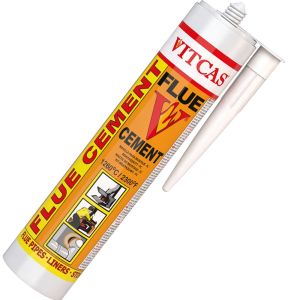 FC - Flue Cement 1250°CSpecial Price £2.39 £1.99 Regular Price £5.99 £4.99
VITCAS Flue Cement is a high-temperature, ready-mixed fireproof mortar, specially formulated for the safe installation and jointing of clay and concrete flue liners. It is ideal for use with domestic fires and stoves, including coal, wood-burning, and gas (including flame effect) appliances.
Read more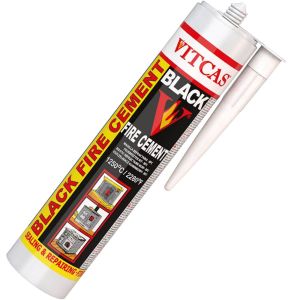 BFC - Black Fire Cement 1250°CSpecial Price £3.59 £2.99 Regular Price £5.99 £4.99
Black fire cement for both domestic and commercial applications, ideal for use on fire bricks, grates, flue pipes, boilers, and other areas exposed to extreme heat. It provides excellent adhesion to fire bricks, blockwork, stone, and clayware. Resistant to high temperatures up to 1250°C / 2280°F
Read more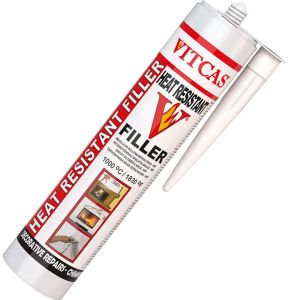 HRF - Heat Resistant Filler 1000°CSpecial Price £11.99 £9.99 Regular Price £23.99 £19.99
Vitcas® Heat Resistant Filler is a perfect solution for filling in small cracks and joints in high-temperature environments. Ideal for use with HT High Temperature Plasterboard joints, this filler offers unmatched heat resistance, up to 1000°C / 1830°F, ensuring durability and reliability.
Read more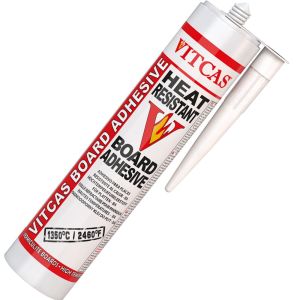 BA - Heat Resistant Board AdhesiveSpecial Price £11.99 £9.99 Regular Price £23.99 £19.99
Vitcas Heat Resistant Board Adhesive (310ml) is capable of withstanding temperatures up to 1350°C. It is ideal for jointing and adhering high-temperature plasterboards, vermiculite boards, insulation boards, and construction boards to brickwork or blockwork. Perfect for use in high-temperature applications.
Read more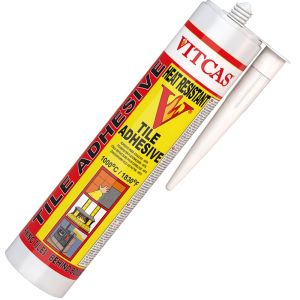 HRTA - Heat Resistant Tile Adhesive 1000°CSpecial Price £3.59 £2.99 Regular Price £8.99 £7.49
Heat Resistant Tile Adhesive in Cartridge packaging to ensure easy use and application. Vitcas Heat Resistant Tile Adhesive should be used for fixing tiles in areas subject to high temperatures, such as fire surrounds, behind boilers, ranges, cookers and radiators.
Read more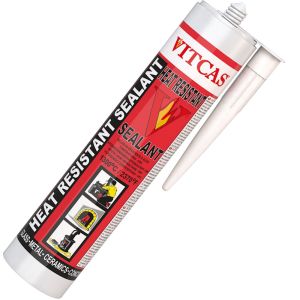 HRS - Heat Resistant Sealant 1300°CSpecial Price £9.59 £7.99 Regular Price £11.99 £9.99
VITCAS Heat Resistant Sealant is a high-performance, high-temperature caulking compound engineered for fixing, jointing and fire-sealing applications. Rated for continuous exposure up to 1300°C / 2370°F, it provides reliable bonding and airtight sealing on ceramics, metals, silica-based materials and glass in demanding high-heat environments.
Read more
Choosing Sealants & Jointing Compounds for Stoves, Fireplaces & Flues
Stoves, fireplaces and flue systems contain different types of joints, connections and repair areas. Some require a rigid refractory cement, others need a purpose-designed flue-jointing material, a high-temperature caulking compound or a filler for small cracks and surface preparation.
The correct product should be selected according to the component being sealed or repaired, substrate, joint geometry, required rigidity, service temperature and exposure conditions. Fire Cement, Flue Cement, HRS Heat Resistant Sealant and Heat Resistant Filler perform different functions and should not be treated as interchangeable materials.
Sealants & Jointing Compounds at a Glance
| Product | Primary function | Maximum temperature | Typical applications |
|---|---|---|---|
| Fire Cement | Rigid sealing and minor refractory repair | 1250°C | Firebricks, firebacks, fireplaces, stoves, ranges, boilers and suitable internal flue-pipe joints |
| Flue Cement | Installation and jointing of compatible flue liners | 1250°C | Clay and concrete flue liners serving compatible domestic fires and heating appliances |
| HRS Heat Resistant Sealant | High-temperature caulking, fixing and jointing | 1300°C | Compatible ceramics, metals, silica-based materials and glass |
| HRF Heat Resistant Filler | Filling small cracks, joints and surface imperfections | 1000°C | Fireplace and stove surrounds, chimney breasts and compatible high-temperature board systems |
Fire Cement for Rigid Stove & Fireplace Joints
VITCAS Fire Cement is a ready-mixed refractory compound designed for suitable fine, rigid joints and minor repairs around fireplaces, stoves and heating appliances.
Buff Premium Fire Cement and Black Fire Cement are both rated to 1250°C. Typical applications include sealing suitable internal flue-pipe joints, securing firebacks and repairing small cracks or localised damage in firebricks, ranges, ovens and boilers.
Fire Cement cures to form a hard joint and should therefore be used where a rigid cementitious seal is appropriate. It should not be substituted for a flexible gasket, movement joint, general-purpose firebrick mortar or weather-resistant exterior cement.
Buff or Black Fire Cement?
| Product | Colour | Temperature | Typical selection reason |
|---|---|---|---|
| Premium Fire Cement | Buff | 1250°C | Neutral refractory appearance around firebrick, masonry and light-coloured repairs |
| Black Fire Cement | Black | 1250°C | Darker finish around black stoves, ranges and dark metal components |
The principal difference is colour rather than temperature capability. Both products are intended for compatible indoor rigid sealing and minor repair applications.
Flue Cement for Clay & Concrete Flue Liners
VITCAS Flue Cement is a ready-mixed high-temperature mortar formulated specifically for installing and jointing compatible clay and concrete flue liners.
Rated to 1250°C, it is suitable for appropriate flue systems serving domestic fires and stoves, including wood-burning, coal and suitable gas appliances.
Flue Cement should be selected because the application requires a purpose-designed flue-liner jointing material, not simply because its temperature rating is similar to Fire Cement. A clay or concrete flue-liner joint performs a different function from a firebrick repair or a joint around another stove component.
HRS Heat Resistant Sealant for High-Temperature Joints
VITCAS HRS Heat Resistant Sealant is a high-temperature caulking-grade compound for fixing, jointing and sealing compatible materials in demanding heat-exposed applications.
HRS is rated for continuous exposure up to 1300°C and provides bonding and sealing on suitable ceramics, metals, silica-based materials and glass.
Its higher temperature capability does not make HRS a universal substitute for Fire Cement or Flue Cement. Substrate compatibility and joint design remain essential. A joint between ceramic and metal components, for example, presents a different specification problem from installing a clay flue liner or repairing a firebrick.
HRS should also not be confused with a lower-temperature flexible silicone sealant. Where a joint is designed to accommodate significant movement, flexibility must be considered separately from maximum temperature resistance.
Heat Resistant Filler for Cracks & Surface Preparation
VITCAS HRF Heat Resistant Filler is a ready-to-use filler rated to 1000°C for small cracks, joints and surface imperfections in compatible heat-exposed construction materials.
It is particularly useful around fireplaces, stove surrounds, chimney breasts and compatible HT High Temperature Fireboard systems. Once set, the filler can be finished and sanded where required before suitable decoration.
HRF performs a surface-filling and preparation function rather than the flue-jointing role of Flue Cement or the rigid refractory sealing role of Fire Cement. Recurring or substantial cracks should be investigated before filling because a surface repair cannot correct structural movement or an unstable substrate.
Sealant, Cement, Filler or Adhesive?
| Requirement | Typical product type | Key consideration |
|---|---|---|
| Fine rigid joint or minor refractory repair | Fire Cement | Indoor use, suitable rigid joint and compatible refractory or heating component |
| Clay or concrete flue-liner joint | Flue Cement | Purpose-designed flue construction and liner compatibility |
| High-temperature ceramic, metal, silica or glass joint | HRS Heat Resistant Sealant | Substrate compatibility, joint design and operating temperature |
| Small crack or surface imperfection | HRF Heat Resistant Filler | Stable substrate and non-structural repair |
| Fixing heat-resistant tiles | Heat Resistant Tile Adhesive | Tile type, substrate, adhesive-bed thickness and installation position |
| Fixing or jointing construction boards | Board or hydraulic adhesive | Board type, substrate, gap geometry and required working time |
Adhesives are included in related fireplace and stove construction work because some apparent “joints” are primarily bonding applications. A product designed to fix a board or tile should not automatically be replaced with a sealing compound simply because both products resist high temperatures.
Typical Stove, Fireplace & Flue Applications
Depending on the selected product, VITCAS sealing and jointing materials can be used for:
- forming suitable rigid joints around fireplaces and stoves;
- repairing small cracks and localised damage in firebricks and firebacks;
- sealing suitable internal flue-pipe connections;
- installing and jointing compatible clay and concrete flue liners;
- sealing compatible ceramic, metal, silica-based and glass components;
- filling small cracks and board joints around heat-exposed construction;
- maintenance and refurbishment of heating appliances and fireplace structures.
The operating environment can vary substantially between these locations. A material suitable for a chimney breast or construction-board joint may not be appropriate for a flue liner, combustion chamber or another component closer to direct flame.
Surface Preparation Before Sealing or Repair
Successful sealing depends on clean, stable bonding surfaces. Remove loose material, soot, dust, grease, rust and contamination that could reduce adhesion before applying cement, sealant or filler.
Existing cracked material should be examined before repair. Loose edges should be removed and the remaining substrate must be sufficiently sound to retain the new material.
Preparation requirements can differ between refractory cements, cartridge sealants and fillers, so use the preparation method specified for the selected product and substrate rather than applying one procedure to every material in the category.
Rigid Joints, Movement and Thermal Expansion
One of the most important selection criteria is whether the joint is intended to remain rigid or accommodate movement.
Fire Cement, Flue Cement and HRS form rigid high-temperature joints. They should not replace a rope gasket, flexible sealant or another movement-accommodating component where the installation relies on compression, expansion or repeated movement.
Metal components can expand differently from masonry, ceramics and refractory materials during heating. Joint design should therefore account for thermal movement as well as temperature resistance.
Drying, Curing and Initial Heating
High-temperature cements, sealants and fillers require appropriate drying or curing before full-temperature service. The procedure depends on the individual formulation.
For example, VITCAS Fire Cement is allowed to dry before being heat cured and then brought gradually towards the appliance operating temperature. Other sealants and fillers can use different curing mechanisms and should not automatically be subjected to the same heating procedure.
Premature high-temperature exposure can trap moisture, disturb the bond or contribute to cracking. Allow each product to complete its specified drying and curing stages before normal service.
Temperature Rating and Joint Selection
The maximum temperature rating of a sealing material is an important specification value, but it is not sufficient on its own to determine product suitability.
For example:
- HRS Heat Resistant Sealant — 1300°C does not automatically replace Flue Cement in a clay-liner joint;
- Fire Cement — 1250°C is not a general-purpose mortar for constructing a complete firebrick lining;
- Flue Cement — 1250°C is formulated for compatible flue liners rather than every rigid stove joint;
- HRF Heat Resistant Filler — 1000°C is intended for suitable cracks and surface preparation rather than structural refractory repair.
The joint function, substrates, movement, environment and installation method should therefore be established before comparing maximum temperature ratings.
Engineering & Application Considerations
- Select by joint function first. Fire Cement, Flue Cement, HRS and HRF are formulated for different sealing and repair tasks.
- Distinguish rigid joints from movement joints. Rigid high-temperature compounds should not replace rope, gasket or flexible sealing systems where movement must be accommodated.
- Identify the substrate. Firebrick, clay liner, concrete, ceramic, metal, glass and construction board can require different materials.
- Do not select on temperature rating alone. The highest-rated product can still be unsuitable for the required joint.
- Fire Cement is intended for fine joints and minor repairs. Complete firebrick construction normally requires a purpose-designed refractory mortar.
- Heat Resistant Filler is not structural reinforcement. Recurring cracks require investigation before cosmetic repair.
- Flue systems require application-specific materials. A joint around a flue pipe is not necessarily the same as a joint between clay or concrete flue liners.
- Allow appropriate curing before heat exposure. Different formulations require different drying and initial-heating procedures.
Why Choose VITCAS Stove, Fireplace & Flue Sealants?
- Application-specific refractory cements for stove, fireplace and internal flue sealing and repair.
- Dedicated Flue Cement for compatible clay and concrete flue-liner installation.
- HRS Heat Resistant Sealant rated to 1300°C for compatible ceramic, metal, silica-based and glass joints.
- Heat Resistant Filler rated to 1000°C for small cracks, joints and heat-exposed surface preparation.
- Complementary fireplace construction materials for board fixing, tiling, refractory jointing and repair.
- Product-specific solutions allowing sealing materials to be matched to joint design, substrate and thermal exposure.
Reliable high-temperature sealing depends on matching the material to the joint rather than simply selecting the highest temperature rating. Identifying the component, substrate, rigidity, movement and exposure conditions first makes it possible to choose a sealing, jointing or repair material designed for the actual task.
Frequently Asked Questions
What should I use to seal around a stove or fireplace?
The correct product depends on the joint and materials involved. Fire Cement is suitable for selected fine rigid joints and minor refractory repairs, while HRS Heat Resistant Sealant is used for compatible high-temperature ceramic, metal, silica-based and glass joints. Flue liners and movement joints require products designed specifically for those functions.
What is the difference between Fire Cement and Flue Cement?
Fire Cement is a ready-mixed compound for suitable rigid joints and minor repairs around fireplaces, stoves, firebricks and internal flue-pipe connections. Flue Cement is formulated specifically for installing and jointing compatible clay and concrete flue liners.
What is the difference between Fire Cement and HRS Heat Resistant Sealant?
Fire Cement is a refractory cementitious compound for fine rigid joints and repairs. HRS is a high-temperature caulking compound designed for compatible ceramics, metals, silica-based materials and glass. The correct choice depends on joint design and substrate rather than comparing 1250°C with 1300°C alone.
What should I use for clay or concrete flue liners?
Use VITCAS Flue Cement for compatible clay and concrete flue-liner installation and jointing. It is specifically formulated for this application and is rated to 1250°C.
Can Fire Cement be used around a flue pipe?
Fire Cement can be used for suitable internal flue-pipe joints where a fine rigid cementitious seal is appropriate. This should not be confused with joining clay or concrete flue liners, for which Flue Cement is the purpose-designed product.
Can HRS Heat Resistant Sealant be used on metal?
Yes. HRS is suitable for compatible metal surfaces together with ceramics, silica-based materials and glass, provided the joint and operating conditions are appropriate for the product.
Is HRS Heat Resistant Sealant flexible?
HRS is a high-temperature caulking compound that cures as a rigid sealing material. It should not replace a flexible silicone, rope gasket or other movement-accommodating seal where the joint is designed to expand, compress or move.
Can Fire Cement repair cracks in firebricks?
Fire Cement can be used for suitable small, stable cracks and localised firebrick repairs. Larger damage, loose masonry or repeated cracking should be investigated before repair, and complete brick construction should use the appropriate refractory mortar.
When should Heat Resistant Filler be used?
HRF Heat Resistant Filler is intended for small cracks, joints and surface imperfections around compatible heat-exposed construction, including suitable fireplace, stove-surround and high-temperature board applications. It is not a substitute for Flue Cement or structural refractory repair.
Can high-temperature sealants be exposed directly to flame?
A high maximum temperature does not automatically establish suitability for direct flame or combustion-chamber service. Materials in direct flame, refractory hot-face or combustion-gas locations should be specifically suited to those thermal and mechanical conditions.
Do sealants and fire cements need to cure before heating?
Yes. Drying and curing requirements depend on the product. Fire Cement uses a drying and controlled heat-curing procedure, while other sealing compounds and fillers can require different curing conditions. Complete the specified curing process before normal operating-temperature exposure.
Is the sealant with the highest temperature rating always the best choice?
No. Temperature resistance is only one selection criterion. The correct material must also match the substrate, joint design, required rigidity, exposure conditions and intended application. A 1300°C sealant can still be the wrong choice for a 1250°C flue-liner joint if it is not formulated for that construction.