
Ceramic Sealing Strip
Ceramic Fibre Sealing Strips for Stove Glass & Door Gaskets
VITCAS ceramic fibre sealing strips are flexible rectangular gaskets for sealing between compatible stove glass and doors and between selected stove panels. Available in 6mm × 3mm and 10mm × 4mm sections, they are rated to 1260°C for high-temperature gasketing applications.
The ceramic fibre construction conforms to suitable sealing surfaces while accommodating thermal expansion and movement at the glass-to-door interface. The strips are not self-adhesive; retention depends on the joint design and may be mechanical or use a compatible fixing method where specified.
Select the strip according to the original gasket profile, dimensions, required compression and retention method. A higher temperature rating does not make ceramic fibre strip an automatic replacement for round glass fibre rope or other gasket forms.
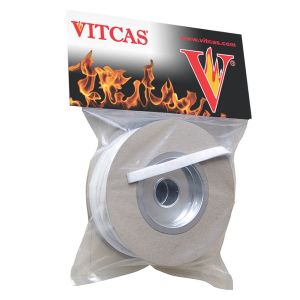 Ceramic Fibre Sealing StripAs low as £1.80 £1.50 Regular Price £3.12 £2.60
Vitcas Ceramic Fibre Sealing Strip. Available in white and in sizes 6x3mm or 10x4mm. Provides an airtight seal between the panels of the stoves, and between a stove door and the glass in a stove door. Also allows for expansion of the glass with the heat. Resistant up to 1260°C / 2300°F.
Read more
Ceramic Fibre Sealing Strips for High-Temperature Gasketing
VITCAS ceramic fibre sealing strips are flexible rectangular gaskets for high-temperature sealing between compatible stove glass and doors, between selected stove panels and in other equipment joints where this gasket profile is specified. Available in 6mm × 3mm and 10mm × 4mm sections, the strips are rated to 1260°C.
Key Characteristics of Ceramic Fibre Sealing Strips
- Accommodates Thermal Movement: the compressible ceramic fibre strip allows compatible stove glass to expand and contract during heating cycles while maintaining controlled contact at the gasket interface.
- Compressible Gasket Profile: conforms to suitable sealing surfaces and gaps when the correct strip dimensions and installed compression are selected.
- High-Temperature Capability: rated to 1260°C for compatible high-temperature sealing and gasketing applications.
- Flexible Ceramic Fibre Construction: adapts to compatible sealing surfaces and minor surface irregularities where the specified profile and compression are suitable.
- Non-Self-Adhesive Construction: retention depends on the joint design. Some stove-glass arrangements use mechanical clamping, while other applications may require a compatible fixing method.
Applications of Ceramic Fibre Sealing Strips
- Stove Glass & Door Interfaces: for compatible joints between stove glass and the door where a rectangular ceramic fibre gasket is specified.
- Stove Panel Joints: for sealing between compatible stove panels where a flexible rectangular strip and controlled compression are required.
- Industrial Ovens, Furnaces & Kilns: suitable for selected high-temperature sealing joints where the strip profile, compression and retention method match the equipment design.
- Engineering & Process Equipment: for selected joints, panels and access points in high-temperature thermal or process equipment where a flexible rectangular ceramic fibre gasket is required and the strip dimensions, compression and temperature capability match the design requirements.
- High-Temperature Gasketing: suitable for selected joints requiring a compressible ceramic fibre seal with temperature capability up to 1260°C.
Selecting Ceramic Sealing Strip
Do not select ceramic fibre strip solely because of its 1260°C temperature rating. The 6mm × 3mm and 10mm × 4mm profiles must match the original joint geometry, required compression and retention method.
Ceramic fibre strip should not be treated as an automatic replacement for round glass fibre rope, flat tape or another gasket form. Profile, resilience, surface pressure and the appliance or equipment retention system remain critical selection factors.
Frequently Asked Questions
How do I choose between 6mm × 3mm and 10mm × 4mm ceramic fibre strip?
Select the ceramic fibre sealing strip according to the original gasket dimensions, joint gap and required installed compression. The replacement profile should match the appliance or equipment design so that the strip maintains controlled contact without creating excessive loading on the adjoining components.
Can ceramic fibre sealing strip be used as a stove glass gasket?
Yes. Ceramic fibre strip is suitable for compatible stove glass gasket arrangements where a flexible rectangular seal is specified between the glass and door or retaining structure. The strip dimensions and compression should match the original gasket arrangement.
Why is ceramic fibre strip used around stove glass?
A compressible ceramic fibre gasket helps accommodate thermal expansion and contraction of stove glass during repeated heating and cooling cycles. Correctly selected strip maintains controlled contact while allowing the glass and surrounding metalwork to move at different rates.
Does ceramic fibre sealing strip need adhesive?
VITCAS ceramic fibre sealing strip is non-self-adhesive. Retention depends on the joint design: stove-glass assemblies commonly use mechanical clamping or retaining hardware, while other high-temperature equipment may use another compatible fixing method specified for the joint.
How much should ceramic fibre gasket strip be compressed?
The required compression depends on the gasket dimensions, joint geometry, sealing surfaces and equipment design. The strip should be installed to the compression specified for the original gasket arrangement rather than compressed according to a universal percentage.
Can ceramic fibre strip replace stove rope or glass fibre tape?
Ceramic fibre strip, round stove rope and flat glass fibre tape have different gasket profiles and compression characteristics. Use ceramic strip where the joint is designed for a rectangular compressible gasket; round rope or flat tape should be selected where those profiles match the original sealing arrangement.
What is the difference between ceramic fibre strip and round stove rope?
Ceramic fibre strip has a rectangular profile suited to selected glass, panel and high-temperature equipment joints, while round stove rope is designed for compatible rope channels and compressible round-gasket arrangements. Profile and installed compression are key differences when selecting a replacement seal.
Can ceramic fibre sealing strips be used in furnaces and kilns?
Yes. Ceramic fibre strips can be used for selected furnace, kiln and industrial oven gaskets where a flexible rectangular seal is required and the joint dimensions, compression, retention method and operating temperature are compatible with the strip.
Can ceramic fibre strip be used for industrial high-temperature equipment?
Yes. Suitable applications include selected access panels, equipment joints and sealing interfaces in high-temperature process and thermal equipment. Selection should be based on the joint geometry, mechanical retention, compression and service temperature required by the equipment design.
What determines the correct ceramic fibre gasket for a high-temperature joint?
Correct selection depends on the gasket profile, strip dimensions, joint gap, required compression, retention method and operating temperature. Considering these factors together provides a more reliable gasket match than selecting on temperature capability alone.
When should a ceramic fibre stove gasket be replaced?
Inspect the gasket when it becomes excessively compressed, damaged, displaced or no longer maintains consistent contact around the sealing interface. Replacement with the correct ceramic fibre strip helps restore the intended gasket geometry and accommodate thermal movement during operation.